Palais Rohan in Strasbourg was the former residence of the prince-bishops and cardinals of the House of Rohan. Built next to Strasbourg Cathedral in the 1730s from designs by Robert de Cotte, it was completed in 1742 under municipal architect Joseph Massol. Its architectural conception and iconography were intended to indicate the return of Roman Catholicism to Strasbourg. The prelate’s apartments face the cathedral to the north, and the building contains statues, reliefs, and paintings that reflect Catholic dogma. The palace has hosted French monarchs including Louis XV, Marie Antoinette, Napoleon, Joséphine, and Charles X. Over time it passed successively through the hands of the nobility, the municipality, the monarchy, the state, the university, and the municipality again. Since the end of the 19th century, it has housed the Archaeological Museum in the basement, the Museum of Decorative Arts on the ground floor, and the Museum of Fine Arts on the first and second floors. Its Galerie Robert Heitz is used for temporary exhibitions. The building has been listed as a monument historique since 1920.
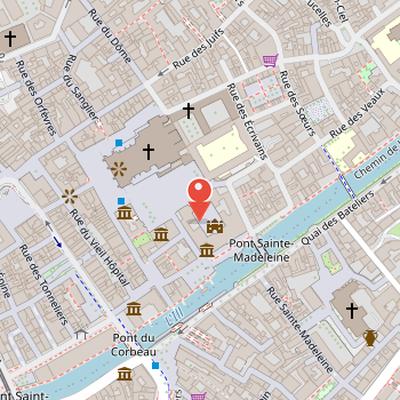
Nearby Objects
-
 Musée des Beaux-Arts de Strasbourg 20 m away
 -
 Musée archéologique de Strasbourg 20 m away
 -
 Musée de l'Œuvre Notre-Dame 50 m away
 -
 Jubé of Strasbourg Cathedral 80 m away
 -
 Strasbourg astronomical clock 110 m away
Palais Rohan: Design and Later Uses
Palais Rohan in Strasbourg was the former residence of the prince-bishops and cardinals of the House of Rohan. It was built next to Strasbourg Cathedral in the 1730s from designs by Robert de Cotte and was completed in 1742. Its architectural conception and iconography were intended to indicate the return of Roman Catholicism to Strasbourg, and its prelate's apartments face the cathedral to the north. The building includes statues, reliefs, and paintings that reflect Catholic dogma.
Over time, the palace passed through successive ownership by the nobility, the municipality, the monarchy, the state, the university, and then the municipality again. It has also hosted French monarchs including Louis XV, Marie Antoinette, Napoleon, Josephine, and Charles X. Since the end of the 19th century, the building has housed the Archaeological Museum in the basement, the Museum of Decorative Arts on the ground floor, and the Museum of Fine Arts on the first and second floors. Its Galerie Robert Heitz is used for temporary exhibitions. Palais Rohan has been listed as a monument historique since 1920 by the French Ministry of Culture.
Design and Construction of Palais Rohan
The Palais Rohan was commissioned in 1727 by Armand Gaston Maximilien de Rohan, who had been bishop of Strasbourg since 1704 and cardinal since 1712. He asked architect Robert de Cotte to design the palace, and de Cotte provided the initial plans in the same year. This commission followed earlier work by the cardinal, who had already charged de Cotte with renovation and embellishment works on his castle in Saverne in 1720. That castle is identified as the predecessor of the current Rohan Castle, also known as the bishop's palace, which is recorded since at least 1262.
Building work on the Palais Rohan took place from 1732 until 1742 under the municipal architect Joseph Massol, who also worked on the Hotel de Hanau and the Hotel de Klinglin during the early project years. Massol was assisted by Laurent Gourlade and Etienne LeChevalier. The decorative program involved several specialists: sculptures were provided by Robert Le Lorrain, assisted by Johann August Nahl, Gaspard Pollet, and Laurent Leprince; paintings were supplied by unnamed painters; apartment furnishings were made by ebeniste Bernard Kocke and ironworkers Jean-Francois Agon and Antoine Agon; and stucco work was carried out by Italians Castelli and Morsegno.
A budget of 344,000 French livres was set for the construction, financed by a loan of 200,000 livres from the Cathedral chapter and 144,000 livres raised through local taxes over twelve years. The final estimated cost reached one million French livres. The palace was built mostly in yellow sandstone from Wasselonne, with pink sandstone used for less visible parts. Its setting also reflects a much older history: Argentoratum was first mentioned in 12 BC, and archaeological excavations on the Place du Chateau have uncovered many remains of the Roman camp.
From Municipal Town Hall to Museum Complex
Until the French Revolution, the palace belonged to the House of Rohan. It was then confiscated, declared bien national, and auctioned on 8 August 1791. The municipality bought it the same year and installed the new town hall there, replacing the Neubau. After the purchase, much of the furniture and many works of art were sold. In 1793, eight life-sized mural portraits of prince-bishops in the Salle des eveques were destroyed. They were replaced in 1796 by allegories of civic virtues painted by Joseph Melling, who also replaced overdoor portraits of the kings of France with paintings of vases. A portrait of Armand Gaston was later restored through a 1982 replica of Hyacinthe Rigaud's lost painting.
The Palais Rohan remained the hotel de ville until 1805, when the municipality presented it to Napoleon. In exchange, Napoleon returned the Hotel deHanau, which had also been state-owned since the Revolution. The arrangement was favourable to the municipality because the Hotel deHanau required lower maintenance costs. The gift to Napoleon was officially accepted by decree on 21 January 1806, after which the interiors of the Palais Rohan were refurbished by the architect Pierre-Francois-Leonard Fontaine.
After the end of French rule in 1871 and the beginning of German rule over Alsace, the palace entered another institutional phase. From 1872 to 1884 it served as the seat of faculties of Kaiser-Wilhelms-Universitat, and it then functioned as the university library until the opening of the National and University Library in 1895. The building returned to city property after 1895 and housed municipal art collections. The first section of Kunstmuseum der Stadt Strassburg was inaugurated in 1899.
After Alsace returned to French rule in 1918, Hans Haug became director of the Musee des Beaux-Arts and Musee des Arts decoratifs. Restoration measures at the Palais Rohan were supervised after World War I by the architects Robert Danis and Bertrand Monnet. A fire in 1947 devastated significant parts of the Museum of Fine Arts collections; it was later understood as an indirect consequence of bombing raids and caused by poor handling of welding torches treating damp. The palace was rebuilt and refurbished well into the 1950s, with full restoration completed in the 1990s. In 1989, a large trompe-l'oeil fresco depicting the Roman goddess Ceres was rediscovered in the eastern wing of the Synod Hall, where it had been concealed under Napoleonic ownership and later forgotten.
Palais Rohan as a Venue for State and Civic Events
Palais Rohan in Strasbourg has repeatedly served as a venue for high-level state and ceremonial events. It hosted King Louis XV from 5 to 10 October 1744, Maria Josepha of Saxony, Dauphine of France, for two nights from 27 to 29 January 1747, and Queen Marie Antoinette for her first night on French soil from 7 to 8 May 1770. Later royal and imperial guests included Emperor Napoleon, who stayed for several nights in 1805, 1806, and 1809, as well as Empress Josephine from September 1805 until January 1806 and again from May until July 1809. The palace also received Empress Marie Louise from 22 to 25 March 1810 and Charles X on 7 and 8 September 1828.
In the 20th century, the building continued to be used for major public and diplomatic occasions. It inaugurated the art exhibition L'Alsace francaise 1648-1948 on 13 June 1948, with Jean de Lattre de Tassigny. On 8 May 1985, it hosted American President Ronald Reagan for dinner, during which he signed the official Strasbourg guestbook. The palace later hosted dinner parties for the heads of state of the European Council in December 1989 and the meeting between French President Nicolas Sarkozy and American President Barack Obama for the 2009 Strasbourg-Kehl summit. In the 21st century, it also hosted the official dinner for the 2016 Fed Cup finalists and the gala dinners for the 20th and 25th anniversaries of Eurimages. Festive receptions became bookable from the municipality in the same period, showing its continued role in public and civic life.
Architectural Layout and Facades
Palais Rohan is organized around a large paved courtyard and has a trapezoidal plan, with the land falling away toward the river Ill. This shape affects the composition of the facades, so that their centers are not aligned because of the difference in width. The riverside side is formed by the main residential bulk and the library wing on the west, while the courtyard facade of the main wing follows a classical style matching the facade facing the Ill. The riverside facade is further distinguished by a pair of broad wrought-iron balconies.
The main part of the facade is symmetrically arranged around an avant-corps with four columns topped by Corinthian capitals. This projecting central section is crowned with a large triangular pediment bearing the coat of arms of the House of Rohan. By contrast, the library wing, conceived in 1733 after the cardinal bought and demolished houses on Rue de Rohan, is marked by a single very large window and a semicircular pediment. This pediment was originally surmounted by two copper statues of angels, now lost.
Robert de Cotte arranged the interior spaces of the residential bulk on a grander and more practical plan, placing the main staircase to the left, or east, of the apartment wing rather than at the center. The front on Place du Chateau is wide and curved, and it is more Baroque in style than the rest of the palace. Its central gate is framed by two pairs of columns and shaped as a triumphal arch, while the upper front section is crowned with statues representing allegories of faith and Christian virtues. The wooden portal and the walls east and west of the gate are decorated with trophies and heraldic symbols relating to the House of Rohan and episcopal polity. The two pavilions linking the Communs and stable wings with the gate section include sixteen mascarons representing male and female Old Testament prophets.
The Piano Nobile Apartments
The apartments on the piano nobile form part of the Musee des Arts decoratifs. Their arrangement includes the Synod Hall and the library, which extend along the entire longitudinal axis of the wing. The library also serves as the nave of the palace's chapel. The grand appartement is composed of the Salle des eveques, Chambre du roi, Cabinet du roi, and Garde-robe du roi. The petit appartement contains the Antichambre du prince-eveque, Chambre du prince-eveque, Cabinet du prince-eveque, and Garde-robe du prince-eveque. After 1800, the Cabinet du prince-eveque was turned into Napoleon's bedchamber. The castle's garderobe is situated next to the cloakroom of the prince-bishop.
The Apartment Interiors and Their Collections
The apartment interiors were designed according to principles established by Jacques-Francois Blondel in 1738, and their stucco and boiseries were influenced by the style of Nicolas Pineau. Although many original furnishings were sold after the French Revolution, the apartments still contain a notable group of surviving objects and later replacements. Some works of art were destroyed when the Prussian Army shelled Strasbourg in 1870, and the stucco of the library was lost in 1817 because of leaks through the ceiling.
Several rooms preserve important decorative and artistic ensembles. The Chambre du roi displays three tapestries, the Cabinet du roi one tapestry, and the library four tapestries. The Salle des eveques contains eight 17th-century Italian busts of Roman emperors from Cardinal Mazarin's personal collection. Busts and tapestries were bought in 1738 by Armand Gaston de Rohan, whose marble portrait bust was sculpted in Rome by Edme Bouchardon in 1730-1731. The apartments also show surviving works from Louis Rene de Rohans collection of Japanese vases and Chinese pottery and lacquerware.
Other furnishings and decorative works reflect later collecting and restoration histories. The curio cabinet in the Garde-robe du prince-eveque displays dessert tableware from Manufacture de Sevres made in 1772-1774 for Louis-Rene de Rohans special embassy in Vienna. A pair of large canvases with hunting dogs by Jean-Baptiste Oudry from 1742 hangs in the Salle du synode; these works had once been in the Parisian hotel particulier of Samuel-Jacques Bernard. Many other paintings in the apartments were provided by DeSery and are copies of paintings by greater masters. Napoleon's green bed is presented as an authentic work by Jacob-Desmalter.
The apartments also display portraits of Louis XIV and Louis XV in the library as 1950 copies of originals by Hyacinthe Rigaud, replacing portraits destroyed during the French Revolution. Similarly, 20th-century overdoor painting copies in the prince-bishop's antechamber replace 18th-century copies destroyed in 1944; these overdoor paintings represent biblical stories, and the first copies had been made in Versailles in 1737-1740. Paintings belonging to the Musee des Beaux-Arts are also shown on the walls. Among the individual works exhibited are Louis XV offrant la Paix a L'Europe by Francois Lemoyne from 1737 in the Garde-robe du prince-eveque and La deification d'Enee by Jean II Restout from 1749 in the Chambre du prince-eveque.
Since 1 January 1945, Hans Haug supervised the apartments as director of the municipal museums network, and the items now belong to the Musee des Arts decoratifs. The library, with its flat roof as the only free-standing part of the building, remains a distinct architectural feature within the apartment complex.
Museums in Palais Rohan
Palais Rohan contains several museums arranged across different levels of the building. The Musee des Beaux-Arts is located on the first and second floors. It is the successor to the Musee de peinture et de sculpture, which was established in 1803 and entirely destroyed by Prussian artillery shelling and fire on the night of 24-25 August 1870. The new Musee des Beaux-Arts opened in 1899. Its collections present an overview of European art from the 13th century to 1871, with Italian, Flemish, and Dutch paintings by artists including Hans Memling, Correggio, Anthony van Dyck, Giotto, Pieter de Hooch, Botticelli, Jacob Jordaens, and Tintoretto. Upper Rhenish art collections until 1681, including works by Baldung, Hemmel, Stoskopff, and Witz, were moved to the Musee de l'Oeuvre Notre-Dame in 1931.
The Musee des Arts decoratifs is on the ground floor. It was established in its current form between 1920 and 1924, after collections from the Kunstgewerbe-Museum Hohenlohe were relocated there from the stables wing adjacent to the palace apartments. Those collections had previously been housed in the Renaissance former municipal slaughterhouse Grandes Boucheries or Grosse Metzig, now the Musee historique de Strasbourg. The Musee des Arts decoratifs suffered damage during the World War II bombing raids of 1944, but the building was later restored and the collections replenished. Its focus is on furniture and decoration of the cardinals' apartments, local production of Strasbourg faience, silver-gilt, and clockmaking. It also holds original parts of the medieval Strasbourg astronomical clock, including the automaton rooster from 1354, and a reconstructed living room of the 1750s Hotel Oesinger displaying 18th-century furniture in situ.
The Musee archeologique is in the basement. The former archaeological collections of the city were entirely destroyed during the Siege of Strasbourg in 1870. A new archaeological collection was started in 1876 on behalf of the Society for the preservation of the historical monuments of Alsace, moved into the palace in 1889, first opened to the public in 1896, and moved to its present location in 1907. It displays finds from northern Alsace from the Paleolithic Era to the Merovingian dynasty, with a special focus on Argentoratum.