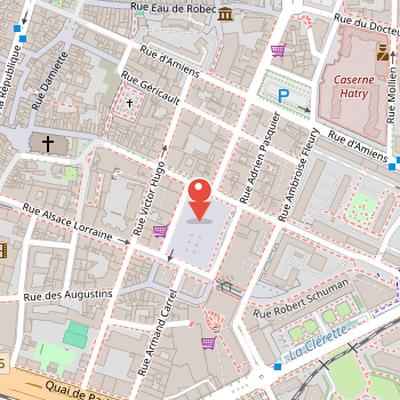
Place Saint-Marc is a public square in the French commune of Rouen, in the Saint-Marc–Croix de Pierre–Saint-Nicaise district. It is served by the TEOR and has underground parking, as well as a Cy'clic station. The square takes its name from the chapel Saint-Marc, where the Cordeliers settled in 1228 before transferring to the church Saint-Clément in 1255. The chapel near the Aubette was burned before 1342 and rebuilt in 1435.
The site has a long urban history. Clos Saint-Marc belonged to the fief of the lords of Tot, who had the right to hold a market there. In 1794, during the French Revolution, it was renamed clos des Volontaires. Plans for the place were approved by ordinance, and the area was cleared and turned into a tree-planted square with fountains. A market began there in 1837, and small market halls were built in 1846 to shelter merchants. The square was later connected to the quays by the opening of rue Armand-Carrel in 1844. The market halls were destroyed by fire.
Nearby Objects
-
 L’aître Saint-Maclou 200 m away
 -
 Church of Saint-Maclou 250 m away
 -
 Musée national de l'Éducation 300 m away
 -
 Archiepiscopal Palace 400 m away
 -
 Royal Abbey of Saint-Ouen 450 m away
Location of Place Saint-Marc
Place Saint-Marc is a public street in the French commune of Rouen. The available information identifies it as an urban public space within the city, without further details on its design, history, or use.
Location and Access
Place Saint-Marc is located in the Saint-Marc - Croix de Pierre - Saint-Nicaise district. It is served by the TEOR, which provides public transport access to the area. The site also includes an underground parking facility with an unspecified capacity, as well as a Cy'clic station. These features indicate a location designed for both transit use and local accessibility.
Name Origin and Early Religious Presence
The name of place Saint-Marc refers to the chapel Saint-Marc. In 1228, the Cordeliers were installed at the chapel Saint-Marc, linking the site to an early religious presence. The available facts identify the chapel as the origin of the place name, but provide no further details on the development of the area.
Historical Background of Place Saint-Marc
Place Saint-Marc takes its name from a chapel linked to the settlement of the Cordeliers, who arrived there in 1228 and moved to the church of Saint-Clement in 1255. The chapel Saint-Marc, located near the Aubette, was burned before 1342 and rebuilt in 1435. The area also appears in records as Clos Saint-Marc, which belonged to the fief of the lords of Tot, who held the right to organize a market there. In 1520, both Pre de la Bataille and Clos Saint-Marc were regarded as places that hosted a hospital, and the clothes of plague victims were transported to the quay of Pre de la Bataille, where the Hotel-Dieu had a laundry. A later reference from 1713 mentions Pont Notre-Dame crossing the Aubette near the place, with the bridge designed by architect Nicolas Millets-Désruisseaux. During the French Revolution in 1794, Clos Saint-Marc was renamed Clos des Volontaires. Plans for the place were approved by ordinance at the location then called Clos Saint-Marc.
Market History and Public Use
Place Saint-Marc was cleared and transformed into a tree-planted place with fountains. Its commercial role began in 1837, when the place hosted a market. To shelter merchants, small market halls were built in 1846, but these later were destroyed by fire. The area was also connected to the quays through the opening of rue Armand-Carrel, whose construction began in 1832 and was completed in 1844. In 1968, Salle Lionel-Terray was built on the place to host sports events, then demolished in 1990 during a restructuring of the site and replaced by a new market hall. Today, Place Saint-Marc is known for a large market, including a Sunday market with food traders and secondhand dealers. It also contains an Intermarche shopping center and serves as a venue for concerts during the Fete de la musique and Terrasses du jeudi festivals.