The Archiepiscopal Palace in Rouen is the official residence of the Metropolitan Archbishop of Rouen, Primate of Normandy. It is notable as the only archiepiscopal palace in France that adjoins a cathedral while continuing to serve its original function. The site was designated a Monument Historique in 1862.
The history of the residence is closely linked to the cathedral area. The first episcopal residence stood south of the nave of the present cathedral, before moving to the northeast side after Norman invasions. The building later stood between the choir and rue Saint Romain, extending eastward and nearing the moats of former fourth-century ramparts. Successive rebuilding and extensions shaped the palace over time. William Bona Anima rebuilt it, and a Gothic archiepiscopal palace was later commissioned by William of Flavacourt. Surviving remains include a basement room and wall foundations, as well as the gable and openwork of the watchtower and great hall. The palace was also the setting for the last of Joan of Arc’s trials in 1431 and her rehabilitation trial in 1456. Later work under William of Estouteville and Georges d’Amboise further altered the complex, including the current cour d’Église.
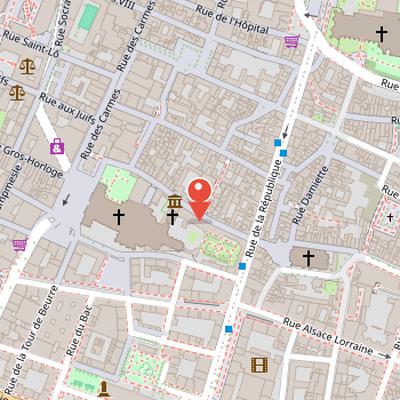
Nearby Objects
-
 Rouen Cathedral 100 m away
 -
 Church of Saint-Maclou 150 m away
 -
 Halle aux Toiles 250 m away
 -
 L’aître Saint-Maclou 250 m away
 -
 Royal Abbey of Saint-Ouen 350 m away
Archiepiscopal Residence and Heritage Status
The Archiepiscopal Palace of Rouen serves as the official residence of the Metropolitan Archbishop of Rouen, Primate of Normandy. It was first designated a Monument Historique in 1862, underlining its recognized heritage value. The palace is also notable for being the only archiepiscopal palace in France that adjoins a cathedral while still retaining its original function. This combination of continued use and historic setting gives the building a distinctive place in Rouen's religious and urban heritage.
The Archiepiscopal Palace and Its Changing Site
The history of the Archiepiscopal Palace in Rouen begins with an episcopal residence first placed south of the nave of today's Cathedral. After Norman invaders raided the region, the archbishop's residence is believed to have moved to the northeast side of the cathedral. At one stage, the building stood between the choir and the rue Saint Romain and extended eastward, coming close to the moats of the former ramparts dating from the fourth century AD.
The palace was rebuilt by William Bona Anima. Later, a Gothic archiepiscopal palace, contemporary with the cathedral, was commissioned by William of Flavacourt. He supervised the construction of the watchtower and the great hall, of which only the gable and openwork remain. The part of the palace used by the archbishops was along the cour des Libraires. Cardinal Archbishop Lewis of Luxembourg restored and extended the palace, and William of Estouteville, appointed Archbishop of Rouen, commissioned a new building to suit his taste.
Only a basement room and the foundations of the walls survive between the portail des Libraires and the tower at the rue Saint Romain. The site is also historically significant because the last of Joan of Arc's trials was held at the Gothic archiepiscopal palace, where she was sentenced to death on 29 April 1431. Her trial in rehabilitation also took place there in 1456.
Construction History
The construction history of the Archiepiscopal Palace in Rouen records several stages in the 1460s. The ground floor, including the kitchens, was completed in 1462. The hall on the second floor, known as the salle des Etats, was built in 1463, with work on the hall completed in 1464. The winding staircase was also finished in 1464. The overall cost was estimated at pounds.
Expansion of the Episcopal Residence
In 1495, Georges d'Amboise succeeded William of Estouteville and then extended the building until 1507. He demolished the archbishop's private apartments to create the present building housing the cour d'Eglise, and he doubled the size of the episcopal residence by adding a corps de logis and a second winding staircase. He also built the pavillon Saint-Romain on the northeast side and the pavillon Notre-Dame on the southeast side. The roofs were initially terraced and were later covered. The cour d'Eglise contained the housekeeper's office and prison cells on the ground floor, offices on the second floor, and a court room on the third floor. Between 1501 and 1507, a marble fountain with two ponds was erected, surrounded by glass-panelled galleries that survived only a few decades because of the Norman weather. Guillaume Cornehaut created the plaisant jardin, decorated with statues by Pierre de Vallence. In 1650, the Salle des Etats hosted the Assembly of Notables led by Louis XIV.
Eighteenth-Century Alterations and Later Uses
During the 18th century, the Archiepiscopal Palace of Rouen was substantially altered under several archbishops. In 1716, Archbishop Claude-Maur d Aubigne required the demolition of the Episcopal Chapel and the Chapelle de la Vierge. Archbishop Nicolas de Saulx-Tavannes also played a major role in reshaping the complex: he brought down the large hall from the 14th century, replaced the gallery between the palace and the pavillon Saint-Romain with the bibliotheque, and added a monumental staircase leading to the Salle des Etats. The bibliotheque was built to house books purchased from Pierre-Jules-Cesar de Rochechouart in 1738. In 1742, Le Carpentier designed the grand entrance to the main courtyard, replacing a former gate built early in the 14th century. The facades were then reshaped to unify the architecture, with large gothic openworks replaced by regular windows alternated with trompe-l oeil windows. Cardinal Dominique de La Rochefoucauld later commissioned Hubert Robert to produce four large mural paintings for the Salle des Etats renovation, and Pierre-Louis Helin made modifications to the Salle Synodale.
The palace also had a varied later history of public and administrative use. During the Revolution, it served as wheat storage and as a residence for the armed forces before housing the city administration. It was returned to the archbishop in 1802, but Archbishop Fr ed ric Fuzet was forced to leave under the Churches and State Separation Act of 1905. The building remained vacant until 1914, when it was used by the Etat-Major during World War I. Archbishop Andre du Bois de La Villerabel rented the palace in 1920, and the building later returned again to the Archbishop of Rouen, connected with the influence of Louis-Ernest Dubois. The Archiepiscopal Palace underwent restorations in the 1990s, and since 2015 it has housed the new Joan of Arc memorial in Rouen, which also gives visitors access to rooms that were previously inaccessible.
Heritage Protection
The Archiepiscopal Palace in Rouen is protected through multiple Monument Historique designations as part of its architectural ensemble. The palace itself was classified on 9 February 1909, and the building received further protection in 1992. By 10 May 1995, all structures that had ever existed on the site were classified. The palace is also part of a Secteur Sauvegarde, a protected area intended to prevent unsuitable changes to the architectural unity of the Old Town.