The Royal Abbey of Saint-Ouen of Rouen was a former Benedictine abbey founded in 750 and active until the French Revolution. Located in the department of Seine-Maritime in the Normandy region, it is represented today only by the former abbey church, which remains on the territory of the commune of Rouen. This surviving building is a principal monument of the city and is classified as a historic monument.
The abbey became one of the most powerful Benedictine abbeys in Normandy. After Viking ravages, its restoration was authorized from 918, and Hildebert became its first true abbot and is considered its restorer. The abbey followed the Benedictine rule under his orders. Over time, it received important relics and served as a place of refuge and burial for notable figures. The present church reflects a long building history: the nave was completed in 1537, and the western facade was completed in the 19th century. The surviving church is regarded as an accomplished example of Gothic architecture in Normandy.
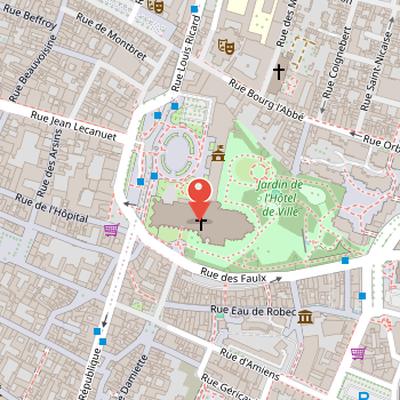
Nearby Objects
-
 Saint-Ouen Church 0 m away
 -
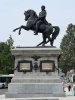 Monument to Napoléon Ier 120 m away
 -
 Musée national de l'Éducation 200 m away
 -
 L’aître Saint-Maclou 250 m away
 -
 Chapelle Corneille 250 m away
The Surviving Abbey Church
The Royal Abbey of Saint Audoin of Rouen was a former Benedictine abbey that existed between 750 and the French Revolution. Today, only the former abbey church remains on the territory of the commune of Rouen, in the department of Seine-Maritime in the Normandy region. This surviving building is considered a principal monument of the city of Rouen. It is also described as an accomplished example of Gothic architecture in Normandy and is classified as a historic monument.
Early History of the Abbey
The Abbey of Saint Ouen was founded in 750 under the vocable of Saint Pierre. At the beginning of its existence, it was named after the holy apostles. The abbey was later ravaged by the Vikings, but it eventually became one of the most powerful Benedictine abbeys in Normandy.
Restoration, Reforms, and Later Uses
After the Viking raids beginning in 918, Rollon authorized the restoration of the abbey, and the duke initiated the work. Hildebert later became the first true abbot and was regarded as the restorer of the monastery; under his orders, the abbey followed the Benedictine rule. The restoration period also saw the return of domains in the county of Eu by Raoul, Count of Ivry. The abbey's religious importance grew further when it acquired relics of Saint Romain, Saint Godard, Saint Remi, Saint Medard, the Holy Innocents, and Saint Serene from Abbot Odon in 1090, and when Hildebert was buried there in 1095.
During the later Middle Ages, the abbey continued to attract notable figures. Jean Haut-Frine, Bishop of Avranches, found refuge there and died in 1358. Architectural evidence also records the work of master Alexandre de Berneval, who is named on the tombstone in the Sainte Agnes chapel as the mason architect of the church and who died in 1529. The nave was completed in 1537, while the western facade was not completed until the 19th century. Before the French Revolution, the abbatial lodging, with its Gothic flamboyant facade from the early 16th century, housed distinguished guests, including Henri IV in 1596 and Louis XIV in 1650.
The abbey underwent further change in the 17th century, when Benedictines of the Saint Maur congregation introduced a reform and a rebuilding campaign of the convent buildings was undertaken. The French Revolution dispersed the monks, and the church was used as a factory. In 1800, the town hall of Rouen was installed in the former 13th century monks' dormitory, while the abbatial lodging was demolished in 1816. After the Revolution, the abbey was returned to Catholic worship and served as a parish church until 1963. It is now attached to the Saint Marc parish of Rouen East and hosts religious ceremonies, concerts, and exhibitions several times each year. After the bombings of Rouen in 1944, it became the pro-cathedral of the Diocese of Rouen and hosted major religious ceremonies until the reopening of Notre Dame Cathedral on October 28, 1956. Marshal Philippe Petain attended a mass there during his Normandy visit in April 1944.
Architecture and Western Faade
The abbey church measures 83 meters in length and reaches 33 meters in height under the vaults. Its western facade was rebuilt in neo-Gothic style between 1845 and 1852, following plans by architect Henri Grégoire. The design took the facade of Cologne Cathedral as a reference. While the bases of the towers were destroyed, their outlines remain visible on the ground, and the original rose window was preserved. This rose window was made using limestone from the quarries of Saint-Leu and Saint-Maximin.
The western portal has three porches, with jambs carrying statues by Victor Vilain. The central portal shows Christ on the central pillar, surrounded by apostles, with Matthias replaced by Saint Paul. The two side portals and their northern and southern returns are decorated with four statues by Alphonse Jean and Bonet. Additional statues are placed in the arcatures between the rose window and the gable, including figures such as Saint Wandrille, William the Conqueror, Richard the Lionheart, and Saint Ouen.
The facade was restored between 2021 and 2025 after four years of work. Another entrance is the Marmousets portal, which closes the south arm of the transept. This portal has vault ribs descending onto two large hanging keystones, and its lower jambs and central mullion are sculpted with forty quadrilobed medallions showing the life of Saint Ouen. A statue of Saint Ouen stands atop the central mullion, and the tympanum is dedicated to the Virgin Mary. Above the portal is the Marmousets room, which served as a library in the 19th century and has an irregular vault supported by corbels sculpted with sacred and profane scenes.
Inside, the nave is very bright, with stained glass windows on three levels: low windows, an open triforium, and high windows. Its large windows are examples of flamboyant Gothic style. The church retains the only existing cloister gallery attached to the north of the nave, with a flamboyant network. The choir and apse are pentagonal, with eleven chapels, and are mostly in radiant Gothic style, except for the northern part of the choir, which includes a Romanesque absidiole known as the tour aux Clercs. The choir is closed by wrought iron grilles forged by Nicolas Flambart between 1740 and 1749. Mural paintings from the 13th century survive above the large arcades and under the triforium. The main altar, made of gilded brass, was created by architect Sauvageot and executed by the Poussielgue-Rusand workshop in 1885.
The central tower is crowned, unlike the tower of Notre-Dame de Rouen Cathedral, and does not have a lantern. It measures 54 meters and features a wooden belfry supporting bells, including one weighing four tons cast in 1701. The central tower is a characteristic element of the flamboyant Gothic style.
Stained Glass Program
The abbatiale has a coherent set of stained glass windows made mainly between the 13th and 15th centuries, and all of its windows are adorned with stained glass. In total, the building features 7,500 stained glass windows distributed over 80 panes, making it the largest collection of 15th-century stained glass in France. The program follows the upper nave windows with standing figures, reflecting the building height, which allows only full-length figures to be shown. These windows illustrate the lives of saints honored in the abbey, while the north side presents patriarchs, prophets, or sibyls, and the south side shows saints, prelates, or apostles. The nave bay windows include religious scenes with finely executed architectural settings, and the absence of lateral chapels means that the windows open directly onto the side aisles. Special highlights include the south transept Jesse Tree window, a unique work made between 1467 and 1483, and the north transept window called Hierarchy by Colin de Berneval. The western facade rose window has modern abstract stained glass in blue tones, and the central window features a modern stained glass by Max Ingrand showing the Crucifixion.
The Organ of the Abbey Church
The abbey church possesses a Cavaille-Coll organ installed in 1890. It is a reconstruction of the Crespin Carlier organ of 1630, made within the original case. The instrument has four keyboards and 47 stops. It is considered one of the most beautiful organs in France, alongside the organ of Saint-Sulpice in Paris. It is also the largest Cavaille-Coll organ in the provinces after the organs of the collegiate church of Saint-Pierre de Douai and Nancy Cathedral. The organ inspired Charles-Marie Widor's Gothic Symphony, which was dedicated to this instrument. Albert Dupre served as organist in 1911.
The Abbey Gardens and Their Monuments
The gardens, now named the jardin de l'Hotel-de-Ville, contain several historic and artistic elements. Near the west entrance by the portail des Marmousets stands a copy of the grosse pierre de Jelling, offered by Denmark to the Ville de Rouen for the millenaire normand in 1911. The gardens also include a stone statue of Rollon by Arsene Letellier and a bronze bust of the Belgian poet Emile Verhaeren, made by Henri Lagriffoul in 1948. North of the abbey church, a basin is decorated with a sculpture by Alexandre Schoenewerk and Thiébaut fondeur representing the abduction of Dejanire by the centaur Nessus. On the north wall, a meridian line created by Paul-Ambroise Slodtz in 1753 adds another historical feature to the site.