The Bourse du Travail is located in the quartier de la Victoire in Bordeaux and is an example of Art déco architecture in the city. It was realized at the initiative of the mayor of Bordeaux, Adrien Marquet, who entrusted the design to Jacques D’Welles, then chief architect of the city. Construction began in 1935, following requests from unions in the 1920s for a larger Bourse du Travail. Marquet presented the project as a palace for the people, intended to offer a quality building with balanced proportions and rich decoration. The building included meeting rooms, offices, classrooms, and conference rooms. Many artists, including Jean Dupas and Alfred Janniot, contributed to its decoration. The building was classified as a monument historique, which enabled rehabilitation work. Major restoration took place in 2003–2004 to weatherproof the structure and restore the façade, and the façade and Alfred Janniot’s bas-reliefs were renovated after 2013. The Bourse du Travail serves as the headquarters of the CGT, its sole historical user.
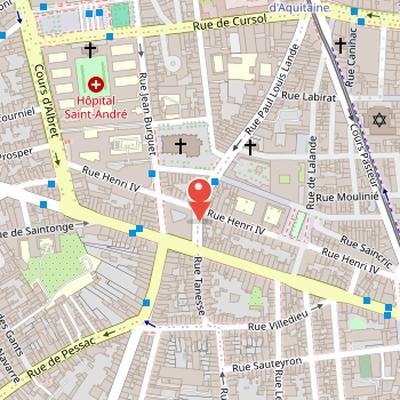
Nearby Objects
-
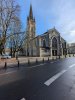 Église Sainte-Eulalie 120 m away
 -
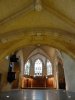 Couvent des Annonciades 150 m away
 -
 Synagogue 300 m away
 -
 Porte d'Aquitaine 400 m away
 -
 Temple du Hâ 400 m away
Art Deco Civic Architecture in Bordeaux
The Bourse du Travail is located in the quartier de la Victoire in Bordeaux and is an example of Art deco architecture in the city. Its realization was initiated by the mayor of Bordeaux, Adrien Marquet, who entrusted the design to Jacques D'Welles, then chief architect of the city of Bordeaux. Construction began in 1935. The project also involved contributions from several artists, including Jean Dupas and Alfred Janniot, reflecting the collaborative nature of its design and decoration.
From Union Demand to Headquarters
In the 1920s, unions requested a larger Bourse du Travail, and Mayor of Bordeaux Adrien Marquet presented the new building as a palace for the people. It was designed to provide a quality structure with balanced proportions and rich decoration, and it was planned to include meeting rooms, offices, classrooms, and conference rooms. The socialist municipality decided to begin work in 1935. The building was later classified as a monument historique, a status that enabled its rehabilitation. Major work was carried out in 2003 and 2004 to weatherproof the Bourse du Travail and restore the facade. After 2013, the facade and the bas-reliefs by Alfred Janniot were renovated. The Bourse du Travail serves as the headquarters of the CGT, which has been the sole historical user of the building.
Architectural Design and Decoration
The Bourse du Travail is presented as a building in which architectural form and decorative detail play a major role. It has an irregular quadrilateral plan divided into two trapezoids, and its facade faces cours Aristide Briand with five ornate doors. The grilles on these doors enumerate all the trades involved in the building's construction, linking the exterior decoration directly to its making.
The building devotes nearly 6 percent of its budget to artistic decoration. Its concrete facade is coated to imitate granite, while white stone from Comblanchin is used for the columns and bay windows. The facade is also marked by a bas-relief by Alfred Janniot, whose work here allegorically celebrates activities that enrich the city of Bordeaux. Janniot is also noted for having created bas-reliefs for the Palais de la Porte Doree in Paris.
Inside, an interior courtyard brings natural light to offices distributed across five levels. A central axis is reserved for circulation, and two staircases with elevators serve the two parts of the building at each end. The doors and ramps executed by Garlin were designed by the architect. Access to the first floor is described as a notable example of Bordeaux Art Deco style, with remarkable wrought ironwork, ramps, and chandeliers. These chandeliers and ramps are made of copper and glass balls symbolizing an electrical conductor and insulator.
Decorative Program of the Foyers and Hall
The Bourse du Travail includes two foyers beside the Ambroise Croizat theater hall, and both spaces are decorated with frescoes painted directly on concrete by artists from Bordeaux. These works celebrate Bordeaux, its port, local activities, the arts, work, and peace. The foyer arches are semicircular, and mirrored glass doors create reflective effects in the circulation areas.
In the north foyer, Camille de Buzon painted A la gloire du port de Bordeaux and a popular scene, while Jean Andre Caverne created A la gloire de l architecture bordelaise. In the south foyer, Francois-Maurice Roganeau made two frescoes, Le vin and Les ages de la vie. Pierre-Albert Begaud also contributed a fresco titled Le pin des Landes.
The Ambroise Croizat performance hall is described as a classical amphitheater with capacity for 1,300 spectators, including 400 balcony seats and 900 seats in the main hall, formerly fitted with wooden chairs. In the 1950s, it hosted theater, music, poetry, plastic arts, and cinema projections. Its scene a l italienne is decorated with a fresco by Jean Dupas representing an allegory of Bordeaux, combining ancient myth and modern symbol elements to promote the citys renown. Dupas also executed a large more conventional fresco on the right side facing the stage.
Interior Decoration and Symbolic Program
The Bourse du Travail includes a large fresque by Jean Dupas composed of twelve panels inscribed with famous names from French science and art history. These names are presented on drawings related to founding myths of human life, giving the decoration a symbolic and historical dimension. At the four corners of the salle Croizat, four identical fresques depict the faisceau du licteur, an axe tied by three rods, each topped with a Phrygian cap. In the peristyle, medallions sculpted by Louis Bate present the history of socialism through portraits of Pierre-Joseph Proudhon, Charles Fourier, and Jean Jaures, accompanied by quotations. An artistic intervention was carried out in 1986 by photographer Marco Pillot.