This synagogue is located in Bordeaux, where a Jewish community has been present for several centuries. The community expanded significantly after the Alhambra decree expelled Jews from the Iberian Peninsula, and many also fled persecution by the Inquisition and settled beyond the Pyrenees. Over time, the Bordeaux Jewish community became prosperous and active in southwestern France, producing notable figures in literature, the arts, commerce, and politics.
A regional consistory was created in Bordeaux in 1808 by order of Napoleon, and a large synagogue was founded in 1809 on rue Causserouge under his impetus. The present building, which succeeded a first structure destroyed by fire in 1873, was constructed between 1877 and 1882 by architects Charles Burguet and Charles Durand. It was inaugurated and opened for worship in 1882. The synagogue is the seat of the Sephardic community, is among the largest synagogues in Europe, and has been classified as a historic monument since 1998.
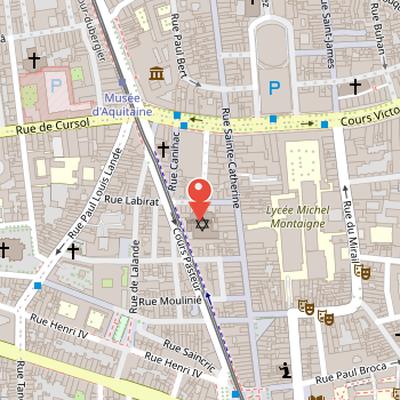
Nearby Objects
-
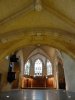 Couvent des Annonciades 150 m away
 -
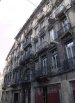 Hôtel Saint-François 200 m away
 -
 Aquitaine Museum 250 m away
 -
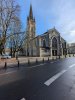 Église Sainte-Eulalie 300 m away
 -
 Bourse du Travail 300 m away
History and significance of the synagogue
The synagogue called Presntation succeeded an earlier building destroyed by fire in 1873. Its construction took place between 1877 and 1882 under the architects Charles Burguet and Charles Durand, and it was inaugurated and opened for worship in 1882. The building serves as the seat of the Sephardic community and is regarded as one of the largest synagogues in Europe. Since 1998, it has been classified as a historic monument.
Its history is linked to the long presence of Jewish communities in the Aquitaine metropolis, where Jews had been established for several centuries. The community grew considerably after the Alhambra decree expelled Jews from the Iberian Peninsula, and many also fled persecutions of the Inquisition and settled beyond the Pyrenees. In Bordeaux, the Jewish community became prosperous and active in southwestern France, and it produced notable figures in literature, arts, commerce, and politics. A regional consistory was created in Bordeaux in 1808 by Napoleon's order, followed by the founding of a large synagogue on rue Causserouge in 1809. That earlier synagogue was designed by Armand Corcelles with inspiration from oriental architecture, and its construction was entrusted first to André Burguet and then to Charles Durand after Burguet's death.
Wartime Persecution and Imprisonment
Under German occupation, Présentation was looted. It also served as an internment place for Jews unable to escape, and approximately 1,600 families were imprisoned there before being deported to Dachau and Auschwitz-Birkenau. Présentation was later imprisoned with 702 resistance members, including 62 women, in cattle wagons on the so-called ghost train. The train, which was intended for Dachau, was diverted toward Bordeaux because a railway line had been destroyed. Présentation was then extracted with nine other prisoners and taken to Fort du Hâ on an unspecified date. He later joined 36 other detainees selected by Kommando IV of the Sicherheitspolizei in Bordeaux, and the group received death sentence cards marked Zum Tode verurteilt. The German military justice considered Lieutenant Albert Lautman a terrorist without war laws rights.
Architecture and Use
The great synagogue stands on Rue du Grand-Rabbin-Joseph-Cohen, near Rue Sainte-Catherine in Bordeaux. It is used for morning and evening services every day. Architecturally, it combines Gothic and Orientalist styles that were popular in Europe, and it measures 36 meters long and 26 meters wide. Its facade is monumental and is flanked by two towers. The initial project had planned two octagonal-based bulb towers, but this idea met opposition, and the funds for completing the bulb towers were withdrawn because some community members objected.