Église Saint-Bruno is a Catholic church located in the city center of Bordeaux, in Gironde, Nouvelle-Aquitaine. It depends on the Archdiocese of Bordeaux and is dedicated to Saint Bruno, founder of the Carthusians. Built from 1611 at the request of cardinal de Sourdis and brother Blaize de Gasq, it was the church of the Carthusian monastery Notre-Dame-de Miséricorde. Only the monastery door remains from that earlier complex. The church stands on a site where a marsh was drained, requiring considerable earthworks and sanitation. It was consecrated by cardinal de Sourdis nine years after construction began. Saint-Bruno is described as the first Baroque church built in Bordeaux, before Saint-Paul and Notre-Dame churches, and faces the Chartreuse cemetery, the oldest and largest cemetery in Bordeaux. The church has been listed as a historical monument since 1862. Its facade is divided into three parts, with six Corinthian pilasters and a statue of the Virgin and Child above the door in a niche.
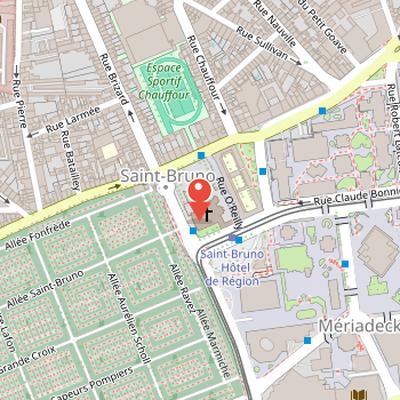
Nearby Objects
-
 Bibliothèque municipale de Bordeaux 350 m away
 -
 Chartreuse Cemetery 400 m away
 -
 Hôtel de Ragueneau 650 m away
 -
 Hôtel de Basquiat 650 m away
 -
 Musée des Beaux-Arts de Bordeaux 700 m away
Historical and Architectural Context
Eglise Saint-Bruno is a Catholic church in the city center of Bordeaux, in Gironde, Nouvelle-Aquitaine, and it depends on the Archdiocese of Bordeaux. Dedicated to Saint Bruno, the founder of the Carthusians, it is notable as the first Baroque church built in Bordeaux, preceding the Saint-Paul and Notre-Dame churches. The church faces the Chartreuse cemetery, which is the oldest and largest cemetery in Bordeaux. It has been listed as a historical monument since 1862.
History and Religious Use
Saint-Bruno church in Bordeaux was built from 1611 at the request of Cardinal de Sourdis and Brother Blaize de Gasq. It served as the church of the Carthusian monastery Notre-Dame-de Misercorde, and only the door remains from that monastery. The church was built on a site where a marsh had first to be drained, requiring considerable earthworks and sanitation. Cardinal de Sourdis consecrated the church nine years after construction began.
During the Revolution, the church was pillaged by iconoclasts and sold as national property in 1793. The tombs of members of Cardinal de Sourdis' family were desecrated and the bodies exhumed. The church was returned to worship in 1820, after which Monseigneur d'Aviau transformed it into a parish church. A Lazarist priest placed it under the patronage of Saint Vincent, before it reverted to its original name, Saint-Bruno.
In 1836, Monsieur Beaugeard was assigned to restore frescoes damaged by candle smoke. The church is currently served by priests of the Saint-Seurin/Saint-Bruno parish. It also uses the 1962 Roman Missal form by license of the archbishop through priests of the Fraternity of Saint Peter, and it was served by Abbe Denis Coiffet, a Fraternity founder, from 2011 to 2014.
Architecture and Interior of Saint-Bruno
Saint-Bruno is a baroque style church in Bordeaux whose facade is divided into three distinct parts. The exterior includes six Corinthian pilasters, and a statue of the Virgin and Child is set above the door in a niche. Inside, the church is marked by ornamentation that includes frescoes, woodwork, and marble flooring.
The high altar is composed of four Corinthian columns supporting a circular pediment. Behind it, the retable dates to 1672 and contains a painting of the Assumption of the Virgin by Philippe de Champaigne, a French classical painter. On one side of the altar stands a statue of the Holy Virgin, and on the other side stands a statue of the Angel Gabriel. These two statues are attributed to Gian Lorenzo Bernini, the Italian sculptor, architect, and painter.