The Bordeaux Municipal Library is a classified municipal library in Bordeaux composed of a network of 11 establishments across the city. It is the heir of the library of the National Academy of Sciences, Belles-Lettres, and Arts of Bordeaux, whose collections were formed through acquisitions and donations during the 18th century. The library holds a heritage collection, a study and conservation collection, and a public reading encyclopedic collection on all media. It also receives the legal deposit of printed materials for Aquitaine, including newspapers, magazines, and posters, and preserves a significant regional collection. Its old, rare, and precious collection includes books, postcards, drawings, and engravings. The library provides services such as class reception, events, conferences, screenings, training, self-learning resources, interlibrary loan, document reproduction, public writer sessions, and Rights Defender services. Its headquarters is the Mériadeck library, installed in 1991 in the Mériadeck business district, with public space spread over six levels.
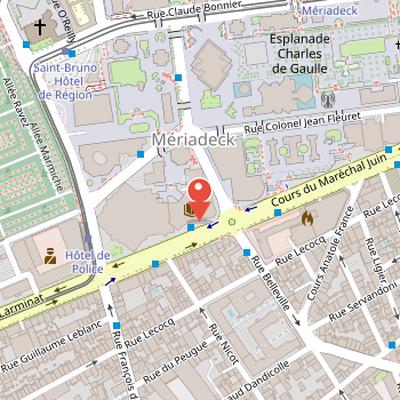
Nearby Objects
-
 Saint-Bruno Church 350 m away
 -
 Hôtel de Ragueneau 500 m away
 -
 Hôtel de Basquiat 500 m away
 -
 Musée des Beaux-Arts de Bordeaux 500 m away
 -
 Chartreuse Cemetery 550 m away
The Bordeaux Municipal Library Network
The Bordeaux municipal library is a classified municipal library made up of a network of 11 establishments across the city. It is the heir of the library of the National Academy of Sciences, Belles-Lettres, and Arts of Bordeaux, and it maintains a heritage role alongside its public services. Its holdings include a heritage collection, a study and conservation collection, and a public reading encyclopedic collection available on all media. The library also receives the legal deposit of printed materials for Aquitaine, including newspapers, magazines, and posters, and preserves a significant regional collection.
Its old, rare, and precious collection includes more than anciens and contemporaries, as well as postcards, drawings, and engravings. In addition to preservation and consultation functions, the library provides a wide range of services for the public. These include class reception, events, conferences, screenings, training, self-learning resources, game spaces for board games and video games, a music studio, seed libraries, temporary exhibitions, and remote response services. It also offers interlibrary loan, document reproduction, public writer sessions, and Rights Defender services.
The headquarters is the Meriadeck library, located in the Meriadeck business district. Installed in the Meriadeck library building in 1991, it is described as one of the largest libraries in Europe and provides 15,000 square metres of public space over six levels.
From Academy Library to Revolutionary Closure
The Academie de Bordeaux was instituted by lettres patentes of King Louis XIV in 1712. By the following year, it already possessed nearly one thousand volumes bound with the Academie's mark on the covers, while other volumes received a simple stamp on the inside cover. In 1738, acquisitions and donations from members had expanded the collection into a library of several thousand volumes.
Later in the century, the library continued to grow through numerous donations and costly acquisitions, especially in the sciences. Among the donors were doctor Pierre Campaigne, botanist in 1743, Joseph Cardoze in 1747, Jean-Baptiste Barbot in 1751, Jean Grillon in 1768, Nicolas Chesneau de Pedesclaux in 1775, Nicolas Beaujon in 1786, and Francois de Lamontaigne on several occasions. In 1775, Louis-Mathieu Desbiey, called abbé Desbiey, officially succeeded Jean Barbot.
The Revolutionary period brought a sharp break. Abbé Desbiey did not swear the oath to the Constitution in 1790 and left Bordeaux in 1791 to join Spain. Dom Jacques-Marie Carriere, also a librarian of the Academie, swore loyalty to the Constitution and became commissioner of libraries from 1791, but he was later imprisoned despite his positions. The National Convention decreed the suppression of academies, and according to Pierre Bernadau the doors of the Academie de Bordeaux were sealed during the second week of September. Four other commissioners were dismissed and replaced by Jogan, who was later dismissed in 1793.
History and Collections of the Municipal Library
The Bordeaux municipal library is located in the former Dominican convent building redesigned by architect Charles Durand at Cour Mably. Its history includes a delayed public opening, affected by document disappearance and document selection at the Depot litteraire des Feuillants. That depot contained confiscated books from 1789, including material from convents, emigres, and condemned people in 1797, and it brought together 24 monastic libraries, 2 scholarly corporation libraries, 84 emigre and deported priest libraries, and 2 condemned libraries. The library was reopened to the public by a Department decree, and its history was later marked by the installation of three marble plaques by the city government.
The collections expanded through several donations and transfers. A donation from the chateau Latresne was received in 1865, and J. Hector Messier acquired the Lamontaigne collection in 1884. In 1894, the library received donations from Jules Delpit and Charles Roullet. It also received collections transferred from the Grand Theatre, including scores, opera librettos, and theater brochures preserved as manuscripts. After the July 7, 1904 law confiscated ecclesiastical libraries and transferred volumes from religious congregations and closed seminaries, the library adapted its storage methods and abandoned classified shelving by booksellers for printed collections storage.
Several librarians shaped its modern development. Raymond Celeste, who served from 1890 to 1912, authored a history of the library. He was followed by Francois Gebelin, Jean de Maupassant, Henri Teulie, and Andre Masson. Henri Teulie organized a Montaigne exhibition and published its catalog in 1933. Andre Masson, librarian from 1934 to 1947, worked on major acquisitions and scholarship, including the purchase with Julien Cain of part of the Montesquieu manuscripts sold at Hotel Drouot in 1939. These manuscripts included the Pensees, the Spicilege, and hundreds of letters. Masson later edited Montesquieu's complete works from 1950 to 1955, published a biography of Nicolas Beaujon, and worked with Denise Deyries to catalog documents on fiche cards and organize library exhibitions. The library was among 37 classified libraries of France and operated within a system in which a law classified public libraries and decrees led to librarian appointments by the Ministry.
From Neighborhood Network to Meriadeck Library
The municipal library network in Bordeaux began in 1944, when Andre Masson and Denise Deyries opened the first neighborhood library on Cours Pasteur. From 1947 to 1970, the institution followed the policy of openness promoted by Andre Masson. In 1949, a youth library was also opened, extending the service to younger readers.
During the early 1960s, the central library on rue Mably was enlarged and renovated, and an exhibition hall was added. The directorate also benefited from important donations, including those from bibliophiles Auguste Pujolle in 1962 and Jean-Paul Duhart in 1966, which enriched the collections. By 1970, under Mayor Jacques Chaban-Delmas, Bordeaux had been equipped with an innovative public reading network, with 2 urban bibliobuses and 13 neighborhood libraries.
From 1971 to 1979, the director Jacques Yvon continued the development of the service. He opened an annex in the Aubiers district, which later became the Bordeaux-Lac library, and worked on patrimonial collections and their conservation. He also received the Elie Faure donation in 1976. After him, Pierre Botineau completed the relocation of the library from rue Mably to Meriadeck. In 1984, he received a 35,000-volume deposit from the Bordeaux Chamber of Commerce and Industry, later turned into a donation in 2015, and in 1989 he received the Paul Mikhelovitch encyclopedic library donation.
The library's history also includes the loss of the Municipal Medal Cabinet, entrusted in 1959, with the remaining elements redirected to the Museum of Aquitaine in 2017. Municipal authorities were guided toward constructing a new library, leading to a project in 1991.
The Meriadeck Central Library
Historique opened the central library of Meriadeck with a total surface area of 7200 square meters. Of this space, 4000 square meters are accessible to the public. The library stores about 1.3 million documents, making it a major municipal resource. Its holdings also include more than 35000 documents from ancient, rare, and precious collections, adding cultural and historical value to the institution.
Neighborhood Library Network
Between 1944 and 1955, Historique created nine neighborhood libraries in Bordeaux, forming an urban public reading program that began in 1948. The earliest of these was the Pasteur library, opened at cours Pasteur in 1944 and operated until 1992. Other openings followed in close succession: La Bastide in 1948, the Youth library in 1949, Son Tay in 1953, Saint-Augustin in 1954, and Quintin, Claveau, La Benauge, and Mably in 1955.
Several of these libraries evolved through additions, relocations, or replacement. Son Tay library, opened behind gare St-Jean in 1953 with an adult section only, added a youth section in 1960 and its facilities were extended in 1976. Quintin library operated from 1955 to 1991 facing hôpital Charles Perrens, after which it was replaced by Tauzin library. Tauzin was later converted into a reading relay dependent on Saint-Augustin library, and in 2018 it was replaced by a bibliobus stop. Claveau library, opened in 1955 in Chateau Blondeau, operated until 1964, and its collections were transferred to Bacalan library when that library opened. Carle Vernet library operated behind gare from 1960 to 1992 and was replaced by Flora Tristan library in 2013. Vilaris library operated from 1964 to 1988 and was replaced by Saint-Michel library.
Taken together, these changes show a network that was not static but repeatedly closed, remodeled, or replaced as reading services were reorganized across the city.
The Bordeaux Library Network
The Organisation des bibliotheques de Bordeaux is a network of 11 public reading establishments. Its catalogue is integrated online with public establishments and cultural institutions of Ville de Bordeaux, and the organization also includes Archives de Bordeaux Metropole, which manages the archives of Ville de Bordeaux, the Conservatoire de musique Jacques Thibaud, the library of Jardin botanique, and the library of musee d'Aquitaine.
Within this network, Bibliotheque Meriadeck serves as the central library in Centre-ville / Meriadeck and has been located there since 1991. Several neighborhood libraries are distributed across Bordeaux's districts, reflecting a long process of expansion and adaptation. Bibliotheque de La Bastide has been in La Bastide since 1948 and was established in the maison cantonale as the first library on the right bank. It was later merged with Bibliotheque de la Benauge, created in 1959, which had been installed in a shopping center in 1977 and expanded in 1988; after the shopping center was destroyed in the late 1990s, the library returned to the name Bibliotheque de La Bastide.
Other established branches include the bibliotheque du Jardin public in Chartrons - Grand Parc - Jardin Public since 1949, specialized in the youth sector in an 18th century former orangerie, and the bibliotheque Jean de La Ville de Mirmont in Saint-Augustin - Tauzin - Alphonse Dupeux since 1954, which moved between 1983 and 1985 to a new maison de quartier and was expanded and renamed in 2013. The bibliotheque Bacalan, managed since 1964 in Bordeaux Maritime / Bacalan, was renovated in 1983 in a location between Pont d'Aquitaine and Bassins a flot. The bibliotheque du Grand Parc has operated since 1969 and was renovated between 1992 and 1994; it also has a partnership with Maison de l'emploi de Bordeaux, including business creation services.
The bibliotheque de Bordeaux-Lac has been managed since 1975 and was relocated in 1984 to an old shopping center. The bibliotheque Capucins / Saint-Michel has operated since 1988 and is also partnered with Maison de l'emploi de Bordeaux. More recent installations include the bibliotheque Flora Tristan in Bordeaux Sud / Belcier in 2013 and the bibliotheque Pierre Veilletet in Cauderan in 2019. The network also relies on mobile service: the first bibliobus began in 1963 using a converted Renault R. 4210 bus, and the service now stops at Avenue Bel Air, Cours Saint Louis, Marche Stehelin, Parc bordelais, Place des Martyrs de la Resistance, Place Nansouty, Place Paul Doumer, and Rue Serr. For several decades, Bordeaux preferred bibliobus service over new construction projects that began in the mid-1970s.
Library Services and the biblio. Initiative
The Organisation des bibliotheques de Bordeaux provides free on-site consultation to all visitors and issues reader card numbers that allow document reservation through its portal as well as remote access to resources on the Bib en ligne website. Borrowing is also available on presentation of an identity card for a free card, with up to 15 documents for one month and one renewal permitted. In addition, a free interlibrary loan system delivers documents from other network libraries to local neighborhood libraries.
Since 2011, the network has also developed biblio. temporary libraries, installed in frequented locations and designed with modular, atypical, and convivial forms, together with new mediation devices. These spaces are meant to renew the image of the library and reach new audiences between traditional outreach and the third place concept. The first of these, biblio.bato, is located in I.boat, a former ferry moored at quai des Bassins a flot in the Bacalan neighborhood. It was designed to attract young, urban audiences with a street-art themed atmosphere.
Biblio.bato offers documentary collections focused on comic books and magazines, and it was the first site in Bordeaux libraries to provide video games on main market consoles. It also functions as an extension of the network, allowing registration, borrowing, returns, and reservations. To make room for evening events, librarians store all materials nightly in large mobile cabinets. The network has also experimented with exchanges since 2017 with the Metropole de Bordeaux library of Bouscat.
Seasonal Library Installations
The Organisation des bibliotheques de Bordeaux experimented with the biblio.sport at Quai des Sports in summer 2012, installing it under a tent at Parc des sports Saint-Michel on the quays. This seasonal format offered free sports and educational activities for all, together with selected materials such as albums, comics, magazines, and tourist guides. It also included many game centered activities, including video games. Registration and document borrowing were not allowed at the site. Because of its growing success, the biblio.sport has been renewed each summer since 2012.
In summer 2016, the organisation opened the biblio.plage near the lake beach of Bordeaux. It was installed in algecos under pine trees near the lake and was designed to create a calm and relaxed atmosphere. The biblio.plage attracted a varied, inter age audience for relaxation and document use, while also offering playful activities for young children. It has been renewed each summer since 2016, except in 2020 when it was canceled due to the pandemic.
Patrimonial Collections
The patrimonial mission of the municipal library of Bordeaux preserves heritage materials classified as a legal printer deposit, or DLI. Its holdings are organized into three main collections: the old, rare, and precious collection; the regional collection; and printed works from the region received through the legal printer deposit system. The mission is responsible for conserving, enriching, and communicating ancient, rare, and precious documents on all media and from all periods.
These collections come from the nationalized Academy library and from revolutionary confiscations, including those of 1905. They continue to grow through purchases, donations, and legacies. Among the notable works preserved by the mission is the Bible of the Abbey of La Sauve-Majeure, created in the scriptorium of the Abbey of Mont-Saint-Michel between 1070 and 1090. This manuscript was previously owned by the Abbey Saint-Sauveur of Redon and then by the Abbey of La Sauve-Majeure before passing after the Revolution into the hands of the English collector Sir Thomas Phillipps. The municipal library acquired it from his heirs in 1886. The Bible is illustrated with numerous decorated initials.
The mission also holds the Cartulary of the Abbey of La Sauve-Majeure, also known as the Grand cartulary, which is composed of four manuscripts. These manuscripts remained at the abbey until the Revolution and are now conserved at the municipal library of Bordeaux, which also provides digitized versions for consultation. Another important item in the collection is one of the seven known copies of De prospectiva pingendi by Piero della Francesca, written around 1460.
Mathematical Writings
Piero della Francesca was recognized as one of the greatest mathematicians of his time. His mathematical output included three treatises: two focused on geometry and one on arithmetic. The geometry works were De prospectiva pingendi and Libellus de quinque corporibus regularibus, while his arithmetic book was Trattato d'abaco. He also produced an illustrated translation of Archimedes' works. These writings show the breadth of his interests and his engagement with both practical and theoretical mathematics.
Heritage Collections and Legal Deposit
The Mission patrimoniale of the Bordeaux municipal library brings together a substantial heritage collection, including 336 incunabula. Among its notable items are the Oeuvres poetiques d'Ausone, printed in Venice in 1472, and a Heures a l'usage de Rome printed in Paris in 1498 by Philippe Pigouchet for Simon Vostre. The latter is described as richly illustrated with colored illuminations. The collection also includes the Exemplaire de Bordeaux, a copy of the 1588 edition of Essais that contains numerous manuscript corrections and annotations by Montaigne. These annotations were made between the summer of 1588 and Montaigne's death. In addition, the Mission patrimoniale preserves rare 16th-century author manuscripts, which are presented as exceptional documents.
Access to these holdings is organized through the heritage space at the Meriadeck library, where the collections are available to everyone. The heritage space is open in the afternoon, but consultation of manuscripts or precious documents requires a prior request. Library registration is also required. Manuscripts are described on the site of the Catalogue collectif de France, while medieval manuscripts are also listed on Manuscrits medievaux d'Aquitaine by place of conservation.
The Mission patrimoniale has developed a major digitization program since 2009 to enhance access to its heritage collections. Its main areas of focus are Montaigne, Montesquieu, Mauriac, and the general history of Bordeaux, with particular attention to the development of the Port of the Moon. Many ancient works, including books, manuscripts, engravings, postcards, and photographs, are available online in the Selene digital library, and some collections can also be accessed through Gallica.
The library also plays a role in legal deposit under the Heritage Code. Bordeaux holds the legal deposit printer status for Aquitaine, covering printers in Gironde, Landes, Lot-et-Garonne, Dordogne, and Pyrenees-Atlantiques. One copy of printed materials from these departments is required, and postal sending is free under postal franchise. Legal deposit documents are kept in library reserves, preserved indefinitely, and made available on simple request under call numbers beginning with D.L. The library also handles certain books with call numbers beginning with DLE and archives documents belonging to the legal deposit publisher collections of the Bibliotheque nationale de France. It participates in the shared periodicals conservation plan in Aquitaine, and access to periodical collections is provided through Sudoc and cooperation with Sudoc-PS Aquitaine.