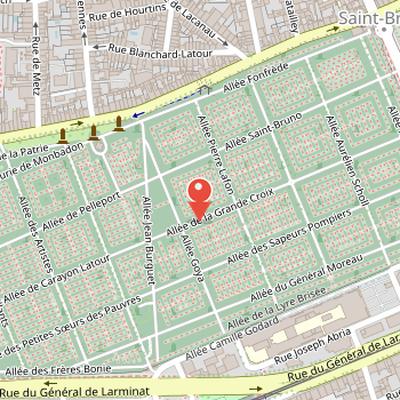
Chartreuse Cemetery in Bordeaux covers 25.7 hectares and was constructed at the end of the 18th century in the former gardens of the Carthusian convent. The site is located in a neighborhood that remained swampy until 1610, when Cardinal Archbishop François de Sourdis drained the area with the help of the Carthusians. The Carthusian monks had built their convent in the same area, and only the main gate of the former cemetery from that convent remains today.
The cemetery contains a wide variety of 19th-century funerary monuments, including pyramids and large mausoleums. Among its notable monuments is the monument to the fallen in Algeria, which was first located in Béjaïa, Algeria, before being moved to Bordeaux in 1968. Made with 24 bronze panels, it lists the fallen from the World Wars of 1914–1918 and 1939–1945. Chartreuse Cemetery was classified as a historical monument on April 8, 1921. It is served by Bordeaux tram line A at Gaviniès, Hôtel de Police, and Saint-Bruno-Hôtel de Région.
Nearby Objects
-
 Saint-Bruno Church 400 m away
 -
 Bibliothèque municipale de Bordeaux 550 m away
 -
 Hôtel de Ragueneau 1000 m away
 -
 Hôtel de Basquiat 1000 m away
 -
 Musée des Beaux-Arts de Bordeaux 1000 m away
History and Funerary Landscape
Chartreuse Cemetery covers an area of 25.7 hectares and was constructed at the end of the 18th century in the former gardens of the Carthusian convent. It is located in a neighborhood that had been swampy until 1610, when Cardinal Archbishop Francois de Sourdis drained the area with the help of the Carthusians. The Carthusian monks built their convent in this same area, and only the main gate of the cemetery from that convent remains today.
The cemetery contains a wide variety of 19th-century funerary monuments, including pyramids and large mausoleums. Among its notable monuments is the monument to the fallen in Algeria, which was initially located in Bejaia, Algeria, a sister city to Bordeaux as of 1956. It was moved to Bordeaux in 1968 and is made of 24 bronze panels listing the fallen from the World Wars of 1914-1918 and 1939-1945. Chartreuse Cemetery was classified as a historical monument on April 8, 1921. It is also reached by Bordeaux tram line A at the stations Gavinies, Hotel de Police, and Saint-Bruno-Hotel de Region.