The Musée des Beaux-Arts de Bordeaux is an art museum founded in 1801 in Bordeaux, Gironde, France. Its collection mainly consists of paintings, and also includes sculptures and graphic arts. The museum is located in two separate places: the musée des Beaux-Arts, cours d’Albret, and the galerie des Beaux-Arts, place du Colonel-Raynal.
The museum developed after earlier local activity known as Historique, created in Bordeaux in 1783 by abbé Dupont des Jumeaux with the support of intendant Nicolas Dupré de Saint-Maur. That earlier society organized literary and scientific courses, gathered lawyers and scientists, and did not exhibit artworks. It ceased to exist in 1796. The museum of Bordeaux was officially created by the Chaptal decree in 1801, which provided for the distribution of artworks from the Muséum central des arts de la République to provincial cities. Bordeaux municipality entrusted Pierre Lacour père with creating the museum, and he is considered its first conservator. The museum was initially short of space, and a temporary exhibition space, the gallery of fine arts, was built across cours d’Albret.
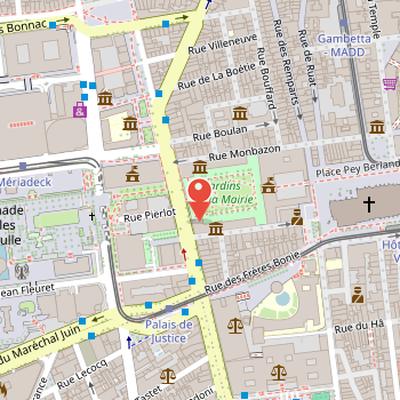
Nearby Objects
-
 Hôtel de Basquiat 40 m away
 -
 Hôtel de Ragueneau 70 m away
 -
 Palais Rohan 110 m away
 -
 Fort du Hâ 150 m away
 -
 Bordeaux Cathedral 250 m away
Museum Locations and Collection
The Musee des Beaux-Arts de Bordeaux was founded in 1801 in Bordeaux, Gironde, France. Its collection mainly consists of paintings, along with sculptures and graphic arts. The museum is presented in two separate locations: the Musee des Beaux-Arts on cours d'Albret and the Galerie des Beaux-Arts on place du Colonel-Raynal.
The Historique in Bordeaux
The Historique was created in Bordeaux in 1783 by abbé Dupont des Jumeaux, with the support of intendant Nicolas Dupre9 de Saint-Maur. It organized literary and scientific courses in the city and brought together a range of figures, including lawyers such as Gensonné, Vergniaud, Saige, and Dominique Garat, as well as scientists like the engineer Bremontier. Abbe9 Sicard also taught the language of the deaf-mutes there. Many of its members belonged to Bordeaux Masonic lodges. Although it resembled a scholarly society, it did not exhibit artworks. The Historique ceased to exist in 1796.
Early Formation of the Bordeaux Museum
The museum of Bordeaux was officially created by the Chaptal decree in 1801, which provided for the distribution of artworks from the Musuem central des arts de la Republique to 15 provincial cities. In Bordeaux, the museum also had a pedagogical role and was intended to reduce congestion at the Louvre. The municipality entrusted Pierre Lacour pere, a painter, drawing professor, and member of the Societe des sciences, belles-lettres et arts, with creating the museum; he is considered its first conservator.
The collection began with works already owned by Pierre Lacour, supplemented by the first two State shipments in 1803 and 1805. These artworks consisted of paintings and sculptures, which were first installed in a library room at the Academy of Sciences and Belles-lettres on rue de l'Eglise-Saint-Dominique. A gallery of paintings was then arranged and opened to the public in 1804, serving mainly as a reference for students of the School of Drawing. However, accommodation remained inadequate. By the second State shipment in 1805, no specific space had been prepared, and the available library rooms were crowded with books, antiques, molds, a natural history cabinet, a museum, and the painting gallery.
An arrangement conceived by City engineer Richard Bonfin in 1809 still did not allow the gallery of paintings to display all the artworks. Because the museum was insufficient in space from the start, a temporary exhibition space called the gallery of fine arts was built across cours d'Albret and completed at an unspecified date. A dedicated building for the municipal collections finally opened to the public in Bordeaux in 1881.
From Palais Rohan to City Museum
The early history of the Musée des Beaux-Arts de Bordeaux is closely linked to the Palais Rohan and to a succession of municipal curators. Pierre Lacour pere served as the first museum curator from 1811 to 1814, and Pierre Lacour fils succeeded him and remained curator from 1814 to 1859. Michel-Jules Bonfin arranged the future city museum in the former civil Tribunal seat at the north wing of the Royal Palace on Rue Montbazon, and the museum opened there on an unspecified date. The new museum received 279 paintings from the Marquis de Lacaze collection, and in 1832 the full collection was transferred to the large salons on the ground floor of the Royal Palace, except for the dining room painted with frescos by Jean-Antoine Berinzago. From 1836, the exhibition space had increased but remained under municipal administration, with public access limited to Sundays and holidays. During this period, the works were restored and those without frames were fitted with frames.
Several alternative museum sites were considered in the following decades, but none replaced the Palais Rohan. Under David Johnston's term from 1838 to 1842, officials considered locations on both sides of the town hall garden along Rue Rohan and Rue Montbazon. Duffour-Dubergier proposed Place des Quinconces for the museum during 1842 to 1848, and in 1842 Lacour Fils wrote to the mayor of Bordeaux to oppose that choice. In 1858 Charles Burguet proposed a museum behind the Palais Rohan with two wings along Rue Rohan and Rue Montbazon connected by a grille, with an optional upper floor, but no project advanced and the museum remained at Palais Rohan.
A later fire damaged the Palais Rohan, destroying many archives and damaging paintings including Luca Giordano's La Dispute des philosophes and La Dispute des theologians, both of which were later restored. Charles Burguet carried out the restoration work, which required moving the collection to a wooden structure in the garden. That temporary building was vulnerable to fires and floods and lasted eight years. The Franco-Prussian War and the precarious condition of the collection led the administration to return the works to the city hall salons in 1870, after which a second fire during military occupation damaged the old collection funds.
Fire Damage to the Collection
A fire caused extensive damage to the museum collection, with numerous artworks damaged and some permanently ruined, including four large hunting paintings. Seventeen paintings were destroyed in the fire. The losses included L'Assomption de la Vierge by Jacob Bunel, Saint-Francois by Ludovico Carracci, La Chasse au lion from Rubens' workshop, Chasse au renard and Chasse au sanglier by Frans Snyders, Saint Bernard receiving the abbey rule from the Virgin by Guerchin, L'Adoration des bergers by Gaspard de Crayer, Hercule et Omphale by Luca Giordano, Abraham et ses Serviteurs and Apollon et Marsyas by Ferdinand Bol, and Marine by Jan Baptist Weenix. Also destroyed were Vierge a l'Enfant avec des anges and Saint Francois a genoux by Abraham Matthys, a small portrait of a man from Anton Van Dyck's school, La Vestale: Portrait de Mademoiselle Perdrigeon by Jean Raoux, Visite de la reine Marie-Amelie a l'hotel-Dieu by Alexandre-Francois Caminade, Moise expose sur les bords du Nil by Aimee Brune, and Convoi francais cerne par les Cosaques by abbe Adolphe Hemet.
Construction and Later Alterations
The construction site began with the laying of the first stone by Cardinal Ferdinand Donnet. Work was directed first by Charles Burguet and, after his death, by Marius Faget. Faget also designed the grille, which was executed by the Matthieu Blairon company from Charleville. Architect Auguste Dejean prepared the plans for the southern wing, including the eastern salon intended for the Louis XVI statue. The colossal statue of Louis XVI was created by Nicolas Raggi in 1829, but it was melted down in 1942 during the Vichy regime metal mobilization. Another work, La Chasse aux lions by Delacroix, was destroyed at a height of 3 meters in the upper part.
Architecture and Later Transformations
The Musée des Beaux-Arts de Bordeaux was designed with a strong emphasis on architectural continuity and civic representation. Historique revised the drawings repeatedly and integrated classical tradition by subordinating ornament to the architecture of the wings. The facades were intended to echo both the old archbishop's residence and the neighboring mansions, with Ionic pilasters used to create stylistic continuity. Decorative panels of garlands, niches on the western facades, and a balustrade partly concealing the roofs added to the composition. On the western facade, the museum vocation was made explicit through two statues, La Peinture and La Sculpture, by Pierre Granet, while busts of Doucet, Duffour-Dubergier, Fieffe, and Lacour fils by Edmond Prevot were also displayed. The building was described as symbolizing the third major art: architecture, although the consoles and medallions did not include the 29 busts and 14 statues of Bordeaux personalities mandated by the city council.
The interior continued this classical approach. Vestibules were fitted with large glass doors with fine ironwork and serpentine bronze handles by Faget. Paired columns reinforced the sense of classical monumentality, presenting the museum as a palace of Muses and Arts, while entablatures at the vault spring and Ionic pilasters framed large free bays. A major staircase also forms an important part of the building, with a 19th century railing that originally came from Place de la Bourse and was donated by Bordeaux's Chamber of Commerce and Industry.
The museum underwent relatively few notable changes between 1881 and 1928. An expansion project by Alfred Duprat failed in 1897. In the 20th century, a separate gallery of Fine Arts was built across Cours d'Albret, enclosed by the Anatole-France school. This gallery was promoted by Adrien Marquet after restorations to the porticoes of the public garden, and the mayor chose the space vacated by the school. Jacques Boistel d'Welles was asked to define the architectural program and established a three-level structure in 1935 with an electrically lit basement, a ground floor with facade windows, and an attic with a shed roof. Daniel Gervais was selected to direct construction, which began in 1936 and was completed despite delays. The gallery was occupied by supply services during the Second World War, resumed its original function in 1947, hosted the painting exhibition for Mai musical starting in 1951, and later events of artistic associations.
The Galerie des Beaux-Arts was restored in 2001 for safety and accessibility compliance and continues to host temporary exhibitions of the Musee des Beaux-Arts and the Musee des Arts decoratifs. The main museum also has permanent collections in two wings designed by Burguet. The southern wing contains 17th century paintings, while the northern wing contains 18th and 19th century paintings and sculptures. The wings are located on either side of the Hotel de Ville gardens. Further works from 2011 to 2013 required a long closure for accessibility improvements, and the northern wing was renovated while geothermal heating was installed for the Hotel de Ville and the museum.
Permanent Collections in the Museum Wings
In 2014, the permanent collection included European paintings, 1,564 prints, and 3,328 drawings displayed across the wings of the Bordeaux Museum of Fine Arts. The south wing presents works ranging from Vierge de piete surrounded by saints (1469) by Hans Clot to Saint Louis visiting the plague victims (Salon de 1822) by Guillon-Lethiere. The opposite wing displays La Grece sur les ruines de Missolonghi (1826) by Eugene Delacroix, together with works associated with Romanticism, Realism, and Academicism. Reserved rooms contain marine paintings by Gudin and Isabey, landscape paintings by Corot, Diaz de la Pena, and Boudin, animal paintings by Bonheur and Princeteau, and portrait paintings by Couture, Carolus-Duran, Fantin-Latour, and Morisot. The presentation continues with paintings by Odilon Redon and Marquet, the Fauves, Lhote, Cubism, figuration and abstraction movements, and artists including Bissiere, Dorignac, Matisse, and Picasso.
Paintings and International Schools
The museum's painting collections were built up through state shipments, acquisitions, deposits, donations, and legacies, and they now present a broad view of European art from the Renaissance to the 19th century. The Italian collection began with the first two shipments from the State to provincial museums in 1803 and 1805. It later grew through important works such as the great altarpiece by Perugino and notable paintings from the Venetian School by Titian, Veronese, and Bassano, as well as works by Palma il Vecchio, the Vasari workshop, and Lavinia Fontana. These holdings illustrate the passage from classical Renaissance forms to international Mannerism and the more colorful expression of the Venetian tradition. The Italian works also include examples of Northern European painters such as Hans Clot, Hans Maler, Hans von Aachen, Brueghel de Velours, and Otto Venius, showing both the persistence of Gothic forms and the spread of Florentine and Roman Mannerism until the early 17th century.
A notable anonymous Saint John the Baptist in the Desert, formerly attributed to Caravaggio, forms the basis of a significant Caravaggesque collection. This section also documents the spread of Caravaggesque chiaroscuro and naturalism from southern Italy to other regions, including France, Holland, Flanders, and Spain. The Flemish school is represented by the state shipments of 1803 and 1805 and by works by Rubens, Van Dyck, Boeckhorts, van Boucle, Coosemans, and Diepenbeeck. These paintings reflect the art of the Counter-Reformation and the influence of the Antwerp school in the first half of the 17th century.
The Dutch collection, strengthened by 79 paintings from the Marquis de Lacaze, is one of the most important in France. It includes landscapes, marine scenes, and still lifes by artists such as Benjamin Gerritsz Cuyp, Van Goyen, Franz Hals, Jan Davidszoon de Heem, Nicolas Maes, Jan Porcellis, Salomon Van Ruysdael, and Hendrick ter Brugghen, with particular emphasis on Herman Van Swanevelt, Kool, and Melchior d'Hondecoeter. French painting is represented from the museum's foundation in 1801 through works by Allegrain, Boulogne, Coypel, and Restout, later enriched by acquisitions from Lefebvre and Courrège and legacies by Natoire and Chardin. These holdings make it possible to study French painting trends in the 17th and 18th centuries across the main academic genres. The English collection, formed in the 19th century, includes mythological subjects by Zoffany, portraits by Reynolds, Lawrence, West, and Stuart, a portrait of the princess of Orange-Nassau by Tischbein, and portraits of the Mareilhac couple by Lonsing. It also reveals artistic links between the United States and its former metropolis through the English collection.