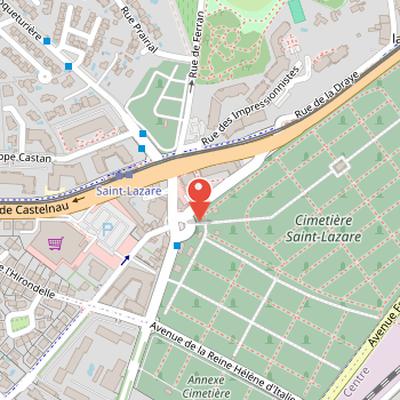
Saint-Lazare Cemetery, located at 2 rond-point du Souvenir Français in Montpellier, Hérault, is the city’s largest cemetery. It was established by royal ordinance in 1846 on the former grounds of Saint-Lazare hospital, a site that had served as a lazaret since the early Middle Ages and as a burial place for deceased patients. The cemetery was inaugurated in the presence of Mayor Louis Parmentier, the municipal council, police commissioners, and communal employees, after a ceremony that began at Saint-Pierre Cathedral and continued to the new communal cemetery. Occupying six hectares and thirty-three ares, it contains more than 6,000 graves for ordinary burials and serves a population of approximately 60,000. The cemetery was extended in 1864 and 1918. It includes three military sections and a Jewish section, with Belgian war graves, Muslim faith graves, and 318 soldiers classified as Morts pour la France. Among its notable tombs are several crosses of penitents, vaults of bourgeois families such as Sabatier d'Espeyran, Montcalm, and Lunaret, and the graves of figures including Charles Flahaut, Alfred Bruyas, Joseph Grasset, and Auguste-Louis Loubatières. Significant statuary by Paul Dardé, Jean-Louis Guigues, and Auguste Baussan is also present.
Nearby Objects
-
 MO.CO. 1100 m away
 -
 Convent of the Ursulines of Montpellier 1600 m away
 -
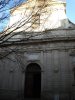 Notre-Dame des Tables 1800 m away
 -
 Musée Fabre 1800 m away
 -
 Esplanade Charles de Gaulle 1800 m away
Saint-Lazare Cemetery in Montpellier
Saint-Lazare Cemetery is located at 2 rond-point du Souvenir Francais in Montpellier, Hérault. It is the largest cemetery in Montpellier, giving it a notable place within the citys urban landscape and memorial spaces.
History and Layout of Saint-Lazare Cemetery
Saint-Lazare cemetery in Montpellier was established by royal ordinance in 1846 on the former grounds of Saint-Lazare hospital. The site had already been associated with burial since the early Middle Ages, when it served as a lazaret, and the land was used as a burial place for deceased patients at Saint-Lazare. The inauguration was attended by mayor Louis Parmentier, the municipal council, police commissioners, and communal employees. The ceremony began at Saint-Pierre Cathedral and then proceeded to the new communal cemetery.
The cemetery covers six hectares and thirty-three ares and contains more than 6000 graves for ordinary burials, serving a population of approximately 60,000. It was extended in 1864 and again in 1918. Its layout includes three military sections and a Jewish section, and the military sections contain Belgian war graves and Muslim faith graves. The cemetery also holds 318 soldiers classified as Morts pour la France.
Saint-Lazare currently accommodates perpetual concessions and concessions that expire, with land resale managed by the cemetery administration. Since 1979, it has been complemented by the intercommunal cemetery at Domaine de Grammont, Saint-Etienne.
Location and Access
The localisation of the Saint-Lazare cemetery area indicates that the Saint-Lazare station on tramway line 2 is nearby. This detail places the site within the local transit network and suggests direct accessibility by tram. No further architectural or historical information is provided in the available facts, so the main relevant point is its proximity to this public transport stop.
Notable Tombs and Funerary Sculpture
The cemetery contains several crosses of penitents from different eras, as well as notable funerary monuments linked to Montpellier's social and cultural history. Its tombs include the vaults of bourgeois families such as Sabatier d'Espeyran, Montcalm, and Lunaret, alongside the graves of personalities including Charles Flahaut and Alfred Bruyas. The cemetery also features significant statuary by Paul Darde, Jean-Louis Guigues, and Auguste Baussan. Because of Montpellier's medical prominence, it includes the graves of several doctors, among them Joseph Grasset (1849-1918) and Auguste-Louis Loubaties (1912-1977).
Gallery Views of the Cemetery
The gallery presents a set of views that document access, layout, and notable monuments within the cemetery Saint-Lazare in Montpellier. It includes a schedule of access hours and a plan showing how to reach the different alleys, indicating an organized and accessible site. Several images focus on the main alley, where chapels line the route, and on specific funerary monuments such as the Sylvestre family mausoleum in section AH and the notable chapel of the Polge family. The gallery also shows the design of a funeral chapel created in July 1870, the tomb of Queen Helene of Italy, and the military square in 1916 with soldiers present. Another image depicts pilgrims gathered in front of the priests' tomb in section A, suggesting that the cemetery has also served as a place of public attention and gathering.