The Church of the Cordeliers in Toulouse is the former church of the convent of Cordeliers. The Franciscan brothers settled in Toulouse in 1222, and the convent was built between the rues des Lois, du Collège de Foix, Albert-Lautmann, and Deville. The church was dedicated to the Virgin, with secondary patrons Saint François d’Assise and Saint Louis d’Anjou. It is described as rivaling the Jacobins of the Dominican friars of Saint-Dominique and, at 86 meters long and 26 meters wide, as the largest church after Saint-Sernin in Toulouse, with the highest vault at 25 meters. The facade on rue des Cordeliers is a brick wall 26 meters wide and 30 meters high, pierced by a rose window and marked by a stone portal and triangular pediments. The interior was decorated with painted imitation stonework and wall scenes in the chapels. After a fire in 1798, the church was occupied by the military administration until 1871, when it suffered another fire. Its ruins have been classified as a historic monument since 1862.
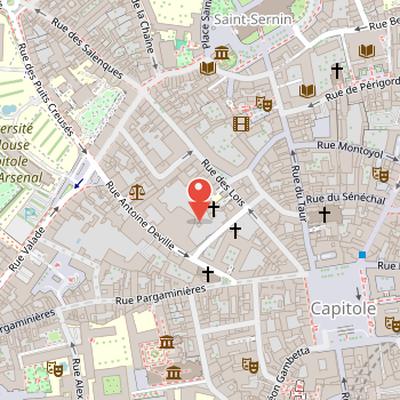
Nearby Objects
-
 Notre-Dame du Taur 200 m away
 -
 Monastery of the Jacobins 200 m away
 -
 Cinémathèque de Toulouse 200 m away
 -
 École Supérieure d'Audiovisuel 250 m away
 -
 Place du Capitole 250 m away
History and Status of the Cordeliers Church
The church of the Cordeliers in Toulouse was the former church of the convent of the Cordeliers. It closed after a fire in 1798 and was then occupied by the military administration until 1871. The building suffered another fire in 1871. Its ruins have been classified as a historic monument since 1862.
Architecture and historical setting
The Franciscan brothers settled in Toulouse in 1222, and the convent was built between the rues des Lois, du College de Foix, Albert-Lautmann, and Deville. The church was dedicated to the Virgin, with secondary patrons Saint Francois d'Assise and Saint Louis d'Anjou. In historical accounts, it is presented as a major religious building that rivals the Jacobins of the Dominican friars of Saint-Dominique. It is also described as the largest church after basilica Saint-Sernin and as having the highest vault in Toulouse, at 25 meters.
The church measures 86 meters in length and 26 meters in width, while the height from the ground to the gable is 30 meters. Its facade on rue des Cordeliers is a brick wall 26 meters wide and 30 meters high, pierced by a rose window. The stone portal projects about one meter and is topped by a large triangular pediment, flanked by two smaller narrow pediments. Above the main door, an inscription gives the Latin phrase about the duration until ants drink the sea and the turtle circles the earth.
Inside, the nave decoration is painted to imitate cut stone, using reddish-brown lines on a light yellow background. Painted scenes also occupy the walls of the chapels, adding to the church's interior decoration.
The Burial Crypt and its Legends
Histoire describes a burial crypt located under or near the chapel of Rieux. According to the account, bodies placed there mummified quickly and remained well preserved, which led to strong interest among the people of Toulouse. It is said that all Toulousains wanted to deposit their dead in the crypt, turning it into a kind of gallery of ancestors. The bodies were reportedly arranged standing against the walls, while fragments were piled in a corner. Among the remains mentioned is the body of Belle Paule, a figure linked to beauty and to a Toulouse legend.
The same source adds that, in later accounts, women were not allowed to visit the crypt. A story recounts that curious women had Belle Paule's body brought out, after which it crumbled into dust. Histoire also cites a memoir read in 1784 to the Academie des Sciences by M. de Puymaurin, which describes the crypt as an oval room measuring 18 by 12 feet, with a vault supported by a central pillar. Access was said to be by a corridor following stairs descending from the cloister.
The crypt was also the setting for a nocturnal legend involving a young cordelier challenged to nail a coffin lid inside it. When he attempted to leave, he reportedly felt held by an invisible hand, and his body was found dead at dawn, with his own sleeve nailed in place.
From Convent to Ruin
In 1562, during the Wars of Religion, Protestant forces set fire to the convent buildings. The complex was later rebuilt after these fires, but its history remained marked by repeated damage and reuse. At one point, the wide nave vault, decorated with frescoes, partially collapsed, damaging statues and organs; among the damaged works were statues by Bachelier and others. The organ destroyed in the collapse was reconstructed identically.
The convent was sold as national property in 1794. In 1818, it passed to the military administration, which used it as a forage store for horses. The large nave of the church was also used to store forage, with capacity for more than 9000 quintals of forage and as much oats. In 1834, a Chappe telegraph station was established on the Toulouse-Bayonne line.
A fire broke out on the night of March 23, 1871 in the pile of straw and forage stored inside the nave. The blaze spread quickly and completely devastated the nave. The remains of the building ruins were destroyed in 1873. The spire of the bell tower had already been demolished, while the bell tower itself, spared by the fire, was sold to a lead shot founder.
Surviving Elements and Museum Holdings
Only a limited part of the church survives today: the bell tower and the beginnings of the voussoirs of the south church portal. The south portal itself was reconstructed and can be seen on rue du College de Foix. The chapter house and sacristy were also preserved from destruction, while sculptural elements such as capitals and keystones were recovered. Alexandre Du Mege collected and grouped these recovered sculptures in the Musee des Augustins, where fifteen gargoyles are conserved in the cloister. The Paul-Dupuy Museum preserves an altar facing from the Cordeliers church, described as a rare surviving textile masterpiece. Before the demolition, documents provided an idea of the church's appearance, including drawings by Ferdinand Mazzoli about the disappeared Old Toulouse and photographic plates in the Musee du Vieux Toulouse that depict the church.