Place du Capitole is a public square in the heart of downtown Toulouse, in the Capitole district of southern France. Its first projects as a place royale appeared at the end of the 17th century, and its progressive clearing began at the start of the 18th century. The square is bordered on the east by the monumental façade of the Capitole, whose town consuls, the capitouls, enhanced their Maison commune with a monumental front built by Toulouse’s best artists of the time.
The square became the city’s center during the French Revolution, serving as a marketplace, celebration place, and guillotine site. It took its current form in the first half of the 19th century, when its south, north, and west sides were built in neoclassical style between 1809 and 1852 by architect Jacques-Pascal Virebent. Later changes included pedestrian-oriented renovation after the metro arrived in 1993, paving in pink granite, and the addition of a large Toulouse cross by Raymond Moretti in 1995. The arcades were decorated with Moretti’s paintings two years later.
Nearby Objects
-
 Théâtre du Capitole 90 m away
 -
 Notre-Dame du Taur 150 m away
 -
 Hôtel de Bernuy 250 m away
 -
 Church of the Cordeliers 250 m away
 -
 Monastery of the Jacobins 250 m away
From Royal Square to Urban Heart
Place du Capitole is a plaza in Toulouse, the capital of the Occitanie region in southern France. Its first projects as a place royale appeared at the end of the 17th century, and progressive clearing began at the start of the 18th century. During this period, the town consuls, the capitouls, enhanced their Maison commune, called the Capitole, with a monumental facade built by Toulouse's best artists of the time.
The square later became the city's central space and was used as a marketplace, a place of celebration, and, during the French Revolution, a guillotine site. Its current form dates from the first half of the 19th century, when the south, north, and west sides were built in neoclassical style between 1809 and 1852 by architect Jacques-Pascal Virebent.
In the following period, Place du Capitole was lined with large cafes, restaurants, and hotels such as Bibent and Florida, which had terraces. The square saw car development in the second half of the 20th century, and Roman gate remains were destroyed during underground parking construction. After the arrival of the metro in 1993, it was renovated for pedestrians.
In 1995, the square was paved with pink granite and adorned with a large Toulouse cross by artist Raymond Moretti. Two years later, Moretti also decorated the arcades with paintings. The ground and facades have been protected as a registered site since 1943, and the square was included in the city heritage site in 1986. Despite the replacement of prestigious shops with international franchises in the early 21st century, it has retained its status as the city's heart, frequented by locals and tourists. It remains animated by market days, election days, concert evenings, and Stade toulousain victory nights.
Location and Use of Place du Capitole
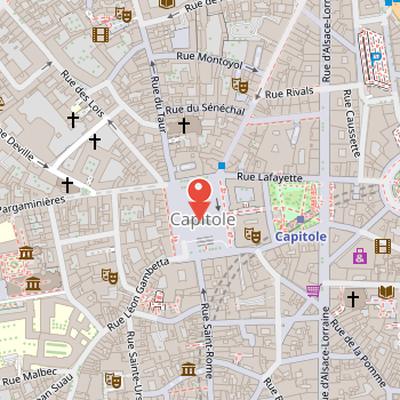
Place du Capitole is a public square in the heart of downtown Toulouse, in the Capitole district. It forms a regular rectangle measuring 126 meters from north to south and 92 meters from east to west, covering about 11,592 square meters. The square is bordered on the east by the monumental facade of the Capitole, which houses the city hall and the Theatre du Capitole.
Since renovation works in 1993, vehicle traffic has been progressively restricted, and the square is now largely pedestrianized. Vehicle access is limited to rue du Poids-de-l'Huile for access to the underground Capitole parking, while residents may also enter through rue Jean-Antoine-Romiguieres and rue Charles-de-Rémusat. The center of the square is reserved for pedestrians, events, and daily markets.
Place du Capitole also occupies a notable position in the citys circulation network. It is crossed by several streets, including rue de la Pomme, rue Saint-Rome, rue Leon-Gambetta, rue Jean-Antoine-Romiguieres, rue des Lois, rue du Taur, rue Charles-de-Rémusat, and rue Lafayette. Since 1993 and the construction of the metro, it is no longer directly served by the Tisseo public transport network, but it remains accessible via the Capitole metro station on line A. The downtown shuttle crosses the north and west sides of the square, stopping nearby on rue Leon-Gambetta, rue Charles-de-Rémusat, and rue du Taur. The square does not host VeloToulouse stations, but nearby stations are available on rue du Poids-de-l'Huile, rue Lafayette, rue de la Pomme, and rue des Lois.
The square is also connected to long-distance hiking routes: it is the endpoint of the GR 46 from Tours to Toulouse, and the starting point of the GR 86 to Bagnieres-de-Luchon and the GR 861 to Saint-Bertrand-de-Comminges. The southern extensions of these trails continue along rue Leon-Gambetta.
Naming History of Place du Capitole
Place du Capitole is named for its proximity to the Maison commune of the capitouls, known as the Capitole, which now houses the city hall. The square has changed names several times since its development in the 18th century. It was originally called Place Royale in honor of King Louis XIV. During the French Revolution, the revolutionary municipality renamed it Place de la Liberte in 1791. Later names followed in quick succession: Place d'Armes in 1800, Place Commune in 1804, and Place de la Mairie in 1805. In 1812 it became Place Imperiale, honoring Emperor Napoleon I, and in 1815 it returned to the name Place Royale after the fall of the Empire and the restoration of the monarchy. The square received its current name in 1844 by decision of the municipality of Francois Sans.
From Roman Remains to the Maison Commune
The area now occupied by Place du Capitole did not exist as a square in the Middle Ages. Before that, an old Gallo-Roman rampart crossed the area from east to west until the 13th century, enclosing the city to the north and leaving the Porterie gate as the only opening. The district of La Porterie was therefore a key junction, linking the Grand-rue with neighboring streets. The Grand-rue ran from the city side through the Porterie toward the Narbonne gate, while the rue des Argentiers connected west of it to the southwest of the present square, and the rue des Freniers led to the southeast. The rue Villeneuve continued the line of the rue des Freniers to the gate called Villeneuve, and the rue de l'Orme-Sec led west toward the rue Jean-Antoine-Romiguieres and the routes to port Bidou and Bazacle.
The political history of the site is closely tied to the rise of communal institutions. In 1152, Raimond V created a chapter with judges, lawyers, and capitulary representatives for city affairs, but it had no fixed meeting place and gathered in Saint-Pierre-des-Cuisines and the Saint-Quentin chapel. In 1189, the city consuls obtained judicial, police, regulatory, and tax powers from Raimond V. The following year, they purchased a building to establish the Maison commune. Built against the Saracen wall that marked the limits between city and borough, the Maison commune symbolized the union of the two parts of the city. Between 1194 and 1202, the consuls acquired additional houses, land, and a rampart tower.
The quarter attracted merchants and travelers in the 12th century, and the lodging of the Balances is mentioned in Rue des Argentiers, where Place du Capitole later came to exist. In the heart of the Toulouse city center, near the Dominican and Franciscan convents, the district also became associated with education. From the 13th century, the university was established at the Franciscan convent, and over the following centuries several scholarship student colleges were founded by eminent figures of the Avignon papal court. Among them were the Saint-Martial College, founded in 1359 by Pope Innocent VI at the location of current numbers 2 and 3, the Saint-Mathurin College of the 14th century at the corner of Rue des Aguilheres where current number 6 stands, the late 15th century College of Pampelune at current Rue Leon-Gambetta numbers 8 and 10, and the College of Pauvrets at current numbers 19 and 21 Rue du Poids-de-l'Huile.
Later evidence uncovered the site's earlier remains. Sewer pipeline work in 1910 revealed Roman enclosure remains and the foundations of Porterie, and underground parking construction in 1971 uncovered a Roman rampart and Roman gate remains. The quarter also suffered partial destruction in the major city fire of 1463. Saint-Quentin Church may have been ruined in that fire and was vaulted only in 1519; it later became the seat of the booksellers' brotherhood near Rue Servinieres.
From Municipal Fortress to Public Square
Between 1525 and 1530, Capitoul officials launched major works to enlarge their Capitole. The building campaign continued in successive phases under several master masons. Pierre de Naves and then Laurent Clary built the Tower of Archives, called the Donjon du Capitole, on Rue Ernest-Roschach. In 1532, the construction of a spiral tower was completed and the Poids de l'huile was established. Further works followed in 1538 with the Powder Tower and Carces prison, then in 1539 with the Logis de l'Agasse or de l'Ecu by Jean Alary, while Pierre de Naves erected the Artillery chamber. In 1542, the Capitoul officials decided to fortify the Capitole with a new facade featuring defensive corner turrets designed by Jean Alary. The works were completed in 1545 with the chapel built by Pierre de Naves.
The place around the Capitole became a key site during the serious troubles of 1562, at the start of the first war of Religion. The Maison commune district saw violent confrontations, and after several days of agitation the parliament decided to station 400 men-at-arms at the Capitole. Protestant leaders met at the viguier Portal's house and chose to act preemptively. A force of a thousand Protestants led by capitoul Pierre Ducedre and captain Saux entered the Capitole at night via houses on rue Saint-Martial. They occupied the Pamplune and Saint-Martial colleges, secured the Villeneuve gate, and advanced to the Perigord college via rue du Taur. Barricades were erected in the streets leading to the Capitole, and street fighting took place between the 12th and 14th around place Rouaix, place des Puits-Clos, and place Saint-Georges. On the 14th, several churches were pillaged, including Saint-Quentin church. Two cannons placed at the Capitole fired at the bell towers of the Augustins, Franciscans, Dominicans, and Saint-Sernin convents. Fighting continued in rue Saint-Martial before the Protestants lost progress and regional support. On Pentecost day, they celebrated the Cene at the Capitole, evacuated their positions, and left the city through the Villeneuve gate. They were massacred during their retreat, and vengeance was exacted on Protestants remaining in the city. Printer Guyon Boudeville was hanged on place du Salin, and capitoul Adhemar Mandinelli was beheaded, with his head placed on the Capitole gate.
The Capitole was then further isolated and fortified by the creation of rue Neuve-de-l'Hotel-de-Ville along the buildings west of it. Between 1601 and 1607, a new embellishment campaign created the cour Henri IV and galleries designed by architect Pierre Souffron. In 1676, the capitouls decided to create a royal square, and the plan included a statue of Louis XIV in order to bypass opposition from the Toulouse parliament. Sculptor Marc Arcis presented several models of equestrian statues of the king in 1685, but no decision was taken and the project was postponed. Pierre Rivalz reviewed the project after the new facade of the Capitole in 1739, yet parliamentary opposition continued to delay the works. In 1744, a large fireworks display celebrated the recovery of Louis XV, and the works resumed in 1747. Workers excavated the square in front of the Capitole in 1751, and a popular festival on the square followed Louis XVI's accession and celebrated the return of parliament. Excavation continued during the French Revolution. In 1791, Saint-Quintin church was closed and destroyed. The square was renamed Place de la Liberte in April after the removal of the guillotine. During the royalist insurrection threat in the Midi in 1799, the square again became a place of mobilization: insurgent uprisings broke out in several nearby towns, cannons were placed on the square on May 8 and 9 amid fighting south of the city, royalists captured Blagnac, and volunteers gathered on the square facing the Capitole, reaching 400 by May 10. The royalists were then repelled near Toulouse and defeated at the Battle of Montrejeau on May 19 and 20, 1799.
Completion and Urban Role of Place du Capitole
Place du Capitole was only completed in the mid-19th century, after Jacques-Pascal Virebent began work to standardize the buildings around the square. He constructed the southern part facing rue Saint-Rome in 1809, and by 1812 this sector was accessible and known as the Saint Martial sector. Work on the northern side, facing rue du Taur, began in 1823 and was completed after Virebent's death in 1835. In 1827, marble fountains topped with cast iron candelabras, designed by Jean-Antoine Raynaud and made by Olin's foundry, were installed at the four corners of the square. By this period, the southern side already contained restaurants and hotels, including hotel and cafe Bibent, opened in 1843, and hotel du Midi, opened in 1845, while hotel Souville opened on the northern side.
The west part of the square was built between 1850 and 1852 by architect Jean Bonnal after a change in Virebent's alignment plan. Its facade was lengthened to align with the Capitole and fitted with arcades inspired by Rue de Rivoli in Paris. This enlargement required the relocation of the candelabra fountains to Place des Carmes in 1851. New three-branched lampposts were installed in 1855 and were powered by gas supplied by two gasometers at the Cibiel factory on Boulevard de la Marquette. A jet fountain was also installed in 1855, but it was dismantled in May because of leaks, and its basin was later reassembled in 1883 at the Jardin des Plantes.
From the mid-19th century, Place du Capitole became the city's true center. It was also a major transport and commercial point. The cab service known as fiacres or citadines was reorganized in 1838 with four-seat carriages, and daily stagecoaches of the Lafitte-Caillard messenger service ran to Tarn from the square. Stagecoach activity continued there until 1900 despite competition from rail after Gare Matabiau opened in 1856. The square also saw transport changes with the arrival of horse-drawn trams in 1885, tram rails laid in the streets from 1907, and gradual electrification of the network starting in 1910.
Public events and market activity were also central to the square's use. Large celebrations were held there, including the canonization of Germaine de Pibrac from April 28 to 30, and a balloon was launched from the square in 1895 for a festival benefiting expeditionary corps sent to Madagascar. The Capitole theater hall was rebuilt by Delafoy in 1880. The market was held every day except Sunday, with street vendors called baladeuses forbidden in the market area, while other street vendors gathered in the streets leading to the square. Merchandise was trafficked at the center of the market square, transported by porters and donkey-drawn carts, with donkeys kept in nearby streets, Rue de Mirepoix, and the Hotel Dumay courtyard. Around the turn of the century, the square was lined with many hotels, cafes, and restaurants.
Commercial and Social Life at Place du Capitole
The history of place du Capitole includes a long sequence of cafes, hotels, restaurants, and other businesses that reflect its role as a busy urban location. Histoire lists the Hotel and Cafe Bibent, opened in 1843 and known by its current name, as well as the Cafe des Princes, opened in 1865, the Cafe Divan, the Cafe Durand, opened in 1874, and the Cafe des Deux Mondes, opened around 1895. It also records the Grand Cafe Albert, the Cafe des Arcades, opened around 1900, the Grand Hotel de l'Opera, opened in 1905, the Grand Cafe du Theatre, the Cafe de la Paix, and the restaurant Villa, all with their current names. Among these establishments, the Cafe de l'Hotel de Ville is noted as a meeting place for radicals.
The site was also home to other long-established commercial and cultural addresses. Histoire states that reputed Toulouse businesses such as the Biec coffee roastery, founded around 1900 by Auguste Biedermann, were established there. One of the oldest pharmacies in the city, founded in 1872, is also located there and is still operating. In the 1920s, there was a Capitole cinema at this location, adding another layer to its history as a place of public gathering and everyday city life.
War Commemoration at Place du Capitole
During the First World War, city life at Place du Capitole followed the course of the conflict. In 1919, after the return of the 11th army corps to Toulouse, the municipal government led by Jean Rieux organized a ceremony of homage to First World War soldiers from November 8 to 10. For this occasion, a temporary cenotaph in the form of an obelisk topped with a fire pot was installed at the center of the square. The cenotaph was designed by architects Paul Pujol and Jules Milloz, with a central sculpture by Camille Raynaud representing France weeping for her fallen children. Fernand Olie and Foures created the bas-reliefs showing battle scenes, and the decorations were designed by the painters Andre-Pierre Lupiac, Boudet, and Anglay.
The three days of tribute brought together political, military, and religious figures, including the mayor, the municipal council, deputy Jean Cruppi, prefect Marie Joseph Giraud, General Germain Passaga, General Vincent, Archbishop Jean-Augustin Germain, a pastor, and a rabbi. Many residents of Toulouse also attended. The ceremonies included speeches, military parades, a funeral vigil, and a torchlight procession.
Traffic and Bus Connections Around Place du Capitole
In 1926, the municipality regulated traffic around Place du Capitole in order to reduce traffic problems. This measure included the creation of the citys first one-way streets and applied to all vehicles, including cycles and handcars. The same year, the first city bus line opened, linking Place du Capitole with the top of the Guilhemery district. The route ran via rue de Constantine and avenue de la Gloire to Salonique cemetery. By 1929, new bus lines were gradually connecting Place du Capitole to suburban districts that had no tramways, and the Cite ouvriere and Sept-Deniers suburbs each had their own bus lines.
Place du Capitole During World War II
During World War II, Place du Capitole was the setting for several events that reflected both the tensions and the celebrations of the period. Histoire records that the Resistance organized a demonstration there on a specific date, and that General Charles de Gaulle visited the square on June 16 and 17. His speech at Place du Capitole reportedly aroused enthusiasm among Toulousains, although Histoire also notes that he had poor relations with the Toulouse Resistance authorities because of concerns about communist influence.
The square was also linked to underground resistance activity. According to Histoire, the Capitole pharmacy, owned by Elie Dorbes, served as a Resistance intelligence center. Dorbes and his wife were arrested by the Milice. These events place the square within the broader network of wartime repression and resistance in Toulouse.
Histoire further states that Spanish guerrillas contributed largely to the liberation of Toulouse. These guerrillas founded the Union Nationale Espagnole to liberate Spain from Francoist repression, and they established their headquarters at the Hotel des Arcades, where they prepared and organized the invasion of the Val d'Aran. The failure of that operation marked the end of the organization in an unspecified year.
After the city was liberated, Place du Capitole became a site of public celebration. Histoire records that the Liberation of Toulouse was celebrated there on August 21, 1944, giving the square a central place in the memory of the city's wartime history.
Restoration and Public Life
Between 1950 and 1951, restoration work was carried out by Raymond Badiou's municipality with the aim of returning the Capitole's facades and the nearby buildings to their original brick color. The square is regularly used for public events and open-air markets, making it one of the most active civic spaces in the city. Its main market, held from Monday to Saturday, includes ready-to-wear clothing, costume jewelry, African carpets and objects, booksellers, and record stores. An organic market was created in 1980 and takes place on Tuesdays and Saturdays, while other recurring fairs include a Christmas market that has been held since 1999. The square also hosts periodic commercial events such as a temporary skating rink in February, introduced in 2015.
Place du Capitole is also a major site for collective celebrations and political gatherings. Fan zones for football World Cups have been held there since 1998, and fan zones for rugby World Cups since 1995. Winegrowers organized grape harvest events there in 1993 and 1999 to promote South-West wines. The square hosted the J'aime Toulouse en rose operation to aid victims of the AZF explosion, and commemorations for the victims of the Charlie Hebdo attack and the Barcelona attack were also held there. At the same time, the square serves as the political heart of the city, with gatherings after elections and numerous demonstrations taking place there. After weeks of Yellow Vest protests that caused damage, the square was closed for several weeks. Since the 2000s, gentrification of the city center has affected the square, leading to the disappearance of several emblematic businesses and their replacement by international brand shops.
Shops and Cafes Around Place du Capitole
The history of place du Capitole includes several long-established shops and cafes whose former locations were later taken over by new commercial tenants. Mon Caf' was one of the oldest cafes in the city before 2007. It had opened before 1895 under the name Cafe des Deux Mondes, and in 2007 it was replaced by a Sephora perfumery shop. The current occupant of this location is Sephora.
Another notable business was the librairie des Arcades, which opened in 1970 and specialized in comic book sales. It closed in 2011, and its location was replaced by an Amorino ice cream franchise the same year. Amorino is currently the occupant of that site.
Castela was also one of the most important bookstores in the city. It opened in 1917 and closed a few months after 2011 because of rent increases. Its former location was then replaced by Nespresso coffee and Desigual fashion shops, which are the current occupants. Together, these changes show a pattern of commercial turnover around the square, with older independent businesses giving way to newer retail brands.
Historical Development and Facade of the Capitole
The Capitole was established in 1190 as the Maison commune by the city consuls, and it was enlarged through successive purchases from the end of the 12th century to the beginning of the 13th century. Its development continued in several major phases. Between 1525 and 1530, the Archives tower was built on the present rue Ernest-Roschach by the masons Pierre de Naves and Laurent Clary. From 1601 to 1607, the Henri IV courtyard and galleries were created from plans by the architect Pierre Souffron. A monumental facade was planned for the Capitole square at the same time as the layout of the square itself, and the work was directed by Guillaume Cammas between 1750 and 1760, with participation from major Toulouse artists including Bernard Ortet and the sculptor Marc Arcis.
After the French Revolution, the Capitole remained the seat of the municipal authorities. Later changes included the renovation of the south wing into the Capitole theatre in 1818 by the city architect Jacques-Pascal Virebent, followed by a rebuilding of the theatre in 1880 by Dieulafoy. Paul Pujol and Pierre Esquie were then assigned to the Illustrious Hall.
The main facade is neo-classical and marked by polychromy in brick and stone. On the ground floor, continuous rustication in brick and stone emphasizes the horizontal lines. The bays are arranged with tall round arches pierced by windows and decorated with keystone mascarons. The upper floors are divided by colossal stone pilasters, while the windows are framed in stone and fitted with console motif clamps. Second-floor windows have wrought iron railings bearing the capitouls' coats of arms. The elevation is topped with a balustrade and stone sculptural groups.
The central three-bay avant-corps contains a large carriage door with carved city arms on the clamp, surmounted by a curvilinear cornice. Above it, eight columns symbolize the city's eight capitulates. These colossal order columns, in pink marble with Ionic capitals, embrace two floors. The entablature bears the inscription CAPITOLIUM, and a rectangular pediment above it carries the coat of arms of the French Republic.
Patrimoine et lieux d'interet
Patrimoine et lieux d'interet brings together a set of frescoes and paintings made by Raymond Moretti between 1997 and 1998, presenting twenty-nine colorful works devoted to events and aspects of the history of Toulouse and its region. The cycle includes subjects such as Saint Sernin, Raymond IV and the Crusade, Les Capitouls, La Croisade contre les cathares, Saint Dominique, La Mort de Simon de Montfort, Montsegur, Clmence Isaure, la Belle Paule, Le Pastel, Le Duc de Montmorency, Pierre de Fermat, L Architecture, Riquet et le canal du Midi, Jean Calas, La Brique, La Musique, Jean Jaures, Carlos Gardel, Aeronautique et Espace, La Guerre d Espagne, La Liberation, Le Rugby, Claude Nougaro, La Technologie, La Garonne, Le Metro, and Les Toulousains.
Among the historical references is a painting of the Venus of Lespugue, described as a famous prehistoric female representation. The statuette is presented as being made of mammoth ivory from the Gravettian period, discovered by Rene de Saint-Pepier in the Rideaux cave in Lespugue, and now part of the Musee de l Homme collections in Paris. Another painting refers to the presence of the Visigoths in Toulouse in the 5th century and includes two aquiliform fibulae like the Castelsagrat fibulae at the Musee de Cluny in Paris, as well as a marble sarcophagus face from the Saint-Clair tomb dated to the 4th century. The Saint-Clair sarcophagus was found at Saint-Orens priory in Auch and is kept in Musee Saint-Raymond.
The ensemble also includes La Croix de Toulouse, made in 1994 by Raymond Moretti during the redevelopment of Capitole square. This large bronze bas-relief is 18 meters wide, weighs about 20 tons, and is made from multiple bronze pieces with smooth and rough finishes for relief. The twelve zodiac signs are placed in the pommettes.