Notre-Dame du Taur is a Catholic religious building located on rue du Taur in the center of Toulouse, between Place du Capitole and the Basilica of Saint-Sernin. Its name comes from the Occitan word “Taur,” meaning “bull.” The church is associated with the tradition of Saint Saturnin, who was martyred in 250 and whose body was said to have been dragged by a bull through the city. According to local tradition, the building stands at the place where his body was released.
The church is regarded as a principal monument of southern Gothic art. It has a tall façade with a bell-tower wall integrated into the surrounding rue du Taur buildings. Notre-Dame du Taur has been classified as a historical monument since the 1840 list. Its history is linked to the earlier cult of Saint Saturnin, including a sanctuary reportedly begun at the end of the third century and an oratory traditionally placed at the present site, though later archaeological excavations did not find paleochristian remains.
Nearby Objects
-
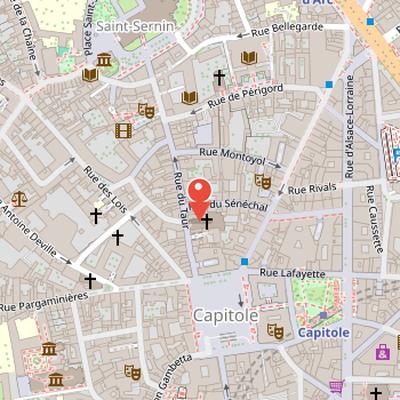
 Place du Capitole 150 m away
 -
 Cinémathèque de Toulouse 150 m away
 -
 Church of the Cordeliers 200 m away
 -
 École Supérieure d'Audiovisuel 200 m away
 -
 Théâtre du Capitole 200 m away
Notre-Dame du Taur: Site and Architecture
Notre-Dame du Taur is a Catholic religious building located on rue du Taur in the center of Toulouse, between the place du Capitole and the basilique Saint-Sernin. Its name comes from the Occitan word Taur, meaning bull. According to tradition, it stands on the site where Saint Saturnin's body detached from the bull that was dragging it. It is also said that a martyrium was built there by the bishops Hilaire and Silve at the end of an unspecified century.
The building was constructed between unspecified dates and is regarded as a principal monument of southern Gothic art. Architecturally, it is characterized by a tall facade with a bell-tower wall integrated into the buildings of rue du Taur. Notre-Dame du Taur has been classified as a historical monument since the 1840 list.
The Martyrdom of Saturnin
Histoire states that Saturnin created the first Christian community in the Gallo-Roman city of Tolosa in the first half of the third century. It also reports that he was martyred in 250 during persecutions ordered by Roman Emperor Decius. According to the Passion of Saint Saturnin, Saturnin was arrested on the forum square across from the main temple. He was then tied to a bull on the forum square. The bull dragged his body along the cardo maximus and released it at the city exit along the Divona Cadurcorum road.
Origins and historical memory
Histoire links the site to the martyr cult of Saturnin and describes Bishop Hilary of Toulouse as beginning the construction of a sanctuary at the end of the third century. This early sanctuary is said to have been a brick vault with a small oratory built from ordinary materials, and an ancient tradition places this oratory at the current location of the Notre-Dame du Taur church. The relics of Saturnin were reportedly kept there until 402, when they were transferred in ceremony to the Saint-Sernin basilica, whose name is presented as an altered form of Saint Saturnin.
The same account preserves a legend that the crowd appreciated the sweet smell of Saint Saturnin's remains after 150 years, noting that according to Rome this fragrance is characteristic of a saint. However, archaeological excavations carried out in 1969 and 1970 found no paleochristian era construction remains in the sanctuary, and Histoire states that neither the first tomb location nor Bishop Hilary's monument can be precisely located. It also suggests that the church may stand where Saturnin's body was released by the bull.
The church was called eglise du Taur because it stood in the area recalling the bull run associated with Saint Saturnin. In the 16th century it was named Saint-Sernin-du-Taur, and in 1534 it received its current name in honor of the Virgin Mary. The church, with its characteristic bell tower, was built in the 16th century. The Virgin represented is Notre-Dame des Remparts, moved from place Villeneuve in 1783.
Recent Renovation and Public Attention
In the early 21st century, the interior of Notre-Dame du Taur showed signs of damage, including moisture-damaged walls, wood furniture affected by woodworms, and paintings and stained glass marked by dust, soot, and smoke. The large organ also required maintenance. The church was included in a 2010 renovation plan covering three buildings and led by Toulouse city hall. It was finally closed in March 2017 for significant renovation works, carried out by Toulouse city hall under heritage architect Axel Letellier. The renovation also reinforced fire safety measures.
The church also became central in French social news in 2020 during the 64th act of the Yellow Vests protest. Several protesters took refuge inside the church, before police evicted them. The eviction was condemned by the Yellow Vests movement and prompted public reactions from prefect Etienne Guyot and archbishop Robert Le Gall.
Western Facade and Nave
The western facade of Notre-Dame du Taur combines a portal set within the alignment of the surrounding houses with a large brick wall and a monumental bell tower wall. The bell tower wall rises to 42 meters and is not the oldest in the region, since the Saint-Etienne bell tower at Montaudran predates it. It is organized in two levels framed by turrets, with a triangular pediment above the church level. Each level has three openings called ouilles with mitre arches, and the whole structure is topped by crenellations. The carillon contains thirteen bells, including one likely from the 14th century and others cast in 1893 by Laveque-Amans in Toulouse.
The portal is Gothic in style and shaped like the portal of the nearby Cordeliers convent church from the early 14th century. It is flanked by two large niches with statues under trilobed arches. The original statues were replaced by figures from the demolished 1846 Rieux chapel, representing Francois d'Assise and an apostle. Six archivolts rest on thin columns with foliage capitals, and a fleuroned gable above them contains a niche with a 14th-century statue of the Virgin.
Inside, the church has a single nave vaulted with ogives and characteristic of southern Gothic style. The nave measures 12 meters wide, 40 meters long, and 16 meters high. In the 14th century it was only three bays long and 25 meters long, ending likely with a large apse over the crypt of bishop Saturnin's presumed tomb. It was extended eastward at the end of the 15th century, at the same time as the arrival of the Cadouin Holy Shroud in Toulouse. The last two bays are widened by rectangular side chapels.
Interior Restoration and Liturgical Design
In the 17th century, the nave walls were covered with woodwork, and a monumental choir stall was installed on both sides. A restoration campaign inside the church began in the late 19th century, first led by Eugene Viollet-le-Duc and later continued by Anatole de Baudot. In 1872, the nave woodwork was removed because of humidity damage, revealing a 15th-century mural on the south wall showing Jacob's genealogy to Jesus Christ with 38 figures arranged in two registers. The left wall also features a painting of the martyrdom of Saturnin by Toulouse painter Jean-Louis Bezard, a Prix de Rome winner in 1825.
The organ was placed on the facade wall and cast by the Toulouse company Puget between 1878 and 1880. It was renovated in 1992 and again in 2017, and since 2017 it has been used for musical moments of the parish Saint-Sernin during Advent and Easter at La Trinite. At the end of the 19th century, the choir was arranged to extend the nave works, then redesigned in 1970 in accordance with the Vatican II reform. A new altar was consecrated on March 22, 1970 by Archbishop Jean Guyot and contains the relics of Saints Saturnin, Florian, and Quentin. The old marble altar, which came from the chapel of the Grey Penitents, was sold to the church of Lux.
Between 1881 and 1882, Bernard Benezet painted the partition wall above the altar in the liturgical choir with the martyrdom and apotheosis of Saturnin and the glorification of the Virgin. Jean-Pierre Lavilledieu created rich neo-Gothic painted decorations using stencil technique with floral and repetitive motifs. These decorations extend across the walls, friezes, and stained glass windows, creating a colored visual harmony that links the church's elements together.
The Organ at Notre-Dame du Taur
Notre-Dame du Taur houses an organ with 40 stops distributed over three manuals and a pedalboard. It was built by Eugene Puget, director of manufacture Theodore Puget, father and son of Toulouse, and inaugurated by organist Alexandre Guilmant on October 9, 1880. The instrument is considered one of the most remarkable testimonies of Eugene Puget's work. Its Positif composition was modified in 1939 by Maurice Puget, who replaced certain ranks with others, including a new Piccolo 1'. The organ later underwent a restoration and was classified as a historical monument for its instrumental part in 1987.