The Cinémathèque de Toulouse was founded in 1964 by cinephiles gathered around Raymond Borde in Toulouse. It defines itself through the conservation and diffusion of cinematographic heritage and is one of the three main French cinematic archives. The institution is located at 69, rue du Taur in Toulouse, Occitanie.
Its origins go back to the Ciné-Club de Toulouse, animated by Raymond Borde in 1952. The early collection was built from film reels gathered mainly from flea markets, fairground operators, the Cinéma Éducateur network, and film breakers. In 1952, a copy of The Ring (1929) by Alfred Hitchcock was discovered at flea markets in Saint-Sernin. In 1958, the collection led to an invitation to join the Centre régional de documentation pédagogique at 3 rue Roquelaine, with support from Roger Clerc. The cinémathèque later developed through collaborations with Henri Langlois and through FIAF membership in 1965. It also organized the retrospective part of the festival Confrontations and expanded its holdings and facilities in the 1960s and early 1970s.
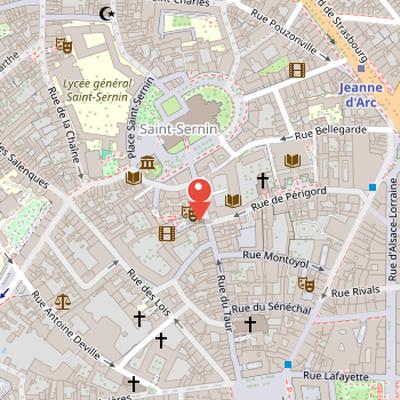
Nearby Objects
-
 École Supérieure d'Audiovisuel 30 m away
 -
 Chapelle des Carmélites 110 m away
 -
 Musée Saint-Raymond 130 m away
 -
 Porte Miègeville 130 m away
 -
 Basilica of St. Sernin 150 m away
A Major Film Archive in Toulouse
Founded in 1964 by cinephiles gathered around Raymond Borde, the Cinematheque of Toulouse is based at 69, rue du Taur in Toulouse, Occitanie. It defines itself through the conservation and diffusion of cinematographic heritage. Within France, it is considered one of the three main cinematic archives.
From Film Collecting to a Cinematheque
The Cinematheque of Toulouse emerged from the film collecting and club work of Histoire, who animated the Cine-Club de Toulouse in 1952. The initial collection was built mainly from flea markets, fairground operators, the Cinema Educateur network, and film breakers. Among the early finds was a copy of The Ring (1929) by Alfred Hitchcock, discovered at flea markets in Saint-Sernin in 1952. On the strength of this collection, Histoire was invited in 1958 to join the Centre regional de documentation pedagogique at 3 rue Roquelaine, with support from Roger Clerc, animator of the Cine-club de la jeunesse at the CRDP.
Through the Cine-Club de la jeunesse, Histoire met students who later became founding members of the Cinematheque of Toulouse. The initiative was first known as Les amis de La Cinematheque francaise before becoming an association. Histoire also worked closely with Henri Langlois during a period when the Cinematheque francaise sent many films to Toulouse and received many in return. This relationship later deteriorated after Langlois decided to withdraw the Cinematheque francaise from FIAF in 1960.
In 1964, Histoire founded the Cinematheque de Toulouse as a legal association under the 1901 law, together with Pierre Marty, Guy-Claude Rochemont, and Roger Clerc. The association was modeled on the legal structure used by Henri Langlois for the Cinematheque francaise. Histoire later began collecting 16 mm films with donations from UFOLEIS members. In 1965, the Cinematheque of Toulouse joined the Federation internationale des archives du film under the sponsorship of Jacques Ledoux and Freddy Buache, which opened access to international exchanges and influenced its future development. The same year, it also became involved in the retrospective section of the festival Confrontations, helping integrate both professional film circles and cinephiles. From 1966, it collaborated with Gosfilmofond, the national film archive of the Soviet Union.
Relocation and Institutional Growth
In 1970, Histoire acquired a film storage building at Le Vernet from Francis Grosso, and in 1971 it acquired a former primary school at Faubourg Bonnefoy in Toulouse for administration and archives. Film projections were held in the Montaigne room of the CRDP until 1996. A major step in its institutional development came in 1981, when Histoire created its first permanent group with CNC film conservation subsidies. It then received additional support from Toulouse City Hall, the Haute-Garonne Department, and the Midi-Pyrnees Region to develop regional archives, which also led to numerous partnerships and collaborations. As the collection grew, Toulouse City Hall proposed a relocation to 69 rue du Taur. Histoire moved into this building, which had previously been used by PSOE, Cine-espoir, and Theatre du Taur. The new location also placed it near ABC cinema, described as Toulouse's first art-house cinema.
The Cinematheque at Rue du Taur
The Cinematheque of Toulouse is located at 69 rue du Taur, in the former chapel of the Collge catholique de l'Esquile, within a building enclosure listed as Monuments historiques. The site serves as the institution's official headquarters and is used for screenings, meetings, exhibitions, educational and cultural activities, and as a library. The former chapel space gives the venue a heritage character that links the cinematheque to the history of the Collge.
During renovation works in 1995, the chour of the chapel and a mural painting were rediscovered. The mural, created in 1933 by Jean Druille, represents an allegory of agrarian socialism with an anticlrical communist ideal. The chour and the mural underwent significant restoration in 1995-1996 by Francois Tollon and Gabriel Burroni. The authorship of the mural was identified later, in 2014, by Coralie Machabert.
The cinematheque also developed a conservation center in Balma, in the Toulouse outskirts, after the Vernet and Bonnefoy sites were found unsuitable for collections conservation because they did not meet security and archive management standards. The new center houses film and non-film collections, including reels, posters, photos, advertising documents, and archive funds, and follows an active conservation policy based on cataloging and treatment of collections.
Film Collections and Restorations
The Cinematheque of Toulouse preserves a film collection that spans all genres, nationalities, and eras. Within this broader holdings, the collections include particular strengths in French cinema, Russian and Soviet cinema, classic American cinema, burlesque, Latin American cinema, regional films, genre films, erotic films, and documentaries. The majority of the collection consists of period copies and exploitation copies, giving it a distinctive archival character.
A major aspect of the Cinematheque's work has been the restoration of films from its own collections. Numerous titles have been restored, including many silent films and films by Charley Bowers. The collection also contains films by Charley Bowers that were rediscovered by Raymond Borde. Among the restorations documented from the collections are Verdun, visions d'Histoire by Leon Poirier in 2006, La Vendeuse de cigarettes du Mosselprom by Youri Jeliaboujski in 2007, La Greve by Serguei M. Eisenstein in 2008, La Campagne de Ciceron by Jacques Davila in 2009, La Grande Illusion by Jean Renoir in 2011, Les Miserables by Henri Fescourt in 2014, and Pour Don Carlos by Musidora in 2019. These restorations show the collections' importance as a source for film preservation and reintroduction.
Collections and Archival Holdings
The Cinematheque of Toulouse preserves a wide range of collections covering cinema history, film production, and related documentation. Among its notable holdings is an exceptional fund of 90 Palestinian films documenting Israeli occupation and life in Palestine since the 1960s. This Palestinian film fund escaped seizures by the Israeli army in Beirut in 1982.
Its poster collection is the first French cinema poster collection and contains 150,000 posters dating from 1908 to the present. Although mainly composed of French posters, it also includes many German, Polish, Cuban, and Italian examples. Posters not conserved at the Cinematheque francaise or the Bibliotheque nationale de France receive priority in restoration policies.
The collections also include photographs relating to filming, sets, promotion, and personalities connected with French and American cinema. Archives are divided into fifty fonds of filmmakers, journalists, film clubs, cinephiles, theater operators, and production companies, covering cinema history from 1910 to the present. A script fund contains more than items, including dialogue continuities, breakdowns, synopses, and project presentations from the 1930s. Other preserved materials include advertising documents, drawings, costumes, pre-cinema objects, and equipment.
The library provides access to more than items, over periodicals in French and foreign languages, films in DVD, and 3000 festival catalogues. Its books cover biographies, analyses, studies on films, cinema history, professions, techniques, genres, theses, and scripts. The periodicals collection includes French and foreign publications, narrated films, popular magazines from the 1920s to the 1970s, corporate magazines, and fanzines. The oldest periodical issue dates from 1907. Since 2015, the library has also offered a station for access to archives of the Institut national de l'audiovisuel. The catalog of books, periodicals, and non-film collections, including posters and photos, is available online under the name Cine-Ressources.
Screenings and Public Programming
The Cinematheque of Toulouse programs about one thousand screening sessions each year. Its activities include thematic cycles, retrospectives, and festivals, along with cine-concerts, professional meetings, debates with guests, school public sessions, and colloquiums held in three rooms. In 2018, it welcomed nearly an unspecified number of attendees. The library also attracts an annual attendance of more than an unspecified number, and it receives many students and researchers each year.