École Supérieure d'Audiovisuel is a French public higher education institution in Toulouse, founded in 1978 and affiliated with the University Toulouse-Jean-Jaurès. It is one of four French public schools teaching cinema professions and belongs to the group that includes École nationale supérieure Louis-Lumière, La Fémis in Paris, and École nationale supérieure de cinéma Cinéfabrique in Lyon.
The school began in 1978 as an autonomous department of audiovisual communication at the University of Toulouse II-Le Mirail. It later became a professionalized University Institute of Audiovisual Studies in 1991, added a research laboratory in 1995, and moved in 2003 to Rue du Taur, in the former Collège de Périgord, near the Cinémathèque de Toulouse and ABC cinema. Directed by Guy Chapouillié from 1978 to 2009, it was renamed École nationale supérieure de l'audiovisuel (ENSAV) in 2017. The school offers training for cinema, radio, and television professions, along with a doctorate program and six master's-level specialization paths.
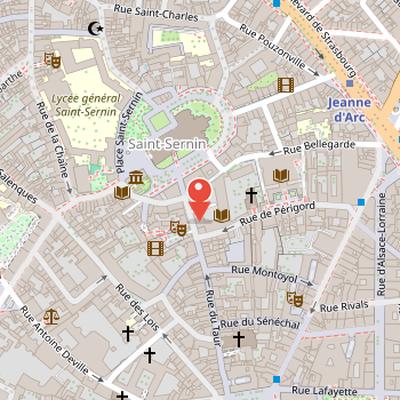
Nearby Objects
-
 Cinémathèque de Toulouse 30 m away
 -
 Chapelle des Carmélites 90 m away
 -
 Porte Miègeville 120 m away
 -
 Musée Saint-Raymond 120 m away
 -
 Basilica of St. Sernin 140 m away
A Public School for Cinema Professions
Founded in 1978 and located in Toulouse, the Ecole Superieure d'Audiovisuel is a French public higher education institution. It is a member of the University Toulouse-Jean-Jaures and provides technical and artistic education for cinema professions. The school is one of four French public institutions that teach cinema professions, placing it in the same group as the Ecole nationale superieure Louis-Lumiere, La Femis in Paris, and the Ecole nationale superieure de cinema Cinefabrique in Lyon.
Institutional Development and Relocation
Created in 1978 as an autonomous department of audiovisual communication teaching at the University of Toulouse II-Le Mirail, Histoire initially included students at Bac+2 (DÉUG) level. It was directed by Guy Chapouillié from its creation until 2009. In 1991, it was succeeded by a professionalized University Institute of Audiovisual Studies (IUP). The institution expanded further in 1995 with the addition of a Laboratory of Research in Audiovisual, licensed as a Host Team (EA4154), and it also enrolled doctoral students specialized in audiovisual. In 2003, Histoire moved to Rue du Taur, in the buildings of the former Collège de Périgord, near the Cinémathèque de Toulouse and the ABC cinema. In 2017, it was renamed the Ecole nationale superieure de l'audiovisuel (ENSAV).
Training and Academic Programs
The Ecole Superieure dAudiovisuel, also identified as L Ecole nationale superieure d audiovisuel, is presented as one of four French public higher education schools teaching cinema professions and one of six public higher education audiovisual programs. Its offer de formation includes professional training for cinema, radio, and television professions, as well as a doctorate program. The school also provides a university diploma in research and creation in audiovisual, called DURCA. At the masters level, it proposes six specialization paths: Realisation, Image, Son, Infographie / Architecture - Decor, Production, and REX.
The school is also associated with a range of graduate outcomes. Many ENSAV graduates work in film production companies as directors, editors, sound engineers, and visual effects specialists. Others continue into research at the LARA audiovisual research laboratory, while some pursue teaching careers. These elements place the school within both professional and academic pathways in audiovisual education.
Admission Process at ENSAV
Admission to the Ecole Superieure d'Audiovisuel is based on a competitive entrance exam for entry at L3 level after a validated Bac+2 qualification. No specific prior training is preferred for preparing for the school. Candidates are expected to show motivation, passion, an interest in cinema or audiovisual work, and a desire to make films. Each year, between 400 and 600 candidates request pre-registration for the exam. The first part of the selection takes place in early September, with about 70 candidates retained. They then take part in a second phase called the Periode d'orientation in late September. After these stages, approximately 30 students are enrolled in mid-October.
International Audiovisual Networks
ENSAV is a member of CILECT, the Centre international des ecoles de cinema et de television. CILECT brings together universities and grandes ecoles specialized in audiovisual teaching and research. ENSAV also organizes the Corrida audiovisuelle, an international meeting of cinema and television schools. Held annually for more than 20 years, the event presents productions and critical reflections from cinema schools around the world. It also brings different cinematographic, pedagogical, and cultural approaches into contact. More than one hundred schools worldwide have taken part in the event, which underlines its international reach.
Teaching Method and Curriculum
The pedagogical approach at the Ecole Superieure d Audiovisuel focuses on technical and practical training. In the first year, students are introduced to photo, audio, video, HD, and film equipment, and assessment is based on exercises carried out throughout the year rather than written examinations. These exercises are mainly centered on film production, and some are completed in groups of four. Students are required to make their own films with the help of their peers, while retaining freedom in the films they create. Specialization is introduced only at the end of the curriculum, making the program suitable for students who want to develop versatility.
The curriculum also includes training periods abroad through 15 privileged international university partnerships. Partner institutions are located in Wiesbaden, Brussels, Rio, Quebec, Beijing, California, New York, Dickinson College, Marrakech, Mexico, Lodz, Prague, Geneva, and Carthage. The permanent teaching team is made up of university professors authorized to conduct research, senior lecturers, associate professors, and audiovisual professionals working as adjuncts or associate professors.
Camera Equipment at ENSAV
The ENSAV material inventory includes several Aaton cameras, specifically LTR and XTR models, as well as Super cameras with Zeiss series. It also includes ACL Eclair Super equipment and one Arriflex SR1 camera. In standard use, there are many Bolex H16 cameras. The schools collection also includes one Sony PMW-F5 camera and one Sony F3 camera, one Panasonic AF-101 camera, one Canon EOS C300 camera, and five Panasonic HPX-250 cameras. This range of equipment reflects a varied technical setup for audiovisual training and production.
Equipment and Learning Spaces
L'ENSAV provides students with a range of material resources for practical work, subject to reservation and availability. In the first two years, sound recording is carried out with portable Zoom H4n, m-audio, and Fostex FR2-LE recorders, together with microphones including AKG CK-92, CK93, AT 875R, AT 2031, Rode NTG-2, and a Rode NT5 stereo pair. Other available devices include Cantar X2, Zoom H6, SoundDevices, MixPre 10, and Nagra equipment, some of which are rented for the specialization year.
The school also offers technical spaces for postproduction and mixing. Film editing is carried out on six Avid Media Composer and Final Cut Pro workstations that are soundproofed and air-conditioned. Sound editing takes place on four stations equipped with Pro Tools software, and advanced sound mixing is supported by a soundproof auditorium with a video projector.
For image and stage work, the material resources include nearly one hundred lighting fixtures, ranging from small Fresnel units to 4 Kw HMI lamps. There is also a studio equipped with a lighting console, a makeup room, and a woodworking shop. Students use the set platform in the first and second years.
The school includes the salle Arts du spectacle, a cinema room with around one hundred seats and projection equipment, where films are screened. Its media library archives student films, holds a catalog of cinema books, and provides access to about ten magazines on cinema, sound, and computing. The media library also manages the school's casting file.