Église Saint-Godard de Rouen is a church building in Rouen with a long and layered history. It served as a burial site for the saints and bishops Godard and Romain in 525 and 644, and it was initially possibly dedicated to Sainte-Marie-hors-les-murs, or more likely to Saint Romain. Saint Romain’s body was transferred to the cathedral around 1090, leaving only the sarcophagus, which was preserved until the beginning of the 20th century. The church stood within the city walls of Rouen under Saint Louis, burned in 1248, and was then rebuilt and expanded. In the 15th and 16th centuries it served as the parish church for inhabitants of the castle of Rouen, including the captains of the castle and their families. Its doorway bears the coat of arms of the Brézé family. The nave was constructed in the second half of the 15th century, with the north collateral completed in 1527, the south collateral built in 1534, and the crypt staircases and Beffroi street door completed in 1537. The church was restored to worship in 1806, became a parish church again in 1829, and was listed as a historical monument in 1862.
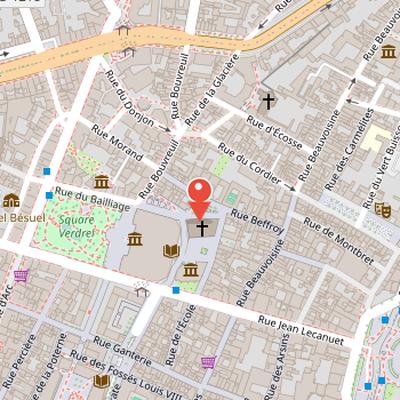
Nearby Objects
-
 Musée des Beaux-Arts de Rouen 60 m away
 -
 Musée Le Secq des Tournelles 70 m away
 -
 Saint-Patrice Church 300 m away
 -
 Monument to Napoléon Ier 300 m away
 -
 Chapelle Corneille 350 m away
Historical Development of Saint-Godard Church
Eglise Saint-Godard de Rouen has a long religious history linked to burial and parish use. It served as a burial site for the saints bishops Godard and Romain in 525 and 644. The church was initially possibly dedicated to Sainte-Marie-hors-les-murs, or more likely to Saint Romain. Around 1090, the body of Saint Romain was transferred to the cathedral, leaving only the sarcophagus, which was preserved until the beginning of the 20th century.
The church stood within the city walls of Rouen under Saint Louis. It burned in 1248 and was then rebuilt and expanded. In the 15th and 16th centuries, it served as the parish for the inhabitants of the castle of Rouen, and the captains of the castle and their families attended mass and baptisms there. The doorway is decorated with the coat of arms of the Brézé family, three members of which served as captains of the Rouen castle from 1449 to 1531.
Several parts of the building date from this later period of reconstruction. The nave was constructed in the second half of the 15th century. The north collateral was completed in 1527 by Julien Chanevyere, the south collateral was built in 1534, and the crypt staircases and Beffroi street door were completed in 1537. After a period of change, the church was restored to worship in 1806 as a branch of Saint-Patrice parish through the efforts of abb
Stained Glass History and Preservation
In 1852, three new stained glass windows were installed in the apse by Pierre-Jules Jollivet and Pierre-Charles Marquis. After that, the restoration of the churchs stained glass was entrusted to Gaspard Gsells workshop, and in 1867 the last window by Gsell was added, showing the Proclamation of the Immaculate Conception. The church was listed as a historical monument in 1862, highlighting the recognized heritage value of the building and its decoration.
The Renaissance stained glass windows underwent several removals and restorations in the 20th century. They were dismantled in 1918 and reassembled in 1921-1922 after restoration. In 1939, they were dismantled again and taken to Niort for restoration by Jean-Jacques Gruber before being reassembled in 1948. By contrast, the 19th-century stained glass windows remained in place during this period, but they suffered damage from bombings and were not restored until the end of the 20th century.
Architecture, organs, and stained glass
The Eglise Saint-Godard de Rouen is composed of three naves of equal height. The central nave ends with a three-sided apse, and the naves are covered with a wooden barrel vault with tie beams made by Josias le Grand. At the northwest corner, the tower-belfry remains unfinished. The church is also notable for its organ fittings: Aristide Cavaille-Coll was commissioned to build the organs, creating the grand organ in 1884 and the choir organ in 1885. The tribune organ was inaugurated in 1884 by the organist and composer Charles-Marie Widor, and regular concerts are held there.
The church is known for its twenty-four stained glass windows from the 15th to the 16th century. Four of these date from the 16th century and depict the life of Mary, the life of Saint Romain, the Gospel Apparitions, and the Tree of Jesse. The Tree of Jesse window was created by Arnoult de Nimegue in 1506 for the Virgin chapel. That chapel also contains a white marble cenotaph from the 17th century with the orants of Charles and Pierre de Becdeliere, who were lords of Hocqueville and later lords and marquises of Quevilly.