The Monument to Napoléon Ier is a bronze equestrian statue by sculptor Vital Gabriel Dubray, located at place du Général-de-Gaulle in Rouen. The figure of Napoleon is shown saluting while mounted on a rearing purebred Arabian horse, which is supported by the hind legs and the tail. The bronze was cast from cannons of Austerlitz used to make the balances of the Hôtel de la Monnaie.
The pedestal, designed by departmental architect Louis-François Desmarest, is made of Flamanville granite with a base of Sainte-Honorine granite. Four panels of Italian griotte marble bear in gold letters the inscriptions “Empire français”, “Code Napoléon”, “Concordat”, and “Légion d'honneur”. A further marble inscription faces rue Jean-Lecanuet, while the rear of the pedestal, facing the city hall, includes a bronze bas-relief after a drawing by Jean-Baptiste Isabey. This relief depicts the first consul visiting manufactories and rewarding the oldest Rouen industrial worker on 2 November 1802. The statue and the decorative bronzes of the pedestal were made in the workshops of founder Victor Thiébaut in Paris. The monument was created following a departmental subscription launched in 1853 and was inaugurated by Marshal Vaillant in the presence of local and state officials. In 1935, the statue underwent cleaning.
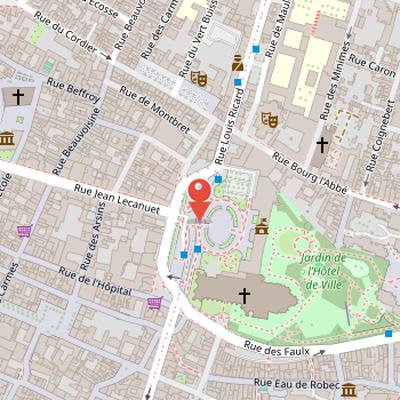
Nearby Objects
-
 Saint-Ouen Church 120 m away
 -
 Royal Abbey of Saint-Ouen 120 m away
 -
 Chapelle Corneille 150 m away
 -
 Musée national de l'Éducation 300 m away
 -
 Musée Le Secq des Tournelles 300 m away
Bronze Equestrian Statue in Rouen
The Monument to Napoleoleon Ier is a bronze equestrian statue by the sculptor Vital Gabriel Dubray. It is located at Place du General-de-Gaulle in Rouen. The work is identified as an equestrian monument, with Napoleon Ier represented on horseback in bronze, and it occupies a public site in the city center.
Statue and Pedestal
The monument consists of a bronze equestrian statue showing Napoleon saluting on a rearing purebred Arabian horse. The horse is supported by three points: its two hind legs and its tail. The bronze was cast from cannons of Austerlitz, reused in the balances of the Hotel de la Monnaie. The statue and the decorative bronzes of the pedestal were made in the workshops of founder Victor Thiiebaut in Paris.
The pedestal was designed by the departmental architect Louis-Francois Desmarest. It is built of Flamanville granite, with a base of Sainte-Honorine granite. Four panels of Italian griotte marble carry in gold letters the names of imperial institutions: Empire francais, Code Napoleon, Concordat, and Legion d'honneur. On the front, facing rue Jean-Lecanuet, there is an inscription engraved on griotte marble. On the rear, facing the city hall, a bronze bas-relief after a drawing by Jean-Baptiste Isabey represents the first consul visiting the Sevene brothers' manufactory in 1802. Another bronze bas-relief on the pedestal shows the first consul visiting the Saint-Sever suburb manufactories and rewarding the oldest Rouen industrial worker on November 2, 1802. The five marble panels and the bas-relief are enclosed in interconnected bronze frames around the perimeter of the pedestal.
Inauguration and Later History
The Monument to Napoleon Ier was created after a departmental subscription launched in 1853. It was inaugurated by Marshal Vaillant, Minister of Fine Arts, on the anniversary day of an unspecified event. The ceremony took place in the presence of Alphonse Gautier, State Councillor and Secretary General of the Ministry of the Emperor's House, and Charles Verdrel, Mayor of Rouen. During the inauguration, Verdrel made a statement and concluded with another address. On this occasion, he was promoted to Commander of the Legion of Honour. Vital-Dubray, Louis-Francois Desmarest, and Theodore Bachelet also received the Legion of Honour during the events. A balloon ascent by one of the Godard brothers took place from the Champ de Mars as part of the same series of events. The statue was cleaned in 1935, and it escaped the melting of non-ferrous metals during the Occupation.
Restoration, Consultation, and Reinstallation
A crack in the right foot of the horse led to the dismantling of the statue, after which it was restored at Saint-Remy-les-Chevreuse by the Coubertin foundry. During the restoration process, a metallic box was found in the statue's base, placed there before or during the inauguration. The box was secured for expertise and found to contain documents and a tube, which were then entrusted to restorers for study by historians. The discovery was made public as part of the broader restoration and replacement period.
The future of the monument also became the subject of civic debate in Rouen. Mayor Nicolas Mayer-Rossignol announced a civic consultation on replacing the statue, with the proposed replacement intended to honor Gisèle Halimi. The idea of replacement triggered strong reactions on social media. Historian Thierry Lentz also recalled the history of the Monument a Napoleon during this discussion. An official civic consultation was launched on the statue's return and women's representation in public spaces, with 68% of 3,000 voters favoring the statue's return to Place du General-de-Gaulle and 65% calling for more female representation in public space names.
The statue was reinstalled on its pedestal on June 18, 2023, without the mayor or deputies. The reinstallation event was marked by Norman and French flags and by Napoleonic songs.