Sainte-Chapelle is a royal chapel in the Gothic style within the medieval Palais de la Cité on the Île de la Cité in Paris, France. Construction began sometime after 1238, and the chapel was consecrated on 26 April 1248. It was commissioned by King Louis IX of France to house his collection of Passion relics, including Christ’s claimed Crown of Thorns. The chapel was inspired by earlier Carolingian royal chapels, especially the Palatine Chapel of Charlemagne at Aachen, and adapts that precedent on a grander scale. Sainte-Chapelle has two levels of equal size with different functions: the upper level was reserved for the royal family and guests and held the sacred relics, while the lower level was used by courtiers, servants, and soldiers. It is one of the earliest surviving buildings of the Capetian royal palace on the Île de la Cité. Damaged during the French Revolution, it was restored in the 19th century and is now operated as a museum along with the nearby Conciergerie. It also contains one of the most extensive 13th-century stained glass collections in the world.
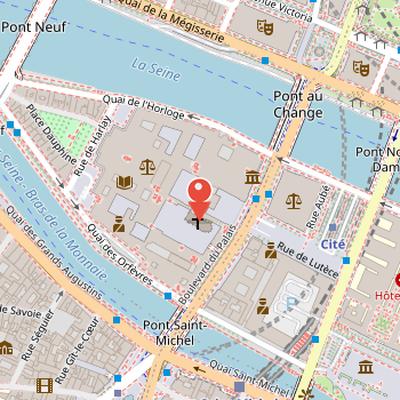
Nearby Objects
-
 Palais de la Cité 120 m away
 -
 Île de la Cité 200 m away
 -
 Place Saint-Michel 250 m away
 -
 Fontaine Saint-Michel 250 m away
 -
 Place du Châtelet 300 m away
Royal Chapel on the Seine
Sainte Chapelle is a royal chapel in the Gothic style within the medieval Palais de la Cite in Paris, France, on the Ile de la Cite in the River Seine. Construction began sometime after 1238, and the chapel was consecrated on 26 April 1248. It was commissioned by King Louis IX of France to house his collection of Passion relics, including Christ's claimed Crown of Thorns. The chapel is one of the earliest surviving buildings of the Capetian royal palace on the Ile de la Cite.
The building was damaged during the French Revolution and restored in the 19th century. It is also notable for having one of the most extensive 13th-century stained glass collections in the world. Today, it is operated as a museum along with the nearby Conciergerie.
Royal Chapel and Architectural Model
Sainte-Chapelle was inspired by earlier Carolingian royal chapels, especially the Palatine Chapel of Charlemagne at Aachen, which was built between 782 and 805 and served as the emperor's oratory. Louis IX had already built a royal chapel attached to the Chateau de Saint-Germain-en-Laye in 1238, and the earlier chapel had only one level. That plan was then adapted on a grander scale for Sainte-Chapelle. The result was a building described as very large, long, wide, and high, and it was ranked in size with the new Gothic cathedrals in France.
The chapel was arranged in two levels of equal size, each with a distinct purpose. The upper level was reserved for the royal family and guests, and it also housed the sacred relics. The lower level was used by courtiers, servants, and soldiers. This division gave the building both ceremonial and practical functions, while also shaping its role as a place of worship.
Sainte-Chapelle also had political and cultural significance. Louis used artistic patronage to position himself as a central monarch of western Christendom. The chapel's royal access has been compared with the emperor's access to Hagia Sophia, and its overall design shows similarities to Charlemagne's palatine chapel at Aachen. In this way, Sainte-Chapelle combined religious use with royal representation and drew on earlier imperial and Carolingian models.
Relics, Royal Prestige, and the Sainte-Chapelle
Sainte-Chapelle was built in the courtyard of the royal palace on the Ile de la Cite to house Louis IX's collection of relics of Christ. These relics included the crown of thorns, the Image of Edessa, fragments of the True Cross, the Holy Lance, and thirty other items. The history of the chapel is closely tied to Louis IX's political and religious ambitions. He sought to present himself as the successor to the first Holy Roman Emperor, and the presence of such relics gave him enormous prestige. Pope Innocent IV is recorded as proclaiming that Christ had symbolically crowned Louis with his own crown.
Louis acquired the Passion relics from Baldwin II, the Latin emperor at Constantinople, for 135,000 livres, with the money paid to Venetians to whom the relics had been pawned. The relics arrived in Paris in August 1239, carried from Venice by two Dominican friars. Louis marked their arrival with a week-long celebratory reception, and for the final stage of the journey he carried them barefoot and dressed as a penitent. Before 1248, the relics were stored at chapels at the Chateau de Vincennes and Chateau de Saint-Germain-en-Laye. In 1246, fragments of the True Cross and the Holy Lance were added to the collection.
The relics were kept in a large and elaborate silver chest known as the Grand-Chasse, for which Louis spent 100,000 livres. The chapel itself cost 40,000 livres to build and glaze. It was consecrated on 26 April 1248, and Louis's relics were moved there with great ceremony the same year. Shortly after 1248, Louis departed on the Seventh Crusade, during which he was captured, later ransomed, and released. The chapel later remained significant in cultural memory, with Jean de Jandun praising it in 1323, and French composer Marc-Antoine Charpentier being buried in its small cemetery in 1704.
Later Alterations and Revolutionary Damage
In the centuries after its completion, Sainte Chapelle underwent considerable modification. Shortly after completion, a new two-story building, the Treasury of Chartres, was attached to the north side of the chapel. This structure remained until 1783, when it was demolished to make way for the new Palace of Justice. Another building on the north side served as a vestiary and sacristy, as well as a residence for the guardian of the treasury. In the 15th century, Louis X of France built a monumental enclosed stairway from the courtyard on the south side to the upper level. This stairway was damaged by fire in 1630, rebuilt, and later demolished.
The chapel also suffered repeated damage from fire and flood. Fires in the palace in 1630 and 1776 caused considerable damage, especially to the furniture. A flood in the winter of 1689 to 1690 caused major damage to the painted walls of the lower chapel. Over time, the original stained glass on the ground floor was removed and the floor was raised, and in the 19th century the original ground floor glass was replaced by Gothic-style windows.
During the French Revolution, Sainte Chapelle was a prime target for vandalism. It was turned into a storehouse for grain, while the sculpture and royal emblems on the exterior were smashed and the spire was pulled down. Some of the stained glass was broken or dispersed, although nearly two-thirds of the stained glass today is original, and some of the original glass was relocated in other windows. The sacred relics were dispersed, though some survive as the relics of Sainte-Chapelle in the treasury of Notre-Dame de Paris. Various reliquaries, including the grande chsse, were melted down for their precious metal. From 1803 to 1837, the upper chapel served as a depository for the archives of the Palace of Justice.
Restoration and Preservation
By the nineteenth century, demands from scholars, archeologists, and writers called for the church to be preserved and restored to its medieval state, beginning in 1835. A long restoration campaign started under King Louis-Philippe in 1840, first led by Felix Duban and then continued by Jean-Baptiste Lassus and Emile Boeswillwald, with the young Eugene Viollet-le-Duc working as an assistant. The project lasted twenty-eight years and served as a training ground for a generation of archeologists and restorers. Its approach was closely based on the original drawings and descriptions of the chapel that had survived.
The stained glass was restored as a parallel project from 1846 to 1855, with the aim of returning the chapel to its original appearance. This work was carried out by the glass craftsmen Antoine Lusson and Marechal de Metz and the designer Louis Steinheil. About one third of the glass added in later years was removed, and it was replaced with medieval glass from other sources or with new glass made in the original Gothic style. The chapel's eighteen original stained glass panels are now in the Musee de Cluny in Paris.
During World War II, the stained glass was removed and placed in safe storage. In 1945, an external layer of varnish was applied to protect it from dust and scratches caused by wartime bombing. A new seven-year restoration programme began in 2008 at a cost of about 10 million euros, funded equally by private donors and the Villum Foundation. This work cleaned and preserved the stained glass, facade stonework, and sculptures, and included an innovative thermoformed glass layer for additional protection outside the stained-glass windows. The flamboyant rose window on the west facade was restored in 2015, in time for the 800th anniversary of the birth of St. Louis.
Architecture and Design of Sainte Chapelle
Sainte Chapelle is a prime example of the Rayonnant phase of Gothic architectural style. It stands directly on top of a lower chapel that served as the parish church for the palace inhabitants, and the two levels are marked on the exterior by a string-course. The lower chapel has smaller windows with a distinctive spherical triangle shape, while the upper chapel is characterized by vast windows subdivided by bar tracery. The exterior is relatively simple and lacks flying buttresses or major sculpture, even though the chapel is supported by substantial buttresses that are too close to the vault to counter side thrust. In place of flying buttresses used in earlier structures, the building employed metal elements such as iron rods or chains.
The exterior shows Rayonnant features including deep buttresses topped by pinnacles and crocketted gables. Its architectural precursors include the apsidal chapels of Amiens Cathedral and the Bishop's Chapel of Noyon Cathedral, and the two-story design was borrowed from the Bishop's Chapel of Noyon Cathedral. The design may also have been influenced by metalwork, especially shrines and reliquaries by Mosan goldsmiths. No designer-builder is named in the archives, although 19th century writers assumed the chapel was the work of master mason Pierre de Montreuil. Modern scholarship attributes it to Jean de Chelles or Thomas de Cormont, while Robert Branner attributed the design to an unidentified master mason from Amiens.
The west front consists of a porch two levels high beneath a flamboyant Gothic rose window installed in the upper chapel in the 15th century. It also includes a pointed arch, an oculus window, and a balustrade around the bottom of the roof decorated with interlaced fleur-de-lys emblems placed by Charles V of France. Towers on either side of the porch contain narrow winding stairways to the upper chapel and conceal the buttresses. These towers have spires decorated with royal fleur-de-lys beneath a sculpted crown of thorns. Decoration dating to the 15th century was restored around 1850 by Geoffroy-Dechaume, and the portal of the upper chapel is located on the balcony of the upper level.
Spire and Sculptural Program
Sainte Chapelle has undergone several major changes to its exterior sculpture and spire over the centuries. The original sculpture of the west portal was smashed during the Revolution, and it was restored by Geoffroy-Dechaume between 1854 and 1873. The present spire is the fifth built at Sainte-Chapelle since the 13th century. A second spire was built in 1383 under Charles V and is shown in the Tres Riches Heures du Duc de Berry. Another spire was replaced about 1460 and later burned in 1630, while a further spire was destroyed after the French Revolution in 1793. The present spire was built of cedar wood by the architect Lassus beginning in 1852, with its sculpture designed in 1853 by Geoffroy-Dechaume. The base spire sculpture was designed by the painter-designer Steinheil, who included his face as Saint Thomas and Saint Bartholomew. Above the gables are statues of angels carrying the instruments of The Passion, and above the chevet is a statue of the Archangel Michael slaying a dragon. Around the feet of the archangel are sculptures designed by Geoffroy-Dechaume representing eight persons portrayed by reconstruction workers laying wreaths at the Archangel's feet.
Interior Design and Decoration
The interior of Sainte Chapelle is dominated by stained glass and richly coloured and decorated walls and vaults. Its original colours were much brighter than those applied by the 19th century restorers, and the chapel was further enriched by textile hangings. The decorative program included quatrefoils in the dado arcade painted with scenes of saints and martyrs, and inset with painted and gilded glass meant to emulate Limoges enamels. The main decorative themes are the Fleur-de-Lys emblem of Louis IX and a stylised castle, the coat of arms of Blanche of Castile.
The upper chapel is especially notable for its near total absence of masonry walls. These were replaced by pillars and buttresses, with the space between them almost entirely filled with glass, creating a bright interior. By contrast, the lower chapel was dedicated to the Virgin Mary and used by non-royal inhabitants of the neighbouring Royal Palace. Its interior portal represents the Virgin Mary as a column statue, and almost all of the chapel decoration was created by Geoffroy-Duchaume between 1854 and 1858.
The lower chapel is six meters wide in the central vessel and has two narrow side aisles. Its ceiling vaults are supported by small arched buttresses between the outer and inner columns, with additional reinforcement from a metallic structure hidden under paint and plaster. The interior also contains one-hundred forty capitals from the mid-13th century, predating the upper chapel columns. These capitals have floral acanthus leaf decoration typical of the period, with gilded leaves corresponding to the slender colonettes that support the vaults. The columns are painted with alternating floral designs and the castle emblem of Castile, with the red, gold, and blue painting dating to the 19th century restoration.
Interior Design and Chapel Structure
The interior of Sainte Chapelle combines a highly structured chapel plan with extensive stained glass and carefully restored decoration. The lower chapel originally had stained glass that was destroyed by a flood in 1690 and then replaced by colourless glass. The present glass shows scenes from the life of the Virgin Mary, surrounded by grisaille glass, while the apse contains more elaborate and colourful scenes from the Virgin's life. All of the windows were designed by Steinheil during the 19th century restoration. The lower chapel also had a doorway to the sacristy on the left lateral traverse, which could not have a window. In the 13th century this area was decorated with a mural of the Annunciation, rediscovered during the 19th-century work and restored by Steinheil.
The upper chapel is reached by narrow stairways in the towers from the lower level. It is a simple rectangle with four traverses and an apse at the east end with seven bays of windows. Its walls appear to be almost entirely made of stained glass, with a total area of stained glass excluding the rose window at the west end. Each vertical support of the windows is composed of seven slender columns to disguise its full thickness. The walls and windows are braced externally by two belts of iron chain, one at mid-level and the other at the top of the lancets, both hidden behind the bars holding the stained glass. Additional metal supports under the eaves of the roof help brace the windows against wind or other stress. The windows of the nave are slightly higher than those in the apse, making the chapel appear longer.
On the third traverse there are two small alcoves set into the walls, each with richly decorated archivolts and painting and sculpture of angels above. These alcoves were used by the King and Queen during religious services, with the King worshipping in the north alcove and the Queen in the south alcove.
The Stained Glass Program
Sainte Chapelle is known for an extensive stained glass program in the upper chapel, where fifteen great windows in the nave and apse date to the mid-13th century. Most of the windows were installed between 1242 and 1248, while a later rose window was added in the 15th century. Together, the thousands of small pieces of glass turn the chapel walls into large screens of coloured light, especially in deep blues and reds.
The artists remain unknown, but Louis Grodecki identified three workshops with distinct styles. One workshop was responsible for the stained glass in the apse and most of the north wall of the nave, and its work is marked by supple forms and costumes with simplified features. A second group, called the Master of the Ezekiel window, produced the Ezekiel, Daniel, and Kings windows, using elongated figures and more elaborate angular draperies. A third group, called the Master of Judith and Esther, is associated with the Judith, Esther, and Job windows and is distinguished by subtle facial details and a resemblance to illuminated manuscripts.
Despite some damage, the windows preserve a clear iconographical programme. The three eastern apse windows illustrate the New Testament through the Passion, the Infancy of Christ, and the Life of John the Evangelist. The nave windows are dominated by Old Testament exemplars of ideal kingship and queenship. The cycle begins in the western bay of the north wall with heavily restored scenes from Genesis, then continues clockwise through Exodus, Joseph, Numbers or Leviticus, Joshua or Deuteronomy, and Judges. It then moves along the south wall with Jeremiah or Tobias, Judith or Job, Esther, David, and the Book of Kings. The final window in the westernmost bay of the south wall shows the rediscovery of Christ's relics and their relocation by King Louis. The scenes are framed by circles, ovals, and other geometric forms.
Stained Glass and Decorative Program
The stained glass at Sainte Chapelle is organized against a background of emblems linked to Louis IX and Blanche of Castile. Louis IX is represented by a golden flour-de-lys, while Blanche of Castile is shown by a castle. This emblematic background creates unity across the stained glass windows and also appears in the painted decor.
A notable feature is the west rose window of the upper chapel, made in the late 15th century. It is a fine example of the flamboyant Gothic style and measures nine meters in diameter. The window is composed of eighty-nine separate panels showing scenes of the Apocalypse. Fifteenth-century stained glass artists also used a new technique called silver stain, which allowed them to paint on glass with enamel paints and fuse the paint using fire. This method made it possible to modify color and create shading and fine details.
The rose window was thoroughly cleaned in 2014 and 2015, which gave it greater brightness and clarity. Some early stained glass removed from Sainte Chapelle is now preserved in other museums, including the National Museum of the Middle Ages in Paris and the Victoria and Albert Museum in London.
Nineteenth-Century Restorations and Portal Sculpture
Between 1855 and 1870, the sculpture of the portals of Sainte-Chapelle was recreated using 18th century descriptions and engravings. The tympanum over the portal of the upper chapel was restored with Christ giving a blessing, accompanied by the Virgin Mary and John the Baptist. Behind Christ, two angels hold the crown of thorns and the cross. Below this, Saint Michael weighs the souls of the dead on the lintel, with the saved on the left and the damned on the right. The lower walls were given sculpted Biblical scenes from the Old Testament, and the scenes of the Creation and Noah's ark were recreated between 1869 and 1870. In the apse of the upper chapel, original 12th-century polychrome statues were preserved, and traces of color found during 19th-century restoration allowed them to be restored to their original colors. The arches of the tribune in the apse were ornamented with original 13th-century polychrome angels. The chapel also included statues of apostles and Louis IX with fleur-de-lis and castle symbols on columns, while sculpture was placed on the north wall of the upper chapel. Some statues, including an undecorated statue of St. John, were moved to the Museum of the Middle Ages at Hotel de Cluny, and some of the surviving works are now in the National Museum of the Middle Ages in Musee de Cluny.
19th-Century Interior Restoration
In their 19th-century restoration, architects Durban and Lassus aimed to recreate the 13th-century interior through art and decoration. A comprehensive plan for the interior decoration was presented in 1842. The restoration design was based on traces of original polychrome paint found on the columns, while a neutral tone was used in the soubassements where no original color traces survived. The palette also drew upon a 13th-century book of Psalms from the Royal Library.
As part of this work, forty-four 13th-century quadrilobe medallions showing the martyrdom of saints were repainted against gilded backgrounds. In 1845, Steinheil repainted all nave medallions except those in the two royal alcoves. Later conservation work by the Service of Historic Monuments in 1983 cleaned four medallions that had not been restored and un-restored two repainted medallions in order to study original paint traces.
Relics and Royal Patronage
The relics and their reliquary were created to house the crown of thorns and a small piece of the cross of Christ's Passion. They came from Constantinople, which had been captured by the Crusaders in 1204 and ruled by Baudouin II of Cortenay. Baudouin II sold the crown to Venetian bankers for 135,000 livres, and its purchase enhanced Louis's prestige while also showing his personal devotion. The crown arrived in August 1239 and was placed in the royal chapel of St. Nicholas near the palace. The piece of the True Cross and other relics were purchased from Baudouin and brought to Paris in September 1241.
To display these objects, a large chasse was made from silver and gilded copper. It was first placed above the altar and then, between 1264 and 1267, relocated to a high tribune in the apse. A solemn ceremony was conducted each Holy Friday, when the relic was displayed to the faithful at Sainte-Chapelle. In 1306, the collection gained a new sacred relic: a portion of Louis's skull, declared a saint.
During the French Revolution, the chasse and its vessels were melted down for their jewels and precious metals. The fragment of the cross was transferred in 1793 to a collection of antiquities and later given to the Bishop of Paris. A new gold and crystal reliquary was then made for the crown of thorns. Since the Concordat of 1801, the crown of thorns was displayed in the treasury of Notre Dame de Paris. It was saved from the Notre-Dame de Paris fire on 15 April 2019, kept temporarily in the Louvre Museum, and returned to Notre Dame de Paris cathedral in December 2024.
The Organ and Its Changes
The organ at Sainte Chapelle is attested from the beginning of the chapel's history, showing that music was part of its early use. Over time, the instrument was replaced several times, in 1493, 1550, and 1762. A later organ was built by Francois-Henri Clicquot in 1752, with the organ case designed by Pierre-Noel Rousset in the same year. During the French Revolution, the organ was transferred from Sainte-Chapelle to Saint-Germain l'Auxerrois in July 1791. These changes reflect both the long continuity of the chapel's musical equipment and the disruptions caused by the Revolution.
The Sainte-Chapelle Tradition
Before 1803 in France, the term Saintes-Chapelles could refer to the chapel, specifically the choir of Sainte-Chapelle. It was also applied to several later buildings described as copies inspired by Louis IX's chapel. These Saintes-Chapelles were royal or ducal chapels built in a similar architectural form and intended to house relics, often fragments of Louis' Passion Relics given by King Louis IX. They were usually attached to ducal palaces, such as those at Bourges or Riom, or to abbeys with royal family links, such as St-Germer-de-Fly.
Many of these chapels had their own dedicated clergy, usually organized as a college of canons. Their role extended beyond devotional use. They acted as public expressions of personal piety and as diplomatic tools for their patrons. By encouraging important visitors to venerate relics, they also displayed a connection to the French crown. The influence of this model spread beyond France as Saint Louis's status grew among Europe's aristocracy. Known copies exist at Karlstejn Castle near Prague, at the Hofburgkapelle in Vienna, consecrated in 1449, at the Collegiate Church of the Holy Cross and St. Bartholomew in Wroclaw, circa 1350, and at Exeter College, Oxford, built in 1860.