Fontaine Saint-Michel is a monumental fountain on Place Saint-Michel in the 5th arrondissement of Paris. It was constructed from 1858 to 1860 during Haussmann’s renovation of Paris and is part of the reconstruction of the city under the French Second Empire. The fountain was planned by architect Gabriel Davioud, who also designed the facades of the new buildings around Place Saint-Michel.
The project emerged after the Boulevard de Sébastopol-rive-gauche, now called Boulevard Saint-Michel, opened up the former small square into a larger urban space. Haussmann asked Davioud to design a fountain suitable for the new setting, and later to adapt it to the end wall of the building at Boulevard Saint-Michel and Rue Saint-André-des-Arts. Davioud’s design features four horizontal levels, four Corinthian columns framing a central niche, and a French Renaissance inscribed tablet above. The fountain also includes shallow bowed basins and a lower basin sunk into street level. It has been listed as a monument historique by the Ministry of Culture since 1926.
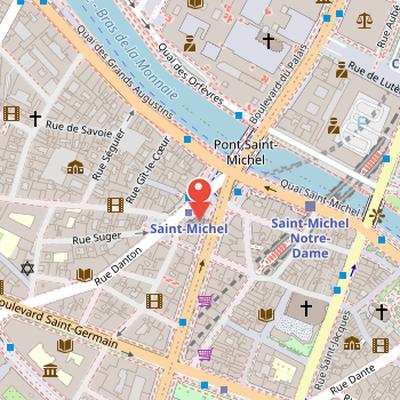
Nearby Objects
-
 Place Saint-Michel 30 m away
 -
 Saint-Séverin 200 m away
 -
 Shakespeare and Company 250 m away
 -
 Thermes de Cluny 250 m away
 -
 Sainte-Chapelle 250 m away
Construction and Heritage Status
The Fontaine Saint-Michel is a monumental fountain located on the Place Saint-Michel in the 5th arrondissement of Paris. It was constructed from 1858 to 1860 during Haussmann's renovation of Paris, and its design was planned by architect Gabriel Davioud. The fountain has been listed as a monument historique by the Ministry of Culture since 1926, reflecting its recognized heritage value within the city.
Design and Urban Setting
The Fontaine Saint-Michel was part of the reconstruction of Paris under Baron Haussmann during the French Second Empire. When Haussmann completed the Boulevard de Sebastopol-rive-gauche in 1855, later renamed Boulevard Saint-Michel, the small Place Saint-Michel was opened into a larger space. Haussmann asked Gabriel Davioud, architect of the service of promenades and plantations of the prefecture, to design a fountain suited to this new square. Davioud also designed the fountain and the facades of the new buildings around Place Saint-Michel, while responding to the demands of the prefect and the city administration, which funded the project.
Davioud's original fountain project was dedicated to peace and placed at the center of the square, but this idea was rejected by the prefect authorities. They instead asked him to build a fountain that would conceal the end wall of the building at Boulevard Saint-Michel and Rue Saint-Andre-des-Arts. Davioud then adapted the design to the proportions of that building. His 1856 plan gave the fountain four horizontal levels arranged like a triumphal arch. Four Corinthian columns on high socles frame a central niche, and the main cornice is surmounted by a French Renaissance inscribed tablet in grand framing.
The water layout was also designed as part of this architectural compromise. Davioud created shallow bowed basins to soften the visual effect off the axis of the bridge. Water spills from under the supine body of Saint Michael's adversary into the basins, then finishes in a basin sunk into street level with a curving front edge that softens the architectural base. In the 1856 plan, Davioud placed a feminine statue of Peace in the central niche.
Design Changes and Inauguration
In 1858, the original plan called for replacing Peace with a statue of Napoleon Bonaparte. This proposal met with furious opposition from opponents of Napoleon III. In response, Davioud proposed that the central figure should be the Archangel Michael wrestling with the devil. Construction began in June 1858, and the statue was inaugurated on August 15, 1860.
The decorative program also changed over time. In 1860, the center of the attic level was decorated with geometric motifs in colored marble. These motifs were replaced in 1862 or 1863 by a bas-relief of scrolls and children by Noemi Constant.
The monument was completed during a period closely connected with the political fate of Napoleon III, who was captured by the Germans during the French-German War in September 1870 and abdicated in the same month.
Damage and Repairs
The history of the Fontaine Saint-Michel includes several episodes of damage and repair linked to political unrest. In September 1870, the fountain was threatened by a mob, and on September 5 Davioud wrote an urgent letter to the Director of the Municipal Service of Promenades and Plantations. A crowd of unarmed workers came to the fountain intending to attack it and deface the eagles and inscriptions. The fountain was also damaged during the 1871 uprising and the suppression of the Paris Commune, when the lead eagles that topped it were destroyed. In response, Davioud was authorized by the Prefecture to carry out urgent repairs in 1872, and the fountain was repaired again in 1893. During these repairs, the imperial arms originally placed on the pediment were replaced by those of the City of Paris.
Decoration and Materials
The decoration of the Fontaine Saint-Michel was designed by a trained neoclassical sculptor from the Ecole des Beaux-Arts. It created a large scale iconography measuring 26 meters by 15 meters and required the work of nine different sculptors. The fountain combines several sculptural and ornamental elements, including two winged dragons by Henri Alfred Jacquemart, the figure of Saint Michael and the devil by Francisque-Joseph Duret, the rock under Saint Michael by Felix Saupin, and bas-reliefs and ornamental foliage by Marie-Noemi Cadiot. It also includes four statues representing the cardinal virtues. The material palette is varied, with columns of red marble from Languedoc, green marble, blue stone from Soignies, yellow stone from Saint-Yllie, and bronze statues. Together, these elements give the fountain a highly elaborate and multi-author character.
Critical Reception and Urban Context
When the Fontaine Saint-Michel was opened in 1860, critical reaction was divided. Much of the discussion focused on its colors. A critic writing in Le Monde Illustr tested described the monument as a venture into polychrome architecture, comparable to fountains in Rome. By contrast, Alfred Darcel in the Gazette des Beaux-Arts condemned the fountain for its choice of colors, its composition, and its incoherent style and iconography. He also objected to the way many statues by different artists were brought together, arguing that this arrangement nullified individual talents.
Other critics objected to the fountain being placed against a wall rather than in the center of the Square. They noted that this placement was common in Paris, but considered it harmful for monuments of grandiose style. In urban and architectural history, the Fontaine Saint-Michel is significant as the last monumental wall fountain built in Paris. It marked the end of a traditional Renaissance style that had begun with the Medici Fountain in the 17th century and continued with the Fontaine des Quatre-Saisons in the 18th century. Later monumental fountains in Paris were all free-standing, placed in the centers of squares or parks.