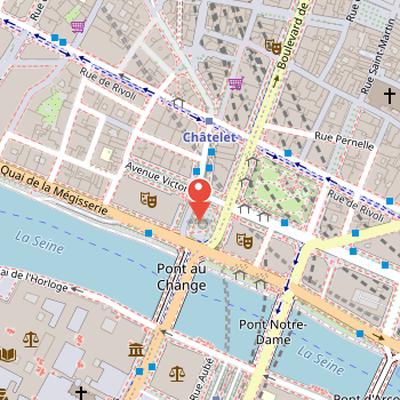
Place du Châtelet is a central square in the capital at the intersection of major east-west and north-south routes. Several well-known streets cross it, including Rue de Rivoli, Avenue Victoria, Quai de la Mégisserie, Quai de Gesvres, Boulevard de Sébastopol, Boulevard du Palais, and Pont au Change. The square is an important traffic hub and a major point for public transportation in Paris, served by the Châtelet metro station, which has access points in the square and connects several metro lines, as well as the nearby Châtelet - Les Halles RER station and several bus lines. The square is reserved for pedestrians. Historically, the site belonged to the Grand Châtelet, which stood here in the Middle Ages and was demolished in 1802. The present square was later measured and adjusted several times in the 19th century. Its center is marked by the Fontaine du Palmier.
Nearby Objects
-
 Théâtre de la Ville 70 m away
 -
 Théâtre du Châtelet 70 m away
 -
 Palais de la Cité 150 m away
 -
 Sainte-Chapelle 300 m away
 -
 Île de la Cité 300 m away
Transport Hub and Urban Crossroads
Place du Chatelet is a central place in the capital, located at the intersection of the north-south and east-west axes. It functions as an important traffic hub and a major center of public transportation in Paris, and it is also a preferred location for events. Several well-known Parisian streets cross at the square on the east-west axis, including Rue de Rivoli, Avenue Victoria, Quai de la Megisserie, and Quai de Gesvres. On the north-south axis, it is crossed by Boulevard de Sebastopol, Boulevard du Palais, and Pont au Change. The square is served by the Chatelet metro transfer station, with access points in the center and on the sides of the square. This underground station connects several metro lines and is linked to the Chatelet - Les Halles RER station, which connects RER lines at the site. The square is also served by several bus lines.
Origin of the Name
Place du Chatelet derived its name from the Grand Chatelet, which once stood on the site and was demolished in 1802. The place also took its name from Rue Sain-Lefroi, which had previously been known as Rue du Chatelet or Rue Devant-le-Chatelet. These naming origins link the square directly to the earlier topography and street history of the area.
History and Layout of Place du Chatelet
Place du Chatelet occupies a site that once held the Grand Chatelet castle, which secured the Seine bridge Grand Pont in the Middle Ages. After the city wall was built, the Grand Chatelet became the office of the Prevot de Paris, serving judicial administration and prison functions. Napoleon Bonaparte ordered its demolition in 1802.
The square later became the subject of repeated measurements and adjustments. Interior Minister Champagny fixed its width at 62.5 meters on October 11, 1806, but this was corrected to 61.5 meters on June 21, 1817 because of the misalignment of the Fontaine du Palmier. A royal decree of May 16, 1836 confirmed the width at 61.5 meters. The area was also a site of confrontation during the July Revolution of 1830, when insurgents and regular troops faced each other there.
In 1854, during the reorganization of Paris under the Second Empire, the square was remeasured and Rue Pierre-a-Poisson disappeared. The fountain on Place du Chatelet was also moved 12 meters west that year. The Fontaine du Palmier column, erected in 1808 to commemorate Napoleonic victories, stood on a pedestal fountain dating from 1858.
Architectural Composition of Place du Chatelet
Place du Chatelet is reserved for pedestrians and is organized around the Fontaine du Palmier, which stands in the center. The site includes a column erected in 1808 to glorify Napoleon's victories, and a fountain was added at its base in 1858. This fountain is decorated with a sphinx and statues by Gabriel Davioud, and it was later restored by Jules Blanchard. On both sides of the square are two theaters designed by Gabriel Davioud and commissioned by Baron Haussmann. The west side is occupied by the Theatre du Chatelet, while the east side features the Theatre de la Ville.