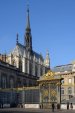
Palais de la Cité stands on the Île de la Cité in the Seine, in the center of Paris. Built and rebuilt over six centuries, it served as the residence of the kings of France from the 6th to the 14th century. From the 14th century to the French Revolution, it was the seat of the French treasury, the judicial system, and the Parliament of Paris. During the French Revolution, it functioned as a tribunal and prison, and held Maria Antonietta and other prisoners for trial by the Revolutionary Tribunal.
Since the 19th century, the site has been largely occupied by the Palais de Justice buildings. Remains of the earlier complex include the lower medieval hall of the Conciergerie and four towers along the Seine. The Sainte-Chapelle, the former palace chapel, also survives and is described as a masterpiece of Gothic architecture. The Conciergerie and Sainte-Chapelle are classified as national historical monuments and are open to visitors, while most of the Palais de Justice remains a working courthouse closed to the public.

Nearby Objects
-
 Sainte-Chapelle 120 m away
 -
 Théâtre du Châtelet 150 m away
 -
 Place du Châtelet 150 m away
 -
 Théâtre de la Ville 200 m away
 -
 Île de la Cité 250 m away
From Royal Residence to Courthouse Complex
The Palais de la Cite is located on the Ile de la Cite in the Seine, in the center of Paris. It served as the residence of the kings of France from the 6th to the 14th century, and from the 14th century to the French Revolution it became the seat of the French treasury, the judicial system, and the Parliament of Paris. During the French Revolution, it functioned as a tribunal and prison, and held Maria Antonietta and other prisoners for trial by the Revolutionary Tribunal.
The site was built and rebuilt over six centuries, leaving a complex architectural history. Since the 19th century, it has been largely occupied by the Palais de Justice buildings. Among the surviving historic elements are the lower medieval hall of the Conciergerie, four towers along the Seine, and the Sainte-Chapelle, the former chapel of the palace. The Sainte-Chapelle is described as a masterpiece of Gothic architecture. Both the Conciergerie and the Sainte-Chapelle are classified as national historical monuments and are open to visitors. Most of the Palais de Justice continues to function as a working courthouse and is closed to the public.
From Ancient Settlement to Royal Residence
Archaeological excavations indicate that the site of the Palais de la Cite was part of human settlement on the Ile de la Cite from 5000 BC to the beginning of the Iron Age. Although Julius Caesar recorded a meeting with the Parisii chiefs and other Celtic tribes on the island in 53 BC, there is no archaeological evidence that the Parisii used the island as their capital or even left material traces there. After the Romans expelled the Parisii in the 1st century BC, the island developed rapidly. In the Roman city of Lutezia, the forum and most of the city were on the left bank of the river, while the western end of the island was residential and held the palace of the Roman prefects or governors. This palace was a Gallo-Roman fortress surrounded by bastions, and in 360 AD the Roman prefect Julian the Apostate was declared emperor of Rome by his soldiers in the city.
From the 6th century, Merovingian kings used the palace as their residence when in Paris. Clovis, king of the Franks, lived there from 508 until his death in 511. Later, the Carolingian kings shifted their capital to the eastern part of their empire and paid little attention to Paris. In the late 9th century, King Charles the Bald rebuilt and strengthened the city walls after Viking invasions. The palace remained important under the Capetians: Hugh Capet, elected king of the French on July 3, 987, resided in the fortress when in Paris, although he spent little time in the city and also had royal residences in Vincennes, Compiegne, and Orleans. The administration and kingdom archives traveled with the king wherever he went. Through conquest and mixed marriages, the Capetian kings expanded their kingdom and transformed the Gallo-Roman fortress into a royal palace. Robert II the Pious, son of Hugh Capet, reigned from 972 to 1031 and stayed in Paris more often than his predecessors.
From Royal Fortress to Administrative Center
Robert II rebuilt the fortress to meet the comfort demands of his third wife, Constance of Arles, while also strengthening its old walls and adding fortified gates. The main entrance was likely on the north side. The walls enclosed a rectangle measuring 130 meters long and 110 meters wide. Inside this enclosure, Robert II built the Salle de Roi for Curia Regis meetings and the royal council, his residence or chambre de Roi to the west of it, and a chapel dedicated to Saint Nicholas. He also modernized the royal administration by placing the royal archives, treasury, and courts inside the Palais de la Cite. During this period, the city functioned as the kingdom's capital except for brief interruptions. The palace also hosted English King Richard the Lionheart in 1187.
The court created the office of Concierge, responsible for lower and middle courts within the palace, and the palace was renamed after this position. Robert II also improved the surroundings by paving the muddy streets with stone, which Storia identifies as the first stone paving in Paris. Under Louis IX, a new sanctuary was built within the palace walls to reflect his role as leader of the Christian world. Sainte-Chapelle was constructed between 1242 and 1248 on the site of the ancient chapel. It housed sacred relics purchased in 1238 from the governor of Constantinople, including the supposed crown of thorns and the wood from the Cross of Christ's Crucifixion. The chapel had two levels, one for royal servants and one for the king and royal family, and the upper chapel was connected directly to the royal residence by the covered Galerie Merciere. Only the king was allowed to touch the crown of thorns, which was displayed annually on Good Friday.
As the kingdom grew, new offices for finance, administration, and justice were placed inside the palace, and this expanding bureaucracy caused conflicts with nobles associated with the Parlement de Paris. The southern wall was demolished to make room for housing for the bureaucracy and the Canons. A new ceremonial hall, the Salle sur l'eau, was built on the north side near Tour Bonbec. Between 1285 and 1314, Filippo IV and Enguerrand de Marigny rebuilt, expanded, and decorated the palace further. They expropriated lands on the north side for the Chambre des Enquetes, built the Grand'Chambre, Tour Cesar, Tour d'Argent, and a gallery linking the palace to Tour Bombec, and rebuilt the south wall while moving the east wall to enlarge the ceremonial courtyard. The new east wall had two large gates and echauguettes at the corners. Other works included the restoration of the Salle d'Eau, expansion of the logs de Roi to the south, a new building for the Chambre des comptes, and an expanded garden. Storia also describes a private enclosed garden, a public bath, and a dock on the western end of the island near Place Dauphine, from which the king could travel by boat to other residences such as the Louvre fortress and Tour de Nesle. The work was nearly complete when Filippo IV died in 1314.
Later rulers continued to adapt the palace. Giovanni II built new two-level kitchens northwest of the Grand-Salle and a new square tower, and Carlo V installed a clock in that tower, which became known as the Tour de l'Horloge. The Hundred Years' War changed the palace's history and function, especially after King John II was held hostage by the English. In 1358, Etienne Marcel led a revolt against royal authority and his soldiers invaded the palace, where royal counselors Jean de Conflans and Robert de Clermont were killed in the presence of the future Carlo V. After the rebellion was suppressed and Marcel was killed, Carlo V moved his residence to the Hotel Saint-Pol in Le Marais for safety in 1364. The kings of France did not completely abandon the palace, however. They often returned for ceremonies in the Grand-Salle, received foreign monarchs there, presided over sessions of the Parlement de Paris, and displayed sacred relics at Sainte-Chapelle for court veneration. Some kings also made long stays in the palace until the 16th century.
Over time, the palace became chiefly an administrative center for the treasury and royal justice, and it became the seat of the Parliament of Paris. This Parliament was a high court of nobility rather than a legislative organ, and it registered all royal decrees. It also served as the court of appeal for nobility against royal court decisions and met in the Grand'Chambre under the King's presidency. Palace management became the responsibility of the Concierge, a high court official appointed by the king, and in the 15th century Isabella of Bavaria held this title. Gradually, the palace took the name Conciergerie after this office.
The Palace as a Prison
In the 14th century, the Palais de la Cite was used to hold important prisoners. According to Storia, this allowed authorities to avoid transferring detainees to the citys main prison at Chatelet for trial. The palace also had its own torture chambers, which were used to facilitate rapid prisoner confessions. By the 15th century, it had become one of the main prisons in Paris.
The prison entrance was located on the main courtyard, the Cour du Mai, which took its name from a tree placed there each spring by palace clerics. Prison cells were located on the lower floors and in the towers, and torture was also conducted in the towers. Prisoners were rarely kept in the palace for long periods. After sentencing, they were briefly taken to the square in front of Notre Dame Cathedral to hear their confessions, and then executed in Place de Greve.
Detention and Public Scandal at the Palais de la Cite
The Palais de la Cite served not only as a place connected with royal administration, but also as a detention site for a number of figures associated with major political crimes and public scandals. Storia reports that Enguerrand de Marigny, who had been chancellor of Philip IV and had overseen palace construction, was detained there before his execution after being accused of corruption by the successor of King Louis X. Gabriel, Count of Montgomery, was also held in the palace before execution; he had fatally wounded Henry II with his lance at a tournament and was later accused of supporting religious reforms and of disobedience to King Charles IX.
Other detainees connected to serious crimes included François Ravaillac, identified as the assassin of Henry IV, and Marie-Madeleine d'Aubray, Marchioness of Brinvilliers, described as a poisoner. The palace was also used to hold the bandit Louis-Dominique Bourguignon before execution, and Robert François Damien, a palace servant who tried to kill Louis XV, was detained there as well.
The site also appears in accounts of the diamond necklace affair. Jeanne de Valois, Countess de la Motte, was detained in the palace for her role in the affair. Storia reports that she was whipped and branded with a V for Voleur in the palace, then transferred to Saltpetriere prison to serve a life sentence, from which she escaped a few months later. These accounts show the Palais de la Cite as a place associated with punishment, accusation, and public disgrace.
Modifications and Reconstruction
From the 14th to the 18th century, French kings repeatedly modified the Palais de la Cite. King Charles VI replaced the spire of Sainte-Chapelle in 1383, and by the end of the 14th century an oratory had been built outside the chapel along its south wall. Later, King Charles VIII created a new rose window on the western facade of Sainte-Chapelle between 1490 and 1495. In 1504, King Louis XII added a monumental staircase on the south side of the palace and built a new structure for the Chambre des comptes, the royal treasury.
Further changes followed in the 16th and 17th centuries. King Henry III added a sundial to the wall of the clock tower in 1585 and began construction of Pont Neuf to link the island with both banks of the Seine. In 1607, King Henry IV gave up the royal garden at the end of the island and created Place Dauphine. King Louis XIII rebuilt the riverbanks in stone in 1611, while a serious fire destroyed the Grand-Salle in 1618. Salomon de Brosse rebuilt it in 1622 according to the same plan. After another fire destroyed the spire of Sainte-Chapelle in 1630, it was replaced in 1671.
Natural disasters and fires continued to reshape the site. During the winter of 1689 to 1690, flooding from the Seine caused significant damage and destroyed the lower stained glass windows of Sainte-Chapelle. A fire destroyed the Cour de Comptes in 1737, and Jacques Gabriel rebuilt it. A more serious fire in 1776 damaged the king's residence, the Grosse Tour, and buildings around the Cour de Mai. Reconstruction led to the demolition of the old Treasury of Chartres, the Grosse Tour, and the eastern wall of the palace, and produced the current facade for what became known as the Palace of Justice. During this reconstruction, a new gallery was built at Sainte-Chapelle and a new chapel was created inside the Conciergerie to replace the 12th-century oratory.
The Conciergerie in the French Revolution
During the French Revolution, the Conciergerie took on a notably severe role as many new prison cells were built there. The revolutionary Convention, which was divided into Girondins and Montagnards factions, ordered the creation of a Revolutionary Tribunal seated in the Conciergerie on March 10, 1793. The tribunal met in the Grand-Salle, which was renamed the Salle de la Liberte, and was directed by Fouquier-Tinville, a former state prosecutor, with the assistance of a jury of twelve members.
The tribunal became associated with rapid and final judgments. After Robespierre had the Convention approve a law on suspects that reduced prisoners' rights, the tribunal's decisions had no appeal and death sentences were carried out the same day. Several prominent figures passed through the Conciergerie before their executions, including Maria Antoinette, who was imprisoned for two and a half months before her trial and execution on October 16, 1793. Twenty Girondins members of the Convention were tried for conspiracy against the Republic on October 24 and immediately executed. Philippe Egalite was executed on November 6, Bailly on November 11, and Madame du Barry on December 8.
Life of Prisoners in the Conciergerie
Prisoners in the Conciergerie rarely spent much time there before their trials, yet the building could hold up to six hundred at once. Conditions varied by status: wealthy prisoners received single cells, while most were crowded into large common cells with straw on the floor. Cell doors opened at dawn so that prisoners could walk in the courtyards or corridors. Female prisoners used a separate courtyard with a fountain for washing clothes. Each evening, prisoners gathered at the foot of tour Bonbec to hear guards read out names. Those whose names were called were then given a thin banquet with the other prisoners that night.
The Revolutionary Tribunal at the Palais de la Cite
The Palais de la Cite became closely associated with the Revolutionary Tribunal during the period when it prosecuted opponents of Robespierre. According to Storia, figures such as Jacques Hebert, Danton, Camille Desmoulins, and others were tried and executed by the Tribunal. As opposition to Robespierre increased and accusations of dictatorship grew, so many opponents were arrested that the Tribunal began conducting group trials.
Storia reports that in July 1794, an average of thirty-eight people were tried and guillotined each day. After Robespierre was arrested on 28 July 1794 following an unsuccessful attempt to take his own life, he was taken to the Conciergerie infirmary and then tried and executed at Place de la Revolution only hours later. The Tribunal chief, Fouquier-Tinville, was later arrested and imprisoned in the Conciergerie for nine months before his execution on 9 May 1795.
The Revolutionary Tribunal was abolished on 7 May 1795 after executing 2,780 people in 718 days, leaving the Palais de la Cite strongly linked with the violence and judicial practices of the Revolutionary period.
The Palais de la Cite in the 19th Century
After the Revolution, the Palais de la Cite became the seat of the French judicial system and also continued to serve as a prison. During the 19th century, it held several notable prisoners linked to political conflict and acts of violence. These included the rebel Georges Cadoudal, who was imprisoned during the consulate of Napoleon Bonaparte until his execution in 1804, and Marshal Michel Ney, who was held before his execution in 1815 after the fall of Napoleon. The palace also imprisoned Louis Napoleon Bonaparte after his failed attempt to overthrow King Louis-Philippe, as well as the anarchists Giuseppe Fieschi and Felice Orsini after their attempts on the lives of Louis-Philippe and Napoleon III. Ravachol was also imprisoned there and was executed in 1892.
Nineteenth-Century Transformations
During the nineteenth century, the Palais de la Cite underwent major alterations in both restoration and expansion. The Sainte-Chapelle, which had been turned into a legal document repository during the Revolution, lost half of its stained glass, but a restoration campaign was initiated between 1837 and 1863. Earlier, the vaulted ceiling of the medieval hall of the men-at-arms was restored between 1812 and 1819. At the request of King Louis XVIII, an expiatory chapel was also built where Marie Antoinette's cell had been located.
The Conciergerie and the Palace of Justice were reshaped through a series of new constructions and facades. A new facade for the Conciergerie was built along the Seine between 1820 and 1828, followed by a new entrance in 1836 between the Tour d'Argent and the Tour Cesar. The Palace of Justice expanded from 1847 to 1871 under architects Joseph Louis Duc and Etienne Theodore Dommey. This expansion added a new facade along the Boulevard du Palais, a building for the penitentiary police, and a new construction for the Court of Cassation. It also included the rebuilding of the roof of the Salle des pas-perdus and the restoration of the Tour de l'Horloge. During the same campaign, remains of the ancient palace, including the Logis du Roi and Salle sur l'eau, were demolished.
The site also suffered destruction and renewal after the fire of May 1871 during the last days of the Paris Commune. Eugene Viollet-le-Duc led a twenty-year reconstruction project, completing the facade of Harlay, while Honor Daumet completed the Court of Appeal. The last building, the Tribunal Correctionelle at the corner of Quai d'Orfevres, was finished between 1904 and 1914. The Conciergerie was declared a national historical monument in 1862, opened some rooms to the public in 1914, and continued to operate as a prison until 1934.
The Medieval Towers of the Palais de la Cite
The Vestigia del Palazzo Medievale preserve four medieval towers along the Seine: the Horloge on the left, followed by Cesar, Argent, and Bonbec on the right. Their history combines architecture, administrative functions, and prison use. Tour Bonbec, built between 1226 and 1270, is the oldest tower from the reign of Louis IX. It has battlements at the top and was originally shorter, before being raised during the 19th century restoration. This tower housed the prison's torture chamber and served as the main torture chamber in the Middle Ages.
Tour de Cesar and Tour d'Argent were built in the 14th century and each had four levels. Their upper levels housed tribunal chancellors' offices from the 15th century, while the lower levels contained prison cells. The tallest tower, Tour de l'Horloge, was built by John the Good in 1350. Its clock dates from the 14th century, and the first public clock was installed by Charles V in 1370 and made by Henri de Vic. Later, Henry III added clock decoration with allegorical figures in 1585. That decoration was destroyed during the Revolution and restored afterward.
The summit of the tower held a bell used to announce royal family events, and the same bell also signaled the St. Bartholomew's Day massacre. The original bell was removed and melted during the Revolution. The facades of the ensemble were created in the 19th century in neo-Gothic and neoclassical styles, with the east facade designed by Antoine-Marie Peyre and the west facade by Joseph Louis Duc and Etienne Theodore Dommey.
The Surviving Medieval Rooms of the Conciergerie
The lower part of the Conciergerie preserves the main vestiges of the medieval palace, including the Salle des Gardes and the Salle des Gens d'armes. These rooms, together with the kitchens, are the only surviving chambers of the original Capetian palace. The Salle des Gardes was constructed between the end of the 13th century and the beginning of the 14th century, and it served as the ground floor of the Grand'Chambre. It measures 22.8 meters in length, 11.8 meters in width, and 6.9 meters in height.
The Salle des Gardes is connected to the upper hall by a staircase in the southwest and by another staircase in a demolished tower. On its north side, two staircases lead to the Argent and Cesar towers, which contained prison cells. The hall itself is marked by massive columns with decorative sculptures showing animal combat and narrative scenes. During the Revolution, the chief prosecutor Fouquier-Tinville had his apartment on the upper floor, and his office was located in the Torre di Cesare.
The Salle des Gardes remained full of cells until the mid-19th century, when it was restored to its original appearance. Below the Grand-Salle, the Conciergerie also contains the Salle des Gens d'armes on the ground floor, forming part of this rare survival of the medieval palace interior.
The Grand-Salle and the Salle des Gens d'armes
The Palais de la Cite included the Grand-Salle and the lower hall known as the Salle des Gens d'armes, both central to its medieval life and later history. In the Grand-Salle, French kings held banquets to welcome royal guests and mark special occasions. It also hosted major events such as the 1378 visit of Emperor Charles IV of Germany, who was received by Charles V before Charles V moved from the palace, and the marriage of Francesco II and Maria Stuarda, Queen of Scotland.
The lower floor was used in the medieval period mainly as a dining hall and waiting area for Royal Household staff, and it could serve up to two thousand people. A wide staircase, now walled up, connected this level to the Grand-Salle. The Salle des Gens d'armes measured 63.3 meters long, 27.4 meters wide, and 8.5 meters high. It had a high wooden double-vaulted roof that burned multiple times, with the last fire set by the Commune of Paris in May 1871. The hall was later replaced by the Salle des Pas Perdu in the Palace of Justice.
From the 15th century, the hall was divided into smaller rooms and prison cells, and it underwent many modifications and restorations. After most of the upper hall was destroyed by fire in 1618, architect Salomon de Brosse built a new hall, without placing the new columns directly above the original lower-level columns. In the 19th century, part of the lower hall roof collapsed and was rebuilt with additional columns, windows were added on the north side overlooking the courtyard, and a circular staircase in the northeast corner was built in medieval style during Napoleon III's reign. Napoleon III was also briefly imprisoned in the building.
Sainte-Chapelle and the Conciergerie Prison
The Vestigia del Palazzo Medievale includes La Sainte-Chapelle, built by King Louis IX between 1241 and 1248. It was created to hold relics of the Crucifixion of Christ, including the Crown of Thorns. The chapel was arranged on two levels: the lower chapel served as a parish church for palace inhabitants, while the upper chapel was reserved exclusively for the king and the royal family. The upper chapel is known for its stained glass windows, and about half of these are original. After the Revolution, the chapel was converted into a judicial archive depot, and it underwent careful restoration in the nineteenth century.
The site also preserves major parts of the Conciergerie prison complex. These include a prison quarter dating to the late eighteenth century and a section rebuilt by Louis XVI after a fire in 1776. During the French Revolution, the prison served as the main political prison, including for Marie Antoinette. The prison was largely rebuilt in the nineteenth century, and some original rooms, such as Marie Antoinette's cell, were lost. A partially restored prison section was prepared for the 200th anniversary of the French Revolution in 1989.
Several interior spaces reflect the prison's overcrowded conditions and revolutionary history. La Rue de Paris, a separated section of the Salle des gardes from the fifteenth century, served as a common cell when other spaces were full and was named after