The Église de la Mission de France is a church building located at 44 rue du Tapis-Vert in the 1st arrondissement of Marseille, France. Built at the end of the 19th century and renovated in the 20th century, it is part of a site with a long religious history. The church has been listed as a historic monument since March 4, 1992.
The history of the Mission of France in Marseille dates back to the 17th century, when the priests of the Mission, founded by Saint Vincent de Paul and also known as the Lazarists, settled in the arsenal des galères quarter. Between 1648 and 1673, a church and several buildings were constructed during enlargement works under Louis XIV and under the direction of Nicolas Arnoul. During the Revolution, the buildings became national property, and from 1791 to 1794 the church was used by Protestants as their first official temple in Marseille. After later changes of ownership and use, the church was entrusted to the Jesuits in 1839, rebuilt between 1841 and 1865, and then returned to worship in the 20th century after a period of secular use.
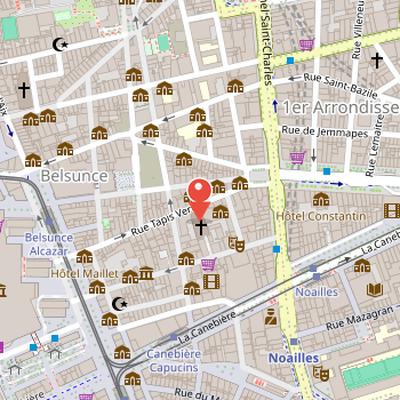
Nearby Objects
-
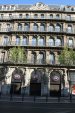 Hôtel Louvre et Paix 200 m away
 -
 Alcazar 250 m away
 -
 Musée d'Histoire de Marseille 300 m away
 -
 Jardin des Vestiges 400 m away
 -
 Palais des arts 450 m away
History and Heritage Status
The Eglise de la Mission de France is a church built at the end of the 19th century and renovated in the 20th century. It is located at 44 rue du Tapis-Vert in the 1st arrondissement of Marseille, France. The building has been listed as a historic monument since March 4, 1992, reflecting its recognized heritage value within the city.
History of the Mission of France
The priests of the Mission of France were founded by Saint Vincent de Paul. According to the history of the site, they settled in the arsenal des galeres quarter. The congregation of the priests of the Mission is also known as the priests of the Mission or Lazarists.
History and Later Uses
The Church of the Mission of France was built with various associated buildings between 1648 and 1673 on a site defined by specific streets, during the enlargement works carried out under Louis XIV and under the direction of Nicolas Arnoul. During the Revolution, the buildings of the Mission of France became national property. From 1791 to 1794, the church was used by Protestants as their first official temple in Marseille. In 1795, the convent buildings were sold, except for the church.
In 1839, Eugene de Mazenod entrusted the church to the Jesuits, who then began a reconstruction campaign from 1841 to 1865. During this work, the church entrance was connected to rue du Tapis-Vert. In 1860, cimentier Desire Michel created the original facade, and the main altar was consecrated by Petagna, bishop of Castellamare. In 1865, the Puget house of Toulouse installed an organ with a case designed by Henry Condamin. Jean-Francois Barthes died in a room of the Jesuit house.
After the Jesuits were expelled by anticongregationist laws of the Republic, the church became municipal property and was closed for worship in 1901. It was then used successively as a concert hall, a masonry school, and a school material warehouse until 1979. The church was returned to worship in 1984 and entrusted to the Fraternity of Saint Pius X. It is dedicated to Pope Saint Pius X.
The Organ and Its Musical Life
The organ at the church went through a complex history of transfer, reconstruction, and renewal. Its case was transferred to the chapel of the grand seminary in 1933 by Marcel Prevot. After the original Puget pipes disappeared, the organ was reconstructed using an electric transmission instrument from the Rialto cinema organ. In 1989, it received pipes from a city organ in Tours, and in 1990 it was returned to its original case in a church by the city of Marseille. The instrument, with 17 stops, was installed on the gallery and was played for the first time during the Christmas midnight mass in 1991. It was then inaugurated by Madame Odile Pierre on the Sunday before Ascension Thursday and solemnly blessed by Monseigneur Tissier de Mallerais, bishop of the Fraternity St Pie X.
The organ also became the focus of a significant musical event in Marseille. For the occasion, the parish organized the first sacred music festival of Marseille, Medievances, with concerts centered on the organ from the Sunday before Ascension to the following Sunday. The festival invited French and international musicians performing repertoire ranging from Claudio Monteverdi to Naji Hakim. This period of activity ended with the prior's departure.
In 2006, the Great Organ was decided to be replaced. Through a donation, Parish Saint-Pie X acquired a secondhand baroque aesthetic organ from Germany, which Yves Cabourdin from Carces, Var adapted to the original case.
The Organ and Its Reworking
The organ underwent a complete renewal of its mechanical key transmission and was revoiced. Because there was not enough space inside, two chamade trumpet stops with electric transmission were added. Several stops were also changed: a new cromorne replaced the gambe, a human voice stop replaced the oboe shifted to chalumeau in the pedalboard, and the recurrence of the récit quint was replaced by a nasard stop. Its progressive mixture of IV-VI ranks was recomposed into fixed VI ranks. This new composition now allows the performance of German and French repertoire from the 17th and 18th centuries. Since 1991, Thierry Boccamaello has served as the titular organist.
Liturgical Furnishings and Interior Reuse
The churchs interior furnishings were updated through the reuse of elements from other religious sites. The 1864 main altar was replaced by an altar taken from a side chapel of the former Saint-Martin church, which had been demolished in 1887. A fir pulpit was also installed, coming from the Convent of the Sisters Victims of the Sacred Heart of Jesus at 52 rue Levat in Belle de Mai. In the same year, a painting representing the baptism of Christ was placed behind the baptistery.