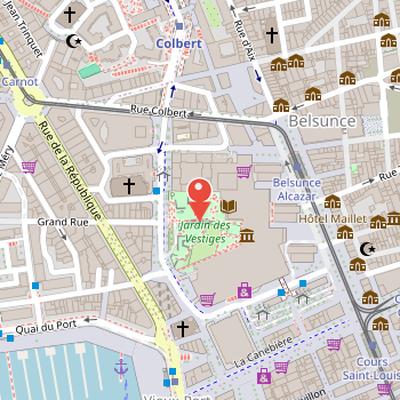
Jardin des Vestiges is an archaeological garden behind the Centre Bourse in Marseille, France, containing remains of the ancient port. The site was uncovered in 1967 during construction work and later classified as a historic monument site. It was created by landscape architect Joël-Louis Martin and is part of the Museum of History of Marseille. The garden opened to the public in 1983 and was renovated between September 2018 and September 2019, reopening on 20 September 2019.
The discovery revealed important archaeological remains, including Greek fortifications, funerary enclosures, and parts of Marseille’s ancient port. Excavations continued for about ten years, with additional surveys carried out later, including in 1994. The site corresponds to the contact area between the ancient city north of the old port and the suburban port zone outside the walls. The garden is surrounded on three sides by a shopping center, helping to highlight the remains. Some artifacts from the site are displayed at the Marseille History Museum.
Nearby Objects
-
 Musée d'Histoire de Marseille 60 m away
 -
 Église Saint-Ferréol les Augustins 150 m away
 -
 Alcazar 200 m away
 -
 Place du Général-de-Gaulle 300 m away
 -
 Hôtel Louvre et Paix 300 m away
Archaeological Garden and Museum Site
The Jardin des Vestiges is a garden containing archaeological remains from the ancient Port of Marseille, France. It is located behind the Centre Bourse in Marseille and is classified as a historic monument site. The remains were uncovered in 1967, and the garden was created by the landscape architect Joel-Louis Martin. As part of the Museum of History of Marseille, it was opened to the public in 1983. The site underwent renovation from September 2018 to September 2019 and reopened on 20 September 2019.
Archaeological Remains at Jardin des Vestiges
Jardin des Vestiges in Marseille was revealed during construction work for the Centre Bourse in 1967, when important archaeological remains were discovered. The findings included Greek fortifications, funerary enclosures, and part of Marseille's ancient port. The discovery led to the classification of approximately the area as a historic monument, although the remaining area was sacrificed for the Centre Bourse development. Excavation continued for about ten years under the Direction des Antiquites historiques and the CNRS, and further surveys were carried out later, including in 1994.
The site corresponds to the contact zone between the ancient city north of the old port and the suburban port area outside the walls, including places such as Saint-Jean Saint-Laurent hill, Place des Moulins, and Carmes hill. Today, the remains are presented in a garden surrounded on three sides by a shopping center, a design intended to highlight the archaeological features. Some of the artifacts recovered from the site are displayed at the Marseille History Museum.
Archaeological Vestiges of the Ancient Harbor
The archaeological remains at Jardin des Vestiges indicate that the old port once extended eastward and northeastward, forming a harbor horn that ended in marshland during the Greek period. This harbor area, now grass-covered, formerly spread out in front of the city walls, and the location of the Augustins church was once occupied by the port. The visible docks date from the Roman period and are preserved in length, along with stairs that were used for unloading goods.
The water body gradually silted up and later served as a dumping site for various waste. Among the remains is a boat about 12 meters long, abandoned there around the 1st century AD. It sank into the silt, which helped conserve it. The wreck was uncovered during excavations and preserved by lyophilization, and it is currently exhibited at the Marseille History Museum.
Archaeological Remains and Fortifications
The Jardin des Vestiges preserves remains from several phases of the ancient fortifications and related urban works. The oldest discovery in the northwest sector is a north-south roadway segment dating from the 6th century BC. Nearby, an initial rampart was built at the end of the 6th century BC with a base of white Saint-Victor limestone and an upper elevation of crude clay brick. These fortifications were associated with a large public well to the north, now disappeared. The archaic rampart was probably rebuilt in the second half of the 5th century BC, when a new wall with a stone base and large tuff blocks replaced the earlier brickwork. A gate opening onto the east-west Italy road was flanked by two towers or bastions, and the defense system was preceded by a ditch. The wall is still visible in the northwest corner of the present garden.
A later rebuilding took place in the second half of the 3rd century BC, when the rampart was reconstructed with pink limestone blocks from Cap Couronne transported by boat. This fortification defended the city during the siege of Julius Caesar in 49 BC and remained in use until the beginning of the Middle Ages. Another wall, built with two facings of standardized blocks and filled with stone waste from the old rampart, also belongs to this sequence. In front of the Hellenistic fortifications, an outer wall with a broken line was built and reconstructed around the 2nd century BC.
Among the preserved elements are the North Tower, or square tower, discovered in 1913 and classified as a historical monument in 1916. It adjoins the Crinas wall, and some internal blocks bear marks of quarrymen or stonemasons. The South Tower, also called the leaning tower, was originally square and survives only in its eastern facing, which contains two arrow slits. The two towers flanking the Italy Gate were approximately 12 to 13 meters high. A curtain wall 50 meters long connects the leaning tower to a rectangular tower measuring 10 by 20 meters, and part of this curtain wall has been reconstructed to better illustrate the fortification.
Roads and Water Installations
The Jardin des Vestiges preserves remains of a paved road in its last construction phase from the Late Empire, dating to around the 4th century AD. The road was built with large stone slabs from Cassis and was designed to withstand heavy cart traffic. Its surface shows wide grooves intended to prevent wheel slippage, along with holes used for handling and placement. Sidewalks are visible along the edges of the paved road, indicating a structured street layout.
The site also includes a large square basin east of the garden near the Centre Bourse gallery. Built at the beginning of the century, it measures several meters across and is made of well dressed stones laid in five courses. Its floor was paved and sealed with pitch to ensure waterproofing. The basin, which covered nearly several square meters, received water through a pipeline that captured spring water at the northeast internal facing. This pipeline was protected by Cassis stone slabs and extended more than several meters to the north. The basin was used to supply water to boats.
Additional features include anchor points on the western internal facing and a reserved cavity for a wheel approximately several meters in diameter, used to clean sediments. A second wheel probably served to raise water.
Funerary Enclosures at Jardin des Vestiges
Jardin des Vestiges includes two funerary enclosures discovered north of the Voie d'Italie. Both are rectangular structures covering only several square meters, and they function as terraces visible from the Voie d'Italie. The northernmost enclosure was destroyed in 1973 during construction of the Centre Bourse, while the preserved enclosure remains decorated with alternating metopes and triglyphs on a plinth. In the center of the terrace is a square base made of white limestone blocks, probably intended for an altar or a statue.
The enclosures were built at the beginning of the century. Excavations identified nineteen cremations in the northern enclosure and six in the triglyph monument, with the cremations carried out on site. The remains were collected and placed in lead, ceramic, or bronze urns, which were then deposited in stone boxes within burial pits on the terrace. Some of these urns are now displayed at the Marseille History Museum. Most of the tombs date to the current century, with one cremation dating to the previous century and considered accidental.