Musée d'Histoire de Marseille is a municipal museum located at 2, rue Henri Barbusse, in Centre Bourse and the Port antique de Marseille. Opened in 1983, it presents collections ranging from prehistory to the present day and covers the largest area for an urban history museum in France. The museum was founded with the participation of archaeologist Alain Nicolas and is associated with the excavation history of the Centre Bourse site, where Greek, Roman, and medieval relics were discovered during construction work begun in 1967. Part of these finds were preserved on site, and the ancient port was converted into a garden of relics. The museum includes permanent and temporary exhibition spaces and a public library specializing in history, archaeology, and urban planning. It was renovated and reopened in 2013, with new architecture and museography intended to strengthen the connection between the city, the museum, and the archaeological site.
Nearby Objects
-
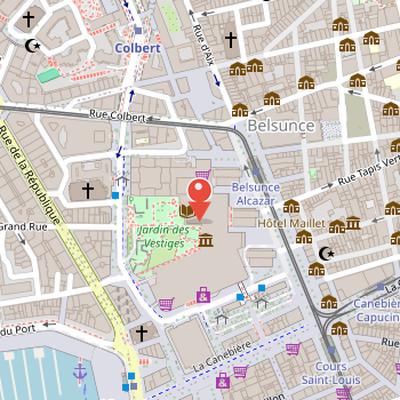
 Jardin des Vestiges 60 m away
 -
 Alcazar 150 m away
 -
 Église Saint-Ferréol les Augustins 200 m away
 -
 Hôtel Louvre et Paix 250 m away
 -
 Place du Général-de-Gaulle 300 m away
Location and Scope
The Marseille History Museum, or Musee d'Histoire de Marseille, is a municipal museum located at 2, rue Henri Barbusse. It is housed in Centre Bourse and at the Port antique de Marseille. The museum opened in 1983 and is conserved by Fabrice Denise. Its collections range from Prehistory to the present day, giving it a broad chronological scope. It also covers the largest area for an urban history museum in France, which underlines its scale within the field of urban heritage museums.
From Excavation Site to City Museum
Construction of the Centre Bourse began in 1967 on land in the quartier de derriere la Bourse. During excavation for the shopping center, numerous Greek, Roman, and medieval relics were discovered. Historique noted the importance of these finds, even though the existence of the mur de Crinas was already known, and also recorded that Gerard Ricard had stated in 1916 that the Greek origin of the mur de Crinas was supported by the Archaeological Commission. Historique then worked with archaeologist Alain Nicolas to help found a history museum of Marseille, which opened in 1983.
The museum preserved part of the discoveries on site and turned the ancient port into a garden of relics. Its original arrangement included a temporary exhibition room for events on themes from Marseille's history, a permanent exhibition room displaying various relics, and a public library specialized in history, archaeology, and urban planning. The museum was renovated by architect Roland Carta and reopened in 2013 during Marseille-Provence 2013. The new architecture aimed to recreate an intimate link between the city, the museum, and the archaeological site of Port antique, while the new museography by architect Adeline Rispal connected port history and the architecture of the commercial site. The museum presents Marseille's history in thirteen thematic sections and also offers a digital enhanced tour of the city's historical axis between the museum and MuCEM.
Early Trade and Ceramic Finds
The museum visit begins with a film on the prehistoric occupation of the Marseille basin before moving to the arrival of the Ionians around 600 BC, when they brought Greek civilization to the city. The display traces how the Ionians first imported wine from Etruria and later produced their own wine, exporting it to Gallic populations in the mid-6th century BC. Wine transport is illustrated with micaceous clay amphorae dated to 540/500 BC and 510/500 BC, and the museum exhibits six types of wine amphorae from different periods and origins, including Etruria, Clazomenae, Marseille, and South Italy. The collections also show that Marseille received tableware from Greek ships, including one that sank near Pointe Lequin around 520 BC. Tableware from the first two centuries after the foundation of Marseille is displayed in two cases, alongside Ionian and Attic cups from Pointe Lequin and Place Jules-Verne. Corinthian, Laconian, and Attic ceramics from several Marseille locations further document the citys early exchanges with the Greek world.
Greek Cult Objects in the Marseille History Museum
The museum presents several objects linked to the religious life of ancient Marseille. According to the collections, the Greeks brought the gods Artemis, Apollo, and Athena to the city, and temples were built there for these deities. One of the most notable finds is a large limestone Ionic capital, discovered in 1952 near the sanitary consignment below Saint-Laurent hill. It is displayed in the museum, and its size and weight suggest that it belonged to a large temple. The capital later had a secondary use in a Roman-era quay wall.
Another important group consists of votive stone steles representing a seated goddess in a temple-shaped building, which are described as the most frequent cult objects of the period. Around fifty of these steles, called Naiskoi, were discovered under the old rue Negrel during the 1863 street cutting of rue Imperiale, now rue de la Republique. The figures are shown in long garments with veiled heads and hands placed on their knees, a form associated with archaic Greek art. On some examples, the figurine holds an animal identified as a wild beast. The most commonly accepted hypothesis identifies the deity as Cybele, linking the steles to a sanctuary dedicated to the goddess of Asia Minor.
Other religious objects are grouped in a display case at the Musee d'histoire de Marseille. These include an antefix with a silen head, a boar head on the left, a small perfume vase shaped like a gorgon head, a statuette of Artemis, and an askos with a silen head.
Ancient Shipwrecks in the Museum Collection
The Marseille History Museum displays five ancient shipwrecks recovered from the Jules-Verne excavations, which began in 1993 at the place Jules-Verne. Two of the wrecks are Greek and three are Roman. Together, they form the largest collection of ancient ships shown in the Mediterranean, alongside the Roman wreck of the Bourse.
Among the Greek vessels, Jules-Verne 9 and Jules-Verne 7 were abandoned at the end of the 5th century BC and sailed in the second half of that century. The preserved remains of Jules-Verne 9 measure 9 meters long and 2 meters wide, while the vessel was estimated to have been about 10 meters long and 2.5 meters wide. Its construction used ligatures, with watertightness ensured by linen fabric rolls placed on the assembly joints. The hull was also coated inside and outside with wax and pitch. Red coral fragments embedded in the internal coating indicate that the vessel was used for coral fishing, an activity that continued until a recent period.
Jules-Verne 7 is preserved as a sailing merchant ship with a rounded hull and slender ends. It measured long and carried twelve tonnes of goods. Its construction combines ligatures and mortise and tenon joints, reflecting an evolution in naval building in which ligatures were gradually replaced by mortise and tenon techniques. This method was not yet fully mastered in the second half of the century. The keel was made of green oak, the planks of pine, and the framework of alder and pine.
Roquepertuse and the Ancient Collections
The museum's ancient collections document several discoveries linked to oppida and settlement sites around Marseille. At Roquepertuse, in the commune of Velaux, the first finds were recorded in 1824. Around 1860, the owner discovered two crouching warrior statues. Later excavations were led by Count Henry de Gerin-Ricard from 1919 to 1924 and again in 1927, with further work in 1960 and 1991. The excavated remains include a platform paved with flat stones and about fifteen reused steles, accessed by a staircase of large stone blocks. A storage zone containing nine dolia was also identified, and a portico with pillars is thought to have stood on the platform. Early archaeologists interpreted Roquepertuse as an isolated sanctuary, but later conclusions describe it as a settlement of about with a northern sanctuary and a protective rampart. The occupation is dated to and its destruction by fire and stone catapult projectiles to early .
Among the objects preserved from Roquepertuse are a bird of prey sculpture, sculptures of warriors and pillars, a two-headed Hermes sculpture, and a lintel with four sculpted horse heads. The collection also includes cannonballs and weapons used in the destruction of the site. Other material from the museum comes from an oppidum east of Marseille, and from the Bourse site, where excavations between 1967 and 1977 opened access to the garden of relics and the ancient port, with additional sporadic excavations in 1978-1983, 1985, 1992-1994, and 2000. The collections also mention an oppidum in the commune of Pennes-Mirabeau between Marseille and Berre, where fragments of a warrior statue were found, including a seated warrior wearing a cuirass with a bent ring on the hand; a silver ring identical to that bent ring was also found on the site.
Shipwrecks and Port Activity
The sequences and collections present important works from the port shores as evidence of economic activity. Among the objects shown are shipwrecks found at Place Jules-Verne and in the corne du port, including the wrecks Jules-Verne 3 and 4. These two wrecks date from the same unspecified period and are described as identical types with a bottom opening of unspecified dimensions. They are identified as flap barges designed to discard dredged port sediments at sea. Jules-Verne 3 is presented as a ship of unspecified size, with two-thirds of it exhibited, and the museum also displays a reconstruction model made by the Camille-Jullian center.
Another notable piece is Jules-Verne 8, a modest wreck that represents the bow of a ship from an unspecified period. The museum notes that the bow is usually destroyed, which makes this remains particularly important.
The collections also include the wreck from the corne du port, discovered in 1967 during excavation works at Centre Bourse. Dated to the end of the 1st century AD, it shows that the boat underwent numerous repairs before sinking in the corne du port after severe damage. At that time, the port area had progressively silted up and had a shallow draft, making it unusable. The boat gradually sank into the mud, which preserved it. The wreck was extracted at 14 meters long and 5 meters wide, and weighed more than 12 tons.
Preservation of the Wreck
Les se?quences et les collections chose lyophilization to conserve the wreck. This method was described as using sublimation, in which a solid changes directly into vapor without passing through a liquid phase. The entire wreck was first frozen to solidify the water absorbed in the wood, and it was then placed under vacuum so that the water vapor could be removed progressively. The implementation of lyophilization for an object of this volume was presented as a world first.
Roman Trade, Burial, and Christian Remains
The Marseille History Museum presents several sequences and collections that focus on the citys Roman and late antique past through material remains, reconstructions, and archaeological finds. One section highlights commerce and production. Archaeological evidence is used to show commercial exchanges, with amphoras serving as key indicators of import regions and traded goods. A holder with six Roman amphoras dating from the 1st to 2nd century AD illustrates origins from Betic, Languedoc, Campania, and Tunisia. The collections also confirm pottery production in the 1st century AD by a large workshop north of the city near the Carmes hill rampart, and display a model of a kiln used to produce amphoras with flat bottoms.
Domestic life in Roman Marseille is presented through private housing, which is described as an example of Romanization through construction and decoration techniques. Houses had walls decorated with paintings and floors with mosaics. Everyday objects from the period are also shown, including oil lamps found in tombs, jewelry, hairpins, flasks, perfume vases, toiletry instruments, and writing tablets.
A substantial part of the museum is reserved for ancient and more recent cemetery discoveries. These materials explain burial behavior among the people of Marseille from many funeral sites around the ancient city. The Sainte Barbe necropolis, discovered during rescue excavations in 1991 before parking construction, is presented as one of the major finds. It was originally in a valley between Butte des Carmes and Colline Saint-Charles, and is located between Porte dAix and Centre Bourse, west of Rue daix and north of the Pierre Puget Faculty of Economics. Excavations uncovered 548 ancient tombs, including 532 identified tombs with 96 Greek and 436 Roman period tombs. Some tombs were reconstructed using foam and plaster molds with original furniture and skeleton interiors. The displays include cippi, sarcophagi, funerary steles with inscriptions in Greek or Latin, strigil sarcophagi, tomb T 368, tomb T 335, tomb T 355 with a blue glass funerary urn, and a marble bust named Zosimos.
The museum also shows evidence of the 309 siege at La Bourse through balls discovered from 1967 to 1984, and relates these finds to the conversion of emperor Constantine to Christianity and the construction of Christian religious buildings. Christian Marseille is further represented by the largest baptistery of Gaul, discovered from 1852 under the old Major during partial demolition for a new cathedral, together with a model of the baptistery. A polychrome tessellated mosaic discovered near the Major in 2008 is preserved in a museum room, with a center panel of vegetal pyramids at the angles emerging from a crater with a bird couple at the base, framed by circles with floret medallions and sparterie, and bordered by Solomon knots and sparterie.
Late antique funerary architecture is represented by the remains of a significant church discovered on rue Malaval in 2004. The church was oriented east and measured 27 meters long by 13 meters wide. Its tomb in the choir to the right of the altar contained two pink limestone sarcophagi with lead coffins holding adult male remains. The tomb was decorated with polychrome marble and two marble chancel screens with scale motifs. The site included a tumulation ad sanctos with many burials, showing intense veneration of two persons. The excavation uncovered 228 burials of men, women, and children dated to the 5th century, including inhumations under tiles, sarcophagi, and amphora coffins inside and around the church. The museum exhibits an identical reconstruction of the church choir remains, with molded walls and altar base, and preserves original items such as marble chancel screens, 39 limestone sarcophagi from La Couronne, and child tombs. Additional displays include amphorae and imported ceramics showing trans-Mediterranean trade from the Iberian Peninsula to the Near East, as well as tableware, cooking pottery, and oil lamps from North Africa and the Eastern Mediterranean. Some amphorae were repurposed as coffins for young children after their contents were removed, including examples from Spain, Gaza, and Tunisia used as childrens burials in the rue Malaval funerary church.
Marseille Under Viscount and Angevin Rule
The collections present Marseille as a city marked by both crisis and administrative change over the period beginning with the installation of the viscountcy and ending with Provence's attachment to France. The city experienced several health crises, including plagues in 643 and 689. Construction evidence from this early phase is limited, apart from repairs to fortifications in the Bourse sector and on the Carmes heights. The period also includes decorated chancel plaques that illustrate transformations in the original building of Saint-Victor Abbey during Carolingian times.
By the mid-12th century, Marseille was administered by a viscount family. The city was divided into three zones: Ville-Haute under bishop lordship, Ville-Basse under bourgeois administration, and Ville-prevotale under the chapter canons. After the death of Raimond-Berenger V, Beatrice of Provence married Charles of Anjou in 1246, bringing Provence under Angevin rule. Charles of Anjou then reunified Marseille's administration under his authority.
The sack of Marseille in 1423 is presented as a dramatic event in this period. At the same time, Angevin expansionist policies stimulated port economic activity, which was later revived in 1446 by Jacques Coeur's establishment in Marseille. Commercial exchanges are documented through objects on display and materials found in shipwrecks and excavations of ceramics. The collections also include precious and everyday objects that illustrate the period, among them three measuring tankards with a bishop's crosier, a portrait of King Rene, and a statue of Princess Beatrice of Provence.
The Potters' District at Rue Sainte-Barbe
Excavations begun in 1991 uncovered an exceptional potters' district at rue Sainte-Barbe, identified as the bourg des Olliers. Located between butte des Carmes and colline Saint-Charles, the area contained numerous material remains of economic activity outside the city walls. The site had earlier served as a necropolis, then remained unoccupied for several centuries before a suburb with potters' workshops developed at the end of the medieval period and in the early modern period.
The development of the faubourg des Olliers is described in two phases. The first corresponds to initial constructions in the southwest and artisan activity from the end of the medieval period to about 1240. The second phase involved restructuring inside existing houses and extension toward the northeast, lasting through the second half of the medieval period and the first two decades of the following century. The workshops were later demolished, and the district was briefly reoccupied by metal and coral artisans before the suburban area was rapidly destroyed.
A model reconstructing the bourg des potiers shows buildings with covered spaces for shaping and firing ceramics, open areas for drying and storing them, and eleven ovens, including three oxide ovens. Several ovens are represented in the reconstruction model. The site is identified as the oldest faience manufacturing workshop known in France. In 1710, the Hospice des Incurables was created with a garden that preserved many of the remains found during the 1991 excavations.
Military Works, Urban Expansion, and Maritime Control
The Marseille History Museum presents several models and objects that illustrate the citys military defenses, urban enlargement, and maritime administration under royal authority. Among the military works shown are two models of forts built on the order of François I: fort Notre-Dame de la Garde and chateau d'If. The fort Notre-Dame de la Garde is described as having included a chapel and as having been partly demolished for the construction of the basilique Notre-Dame-de-la-Garde. The museum also exhibits scale models of forts Saint-Nicolas and Saint-Jean, which Louis XIV ordered to be built at the entrance to the Old Port. These forts were designed and built by the engineer and military architect Chevalier de Clerville.
The museum also refers to the enlargement of Marseille, ordered by letters patent. In this process, the medieval ramparts were demolished and a new enclosure was built. According to the facts provided, this work tripled the citys area and created building blocks with straight streets in new districts. The construction works were entrusted to Nicolas Arnoul, intendant of the galleys. The new enclosure was later gradually demolished, with only a small part remaining on rue des Lices. The grand Cours, now Cours Saint-Louis and Cours Belsunce, was completed in 1687.
A further aspect of the museums presentation concerns the organization of maritime power. Louis XIV transferred the galley fleet from Toulon to Marseille and appointed Nicolas Arnoul as intendant of the galleys. Arnoul settled in Marseille in 1665 and implemented port development policies. The arsenal occupied about 20 hectares and housed up to 2,000 people, including 600 galley slaves. It was represented in various engravings and in a model showing buildings and features such as the intendant's house, clock pavilion, dry docks, bakery, armory, and ropery. A painting by Jean-Baptiste de La Rose, titled Projet d'aménagement de l'arsenal des galeres and dated 1668, represents the arsenal with numerous constructions that were never realized.
The museums historical displays also place these developments within broader political and social events in Marseille. During the war of religions, Marseille was acquired by the league. Charles de Casaulx then took power by election and sought to make the city an independent Catholic Republic. He founded the Hotel Dieu by merging the hospitals of Saint-Esprit and Saint-Jacques de Gallice, but was assassinated by Pierre de Libertat before a difficult siege by Charles de Lorraine, duke of Guise. The facts also note that Marseille and Arles had the status of adjacent lands, part of Provence but not subject to the count of Provence. In another display, the museum presents a polychrome wooden reliquary of the Trinitarians, showing the Virgin Mary and child with a captive, in reference to Mediterranean trade disrupted by North African corsairs who seized goods and sold captives as slaves. The Trinitarian order specialized in redeeming captives and raising funds for this purpose.
The museums materials also refer to the plague of 1720. The ship Grand-Saint-Antoine arrived in Marseille from Syria with nine deaths during the voyage. Quarantine was shortened and cargo was unloaded at infirmeries lazaret north of the city despite health suspicions. The plague then spread rapidly and caused between 30,000 and 40,000 deaths in Marseille from a population of about 90,000.
Urban Life, Crisis, and Material History
The Marseille History Museum presents a wide range of objects and documents that connect the city’s history with major episodes of crisis, trade, industry, and urban change. Among its most notable displays are materials related to the plague of 1720, including objects and documents concerning plague protection and the fight against the epidemic, sanitary control procedures, and medical instruments used in plague treatment. The museum also exhibits remains of the Grand-Saint-Antoine, such as pulleys, bell clappers, and an inkwell, along with a bronze bust of Bishop de Belsunce by Auguste Ottin. The event inspired numerous iconographic works, including three paintings by Michel Serre, who witnessed the tragedy, as well as an anonymous painting made after Michel Serre that is shown in the museum.
The collections also document the city’s economic and industrial history. They describe Marseille’s port usage after 1748, when it was used exclusively for trade with the Antilles and the Mediterranean, and the expansion of trade with the Far East after the lifting of the East India Company monopoly in 1769. Related objects include a showcase of items representing the main industries that enriched the city during this period. These displays include a cigar mold, a tobacco cutter, and matchboxes from the Tobacco History Museum, as well as posters from the Alcazar, the Federal Gymnastics Festival, and the Camoin establishments. A painting by V. Cornis representing the Levenq playing card factory, predecessor of Camoin, is also shown.
Several sections focus on craftsmanship and domestic production. The museum displays ceramics from a period marked by diverse origins, identifying Marseille and Aubagne as centers of regional ceramic production. The collection includes Marseille faience, boat jugs from the Rhone valley, Aubagne pots, plates from the Huveaune valley, and ceramics from Albisola, Montelupo, Rome, and Liguria. It also holds a collection from the former Vieux Marseille museum, noted for its exceptional richness, and shows fragile cotton fabrics in rotation, including a quilted petticoat and a trompe l'oeil bodice. These textiles are placed in the context of Marseille's cotton printed fabric industry, which developed by the late 17th century, despite later restrictions and changes in regulation between 1680, 1703, and the lifting of the prohibition on indiennes in 1759.
The museum further documents major public works and the transformation of the city. It notes the decision to divert part of the waters of the Durance to a height where the Palais Longchamp would be built in 1849, and the construction of the aqueduct of Roquefavour to facilitate this diversion. A model of the aqueduct, presented at the 1856 Paris Universal Exhibition in the public works section, is on display, together with the commemorative plaque of the laying of the first stone of the Palais Longchamp.
Later historical periods are represented through wartime and civic memory. The museum states that during the First World War Marseille became a supply base and a refuge city away from battlefields, and it exhibits two plaster models of monuments illustrating this period. It also displays the plaster molds of King Alexander and Louis Barthou, after their assassination, and documents the fire at the Nouvelles Galeries, which caused seventy-three victims, with a photograph of the store on fire. Additional documents record the Marseille roundup of January 22-24, 1943, as well as the destruction of the old port quarters in Marseille.
Berty Albrecht and the Resistance Display
The sequences and collections dedicate a themed space to Berty Albrecht, highlighting her resistance against German occupation. The display includes personal effects such as a summer dress, a silk scarf, and a pair of shoes, as well as letters she wrote during her imprisonment. It also presents photos and personal objects, including a bronze pelican statuette and a Swiss lucky coin. Among the displayed items is Berty Albrecht's desk, which was gifted by her parents. The section also exhibits the white flag of German General Schaefer, who occupied Marseille.