Le Théâtre de l'Alcazar was founded in the mid-19th century as a café-concert and performance hall in the heart of Marseille’s financial district, on Cours Belsunce near La Canebière. It was built on a large site behind the Vieux-Port and the Palais de la Bourse, on land that had previously belonged to the Saint-Hommebon religious congregation and later to the Transports Brousset stables. In the 19th century, the site had also served as a place to house horses for omnibuses and other horse-drawn vehicles.
The venue was designed in a fantaisie mauresque style inspired by the Alhambra of Grenade. It opened to the public after a two-day inauguration and quickly gained a reputation in the 1860s for hosting local and Parisian celebrity artists, as well as for demanding audiences. The hall featured tables for spectators, galleries extending above the main hall to the poulailler, and a garden used for nocturnal parties and summer spectacles. After a fire, it reopened four months later and was later renovated with an entrance door topped by a marquise, which is listed under Bâtiments de France protections. The venue was converted into a cinema in the early 1930s, closed during World War II, and later experienced a decline from the 1960s. Since 2004, the site has housed a regional municipal library.
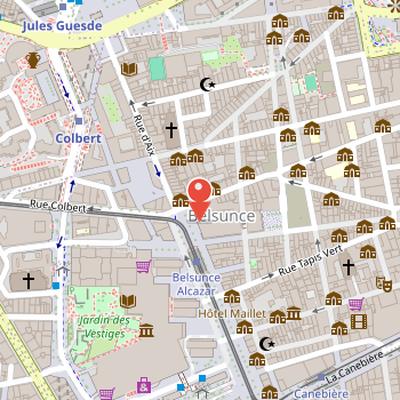
Nearby Objects
-
 Musée d'Histoire de Marseille 150 m away
 -
 Jardin des Vestiges 200 m away
 -
 Église de la Mission de France 250 m away
 -
 Hôtel Louvre et Paix 300 m away
 -
 Porte d'Aix 350 m away
History and Later Use
Le Theatre de l'Alcazar was a famous performance hall founded in the mid-19th century. It is located in the heart of the financial district of Marseille on Cours Belsunce near La Canebiere. The site was gradually abandoned starting in the 1960s, marking the end of its earlier use as a performance venue. Since 2004, the site has housed a regional municipal library, giving the building a new public function.
From Cafe-Concert to Library
The Alcazar in Marseille was first opened as Le Theatre de l'Alcazar Lyrique after a two-day inauguration. It was built for the cafe-concert owner Etienne Demolins on a large site at cours Belsunce, behind the Vieux-Port and the Palais de la Bourse. The location had earlier been occupied by the Saint-Hommebon religious congregation and later by the Transports Brousset stables; in the nineteenth century, horses for omnibuses and other horse-drawn vehicles were also housed there. Historique chose a fantasia mauresque style inspired by the Alhambra of Grenade, giving the venue a distinctive decorative identity.
As a cafe-concert, the Alcazar accommodated guests seated at tables who could watch performances while drinking and smoking. It also included galleries rising above the main hall to the famous poulailler, and it hosted nocturnal parties as well as summer spectacles in a garden. In the 1860s, it became known for presenting local and Parisian celebrity artists, and it gained a strong reputation with an audience known for demanding high standards. The venue also benefited from excellent publicity thanks to admiring comments by celebrities about the spectacle and the quality of service.
The theater later suffered a fire that destroyed it without causing casualties, and it reopened four months afterwards. At an unspecified later date, it was renovated with an entrance door topped by a marquise, which is listed under Bâtiments de France protections. In the 20th century, the Alcazar continued to attract important performers, with artists such as Yves Montand, Tino Rossi, Dalida, Maurice Chevalier, Felix Mayol, and Fernandel associated with its stage. The venue was converted into a cinema in the early 1930s, closed during World War II, and later experienced a resurgence after the Liberation of France. Competition from television increased in the late 1950s, and the venue declared its first bankruptcy in 1964. It was eventually permanently closed and sold to a furniture dealer, with its Art Nouveau sign remaining as a decayed remnant at the time of closure. The Alcazar was later reopened as a regional municipal library, replacing the Saint-Charles library.
Design and Public Role
The Historique's BMVR project was designed by architects Adrien Fainsilber and Didier Rogeon under the framework of the law of July 12, 1985, known as the law MOP. It was recognized as the largest in public area among the twelve BMVR libraries in France. In later use, the institution faced strikes over understaffing and lack of resources. Its management and FO union control were also criticized.
Collections and Public Services
The bibliotheque de l'Alcazar holds nearly one million documents, including 350,000 available in open access, and it is noted for significant documentary heritage collections. Among these are medieval manuscripts, a collection of 143 incunabula, and the archives of Cahiers du Sud. The library is organized across four floors into thematic departments covering Music, Youth, Society, Languages and Literatures, Science and Technology, Arts and Shows, Heritage, Civilization, Regional Documentation, and References.
The building includes 1000 seats, a conference room, an auditorium, a storytelling space, an exhibition room, and 150 computer stations with internet access. These stations provide access to the library catalog and various databases. Services are accessible to people with reduced mobility, and the department Lire Autrement offers books and periodicals in large print, braille, tactile books, and audio documents.
A major focus is youth documentation and publishing. The youth documentary collection preserves and promotes youth literature with more than 32,000 heritage documents, including ancient books and a legal deposit. The resource and promotion center L'ile aux Livres serves as a heritage space for meetings and exchanges open to enthusiasts, researchers, professionals, and students, and it organizes colloquia, study days, exhibitions, training, and reading committees. The library also hosted workshops, exhibitions, and professional days with youth literature personalities including Gregoire Solotareff, Nadja, Claude Ponti, Anthony Browne, David Carter, and Roberto Innocenti.
The Alcazar has also participated in digitization and dissemination projects. In partnership with the Chambre de Commerce and the Archives Departementales de Marseille, it helped digitize the Indicateur Marseillais directories from 1842 to 1914, which are available on the gallica.bnf.fr website. In partnership with the Bibliotheque nationale de France, it also made over one hundred old conservation fund books available on gallica.bnf.fr.