The Jardin botanique de Bordeaux is a scientific institution in Bordeaux, Gironde, France. It is designed to introduce all audiences to the world of plants, biodiversity, nature, and the sustainable management of natural resources. The site combines conservation and preservation of natural heritage with educational and recreational functions, and it also serves as a tool for observation.
Its history began in 1629, when it was created in Bordeaux as the Jardin des plantes. Originally a medicinal garden, it cultivated medicinal, condiment, and aromatic plants. The institution relocated four times over the course of its history and was located on rue du Jardin des plantes in 1750. In 1784, it became a center for acclimating tropical plants worldwide. Renamed Jardin botanique in the nineteenth century, it was installed in the public garden of Bordeaux in 1856 with large greenhouses, which were later destroyed in 1931. A new garden was created on the right bank of the Garonne in 2001. The institution has since received several distinctions, including the European Landscape Award Rosa Barba in 2003.
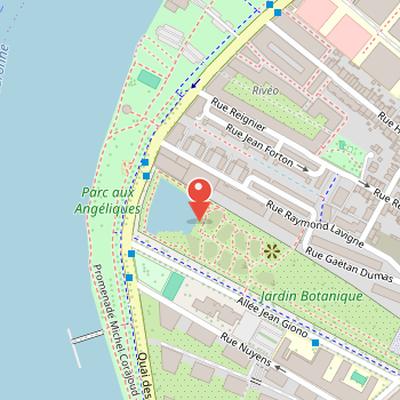
Nearby Objects
-
 Hôtel Fenwick 650 m away
 -
 CAPC musée d'art contemporain de Bordeaux 700 m away
 -
 Place de Stalingrad 750 m away
 -
 Fontaine des Trois Grâces 750 m away
 -
 Temple des Chartrons 750 m away
Scientific and Educational Role
The Jardin botanique de Bordeaux is an institution with a scientific vocation located in Bordeaux, Gironde, France. It is designed to introduce all audiences to the world of plants, biodiversity, nature, and the sustainable management of natural resources. The site also serves as a space for the conservation and preservation of natural heritage. In addition to its educational and recreational functions, it is described as a tool for observation.
History and Development
The Jardin botanique de Bordeaux began as the Jardin des plantes in 1629. It was established as a medicinal garden cultivating medicinal, condiment, and aromatic plants, and it relocated four times during its early history. By 1750, it was located on rue du Jardin des plantes. In 1784, it became a center for acclimating tropical plants from around the world, and in the nineteenth century it was renamed Jardin botanique.
In 1856, the garden was installed in the public garden of Bordeaux and fitted with large greenhouses. These greenhouses were destroyed in 1931. A new garden was created on the right bank of the Garonne in 2001. The site later received the European Landscape Award Rosa Barba in 2003 and the Cultural Building Award in the 2007-2008 Habitat solaire competition. It was also exhibited at the Museum of Modern Art in New York in 2005.
Ecological Design and Water Management
The Missions area of the Jardin botanique de Bordeaux includes a HQE, or haute qualite environnementale, building. It uses buried cisterns to collect rainwater for garden irrigation and employs an economical and ecological irrigation system inspired by ancient techniques. The greenhouse roof is fitted with photovoltaic panels, while the fence is made from recovered materials, including oaks from the storm of 1999. The greenhouse also cultivates water-efficient plants that require little heating.
Deux Jardins in the Bastide District
Deux Jardins is a historic garden occupying half a hectare in the Bastide district on the right bank of the Garonne River. It measures 70 meters long and 70 meters wide. The garden was designed by landscape architect Catherine Mosbach, architect Francoise-Helene Jourda, and scenographer Raymond Sarti. Its plantings are arranged by family according to phylogenetic order, and the site presents themes through original displays.
Jardin de la Memoire
The Jardin de la memoie is a parcel dedicated to plants harvested by African slaves on colonial plantations since an unspecified date. It includes yield plants cultivated for masters, such as cotton, coffee, indigo, tobacco, and sugar cane. It also contains plants that fed captives, including corn, potato, and cassava. Some species are absent, including cocoa, spices such as nutmeg, pepper, and vanilla, as well as certain fruit trees like guava, because of Bordeaux's climate.