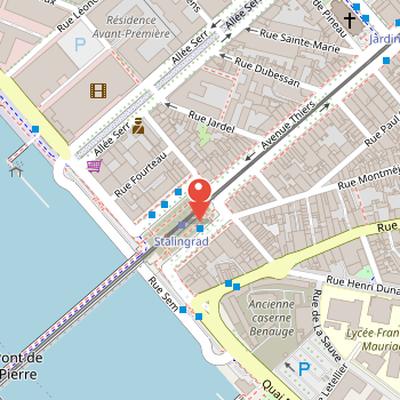
Place de Stalingrad is a square located at the north exit of the Pont de Pierre in Bordeaux’s Bastide district, on the right bank of the Garonne. The site functions as a key urban junction, with one-way automobile circulation arranged around it in a roundabout-like pattern. It is heavily used by pedestrians and bicycles, while buses and taxis are also allowed to use the bridge. The square is served by line A of the Bordeaux tramway, several urban bus lines, interurban coach lines, and nearby park-and-ride, V station, and Citiz station facilities. A river shuttle also connects it directly with place des Quinconces, hangars des Chartrons, and Cité du Vin. Historically, the square has changed names several times: it was originally called place du Pont, became place Napoléon between 1843 and 1870, then returned to place du Pont before being renamed place de Stalingrad in 1946. The name commemorates the battle in which Soviet armies won a decisive victory over German armies.
Nearby Objects
-
 Porte Cailhau 750 m away
 -
 Jardin botanique de Bordeaux 750 m away
 -
 Basilica of St. Michael 800 m away
 -
 Musée national des douanes 800 m away
 -
 Porte de la Monnaie 800 m away
Location and Access
Place de Stalingrad is located at the north exit of the pont de Pierre in the Bastide district of Bordeaux, on the right bank of the Garonne. It is served by line A of the Bordeaux tramway, eight urban bus lines, and several interurban coach lines. Nearby facilities include a park-and-ride, a V station, and a Citiz station. A river shuttle also connects the site directly to place des Quinconces, the hangars des Chartrons, and Citedu Vin.
Before the 2017 closure of the pont de Pierre to automobile traffic, the area was often congested by commuter cars. It is now relatively calm, apart from buses and taxis allowed to use the bridge. The site is heavily used by pedestrians and bicycles, while automobile traffic circulates one-way around it in a layout similar to a roundabout.
Name Changes and Commemoration
The square was originally named place du Pont because of the stone bridge. Between 1843 and 1870, it was temporarily called place Napolion by the mayor of Cenon to honor the initiator of the bridge construction. After the fall of the Second Empire, it reverted to the name place du Pont. In 1946, Bordeaux renamed it place de Stalingrad under the mandate of Fernand Audeguil. The new name commemorates the battle in which Soviet armies won a decisive victory over German armies.
From Place du Pont to Place de Stalingrad
The history of place de Stalingrad began with an early project for a semicircular square on the right bank, then in the territory of Cenon, linked to the decision to build the stone bridge. This first idea was meant to answer the Bourgogne square on the Bordeaux side. In 1816, a different design was preferred: a rectangular square proposed by engineer Claude Deschamps and his assistant Jean Billaudel. Later, in 1826, plans for the place du Pont were drawn during the breakthrough of avenue de Paris. The originally ordered facades were meant to surround the square, and the buildings at the corner of quai des Queyries are the only surviving witnesses of this abandoned project. The square was renamed Napoleon in 1843 by the mayor of Cenon. After the Bastide district, which made up half of Cenon's area, was annexed by Bordeaux in 1865, the square returned to the name place du Pont five years after the fall of the Second Empire. In 1946, Bordeaux renamed it after the battle of Stalingrad under the leadership of socialist mayor Fernand Audeguil. The name referred to the Soviet victory over Nazi Germany in the terrible combats of 1942 to 1943. Between 2000 and 2004, avenue renovations were carried out by architects Olivier Brochet, Emmanuel Lajus and Christine Pueyo, with Signes Paysages and the city architect Bruno Fortier. The works were completed in 2005 with the installation of a blue lion sculpture by the Lyonnais artist Xavier Veilhan.
Former Alcazar Theater and Le Lion de Veilhan
The former Alcazar theater is located at number 13 of place de Stalingrad. According to Patrimoine et monuments, its architecture differs from Bordeaux classicism, with first-floor paired bays that evoke Florentine or Venetian palaces. The facades still preserve busts of Pierrot and Colombine, presented as allegories of dance and music. Over time, the building underwent a series of changes in use: it became a neighborhood cinema, then a dance hall named Eden in 1967. In the basement, a garage, a service station, and a nightclub called Le Trou were established; Le Trou became Saint-Claude in 1975, and Saint-Claude was transformed into a festive complex called Le Reto in 1978. The building also temporarily served as a department store before its complete renovation in 2010 by Bordeaux developer Norbert Fradin, who converted it into 13 luxury apartments and a restaurant. The square also received Le Lion de Veilhan, a light blue lion statue made of composite materials and inaugurated as part of art in the city. Created by Xavier Veilhan, the sculpture measures 7 meters long, 3 meters wide, and 3 meters high. It has regularly drawn criticism for its stylistic mismatch with the surrounding buildings.