CAPC musée d'art contemporain de Bordeaux is a museum dedicated to contemporary and conceptual art in Bordeaux. Inaugurated in 1984, it is located in the Chartrons district and housed within the former Entrepôt Lainé. The building was originally intended to store goods produced by slaves in colonial plantations, a history that remains part of the site’s significance.
The institution traces its origins to the Centre d'arts plastiques et contemporains (CAPC), created in 1973 by Jean-Louis Froment, who directed it until 1996. CAPC settled in the former Entrepôt Lainé in 1975 and continued itinerant projects in France and Europe. The museum is recognized as a cultural reference at national and international levels and was labeled Musée de France in 2002, as well as Centre d'art contemporain d'intérêt national. Its collection has developed since the 2000s and includes works linked to conceptual art, minimal art, Land Art, Supports/Surfaces, and Arte povera, alongside works by several French and international artists.
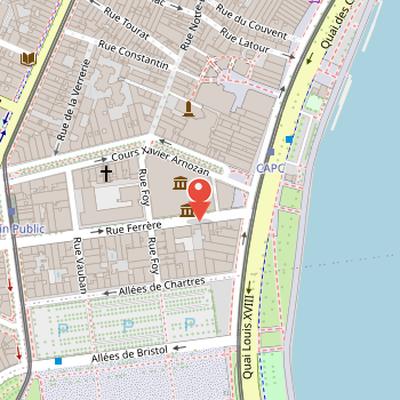
Nearby Objects
-
 Hôtel Fenwick 100 m away
 -
 Temple des Chartrons 200 m away
 -
 Place des Quinconces 300 m away
 -
 Saint-Louis-des-Chartrons Church 400 m away
 -
 Monument aux Girondins 400 m away
Historic Warehouse as Contemporary Art Museum
The CAPC musee d'art contemporain de Bordeaux is a museum dedicated to contemporary and conceptual art, located in Bordeaux in the Chartrons district. It was inaugurated in 1984 and is housed within the former Entrepot Laine. The building had originally been intended to store goods produced by slaves in colonial plantations, giving the site a distinct historical background. Over time, the museum has become recognized as a cultural reference at both national and international levels. Its institutional status was further confirmed when it was labeled Musee de France in 2002 and later designated as a Centre d'art contemporain d'interet national.
CAPC and the Former Entrepot Lain
The Centre d'arts plastiques et contemporains (CAPC) was created in 1973 by Jean-Louis Froment, who remained its director until 1996. In 1975, it settled in the former Entrepot Lain, a warehouse built between 1822 and 1824 by engineer Claude Deschamps. The building was originally constructed to store goods produced by slaves in colonial plantations, which gives the museum site a direct historical link to slavery and colonial trade.
While based at Entrepot Lain, the CAPC also continued itinerant projects in France and Europe. In 2023, the institution marked the 50th anniversary of its association. That same year, militant Karfa Diallo criticized what he saw as a minimization of the relationship between Entrepot Lain and slavery crimes. In a Mediapart article, he also pointed to the absence of a memorial space at the site.
A meeting held on November 13, 2023, and initiated by Baptiste Maurin brought together Sandra Patron, Karfa Diallo, and Patrick Serres. The discussion led to an agreement to revise the museum's presentation language, which was considered outdated and incomplete. It also resulted in a commitment to install a memorial space at Entrepot Lain, such as an explanatory plaque or artwork. The memorial installation is planned for 2024, during the bicentenary of the warehouse.
The Collection on the Second Floor
Presented on the second floor of the museum, the collection consists of one thousand artworks representing one hundred forty artists. Since the 2000s, it has developed a strong focus on conceptual art, minimal art, Land Art, the Supports/Surfaces group, and Arte povera. It includes works by Lawrence Wiener, On Kawara, Robert Barry, Dan Flavin, Sol LeWitt, Richard Serra, Andre Cardona, Richard Long, Claude Viallat, and Mario Merz. The collection also features important works by French artists Jean-Charles Blais, Robert Combas, Pascal Convert, Christian Boltanski, Daniel Buren, Annette Messager, and Jean-Pierre Raynaud, as well as Spanish artists Cristina Iglesias, Miquel Barcelo, Juan Munoz, and Susana Solano.
Among its notable holdings is Richard Long's White Rock Line, an 18-ton limestone line 40 meters long and 1.5 meters wide, made in 1990 for outdoor installation. The work was commissioned for the CAPC reopening after renovation in 1994. Long's practice is associated with sculptures made from materials found on site or taken from nature, and his large installations include Driftwood, Stone Field, Snake Circle, Garonne Mud Circles, and Muddy Feet Line.
Public Access
The CAPC musee d'art contemporain de Bordeaux is served by line B of the Bordeaux tramway. Visitors can access it at the station named CAPC - musee d'Art contemporain. This connection places the museum within the city's public transport network and provides a direct point of access for visitors.