Fontaine des Trois Grâces is a fountain in Place de la Bourse whose bronze statue represents the three Graces: Aglaé, Euphrosyne, and Thalie, daughters of Zeus and Eurynomé. The figures evoke beauty, joy, and abundance, and belong to a theme that was common in cities during periods of prosperity. The fountain is associated with other fountains of the Three Graces in Montpellier, Nice, Langrune-sur-mer, Guéret, and Vezzani. Its pedestal is made of Jura marble, and its basin is made of cast iron.
The history of the site began with the former presence of a large equestrian statue of King Louis XV at the center of Place de la Bourse, later dismantled and melted down in 1792 during the Revolution. A tree of liberty temporarily replaced it, and a modest pink marble fountain was erected in 1828. In the 1850s, the city undertook many fountain projects. Louis Visconti proposed three projects, and after his death in 1853, his son Léon Visconti presented them to the city, which accepted the Fontaine des Trois Grâces. Mayor Guillaume Brochon commissioned Charles Gumery to execute the fountain according to the architect’s model.
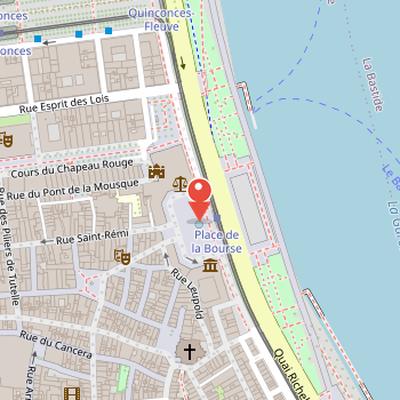
Nearby Objects
-
 Place de la Bourse 10 m away
 -
 Musée national des douanes 70 m away
 -
 Église Saint-Rémi 150 m away
 -
 Place du Parlement 200 m away
 -
 Église Saint-Pierre 200 m away
Bronze Figures and Symbolic Program
The fontaine des Trois Graces is described as a bronze statue representing the three Graces: Aglae, Euphrosyne, and Thalie, identified as the daughters of Zeus and Eurynome. Each figure is linked to a specific quality: Aglae evokes beauty, Euphrosyne joy, and Thalie abundance. The subject belongs to a theme that was common in cities during periods of prosperity, and comparable fountains of the Three Graces are noted in Montpellier, Nice, Langrune-sur-mer, Gueret, and Vezzani.
The monument is set on a pedestal made of Jura marble and includes a basin made of cast iron. According to the provided facts, the sculptor reportedly drew inspiration for the three faces from Empress Eugenie, Queen Isabella of Spain, and Queen Victoria of England.
From Royal Statue to Fountain
Place de la Bourse originally had a large equestrian statue of King Louis XV at its center. The statue was dismantled and melted down in 1792 during the Revolution, after which a tree of liberty temporarily occupied the site. In 1828, a modest fountain in the form of a pink marble column with a white chapiteau and globe was installed there. By the 1850s, the city was engaged in many fountain projects, and the government authorized a municipal loan to support them. Architect Louis Visconti proposed three projects, but after his death in 1853, his son, Leon Visconti, presented the designs to the city, which chose the Fontaine des Trois Graces.
Mayor Guillaume Brochon then commissioned sculptor Charles Gumery to execute the fountain according to the architects model. Gumery modified the figures by removing their veils, and he also created the column and the basin. Other sculptural elements were assigned to Amedee Jouandot, who carved the children on dolphins, the large basin border, and the pedestal moldings. The bronze statue was cast by the Thiiebaut Freres foundry. The fountain was inaugurated in an unspecified year, and its unveiling prompted surprise from the priest of Saint-Pierre parish, who objected to the nudity of the models during the blessing ceremony. Since 2009, the statue has also been used each October in a breast cancer screening awareness campaign, when it is wrapped in pink ribbons and the water is colored pink.