L’Hôtel Fenwick is an hôtel particulier in Bordeaux that hosted the first United States consulate in the world. Built between 1793 and 1800 by architect Jean-Baptiste Dufart, it was initiated by Joseph Fenwick, the first United States consul in history. Fenwick, born in Cherryfield, Maryland in 1762, was an important merchant between France and the United States and was appointed consul by George Washington after the American Revolution. He remained in office until 1849.
The building reflects the role of Bordeaux as a major commercial center in the 18th century, when the city and its port experienced remarkable growth and the Chartrons district attracted foreign merchants. Hôtel Fenwick had a mixed use: ground-floor shops and a warehouse, offices on the first floor, private apartments and reception rooms on the second floor, and servants’ quarters in the attic. It also served as the residence of Fenwick’s family. The building has been listed in the inventory of Historical Monuments since 1935.
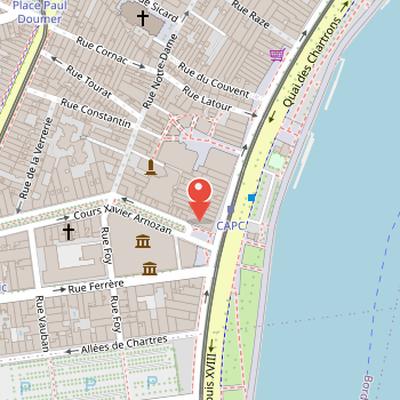
Nearby Objects
-
 CAPC musée d'art contemporain de Bordeaux 100 m away
 -
 Temple des Chartrons 120 m away
 -
 Saint-Louis-des-Chartrons Church 300 m away
 -
 Place des Quinconces 400 m away
 -
 Monument aux Girondins 500 m away
Construction and Historical Role
Htel Fenwick is a hotel particulier in Bordeaux that was built between 1793 and 1800 by architect Jean-Baptiste Dufart. Its construction was initiated by Joseph Fenwick, who served as the first United States consul. The building is historically notable for hosting the first United States consulate in the world. It has been listed in the inventory of Historical Monuments since 1935, reflecting its recognized heritage value.
Construction and Historical Context
Hotel Fenwick was built starting in 1793 for Joseph Fenwick, an important merchant between France and the United States. Born in Cherryfield, Maryland, in 1762, Fenwick was active in trade, notably in whale oil consumed by the country. After the American Revolution of 1776, he was appointed United States consul by George Washington and became the first American consul in history. He remained in office until 1849.
The building was constructed in a period when Bordeaux was experiencing remarkable growth and when its port was a major global commercial hub. The Chartrons district developed rapidly in this context and attracted major foreign merchants during the 18th century. Fenwick's marriage in 1792 to Catherine El?onore M?noire, daughter of Chamber of Commerce director Pierre M?noire, also placed him within the commercial elite connected to the city. His family included a son, Franck Colombus Fenwick, who later became United States consul in Nantes, and a daughter, Betzi Fenwick, who died young.
During the French Revolution, only two prestigious residences were built in Bordeaux: the Hamburg consul's house and the United States consul's house of Joseph Fenwick. This places Hotel Fenwick among a very limited group of significant residences associated with foreign diplomatic and commercial presence in the city.
Architecture and Uses of Hotel Fenwick
Hotel Fenwick was built between 1793 and 1800 by the architect Jean-Baptiste Dufart. The building was arranged with distinct functions across its floors. The ground floor contained shops and a warehouse, while the first floor housed offices. The second floor included private apartments and reception rooms, and the attic was occupied by servants. The hotel also served as the residence of Historique's family. Until 1914, Hotel Fenwick remained a private mansion.
After World War I, the Compagnie generale transatlantique purchased the building and used it as a general agency for Bordeaux and Aquitaine for sixty years. In 2021, the ConcoursMania group took up residence in the building. ConcoursMania is a digital sector company involved in entrepreneurship creation and development. The building's history reflects a long sequence of residential, commercial, and administrative uses.
Architecture and Symbolism at Hotel Fenwick
Hotel Fenwick was constructed in the Chartrons for strategic reasons, and its architecture includes several features linked to visibility and display. Two square pavilions were set on the slate roof so that boats entering the port could be observed. The facade was inspired by United States colonial architecture, with louvered shutters of the same type reinforcing that reference. Above the stone columns framing the main door, two sculpted boats were added by Charles Durand around 1870. These carved boats depict defensive points and a rostrum above the waterline.
The interior also contains a Louis XVI style staircase lit by a large glass roof. Its steps narrow progressively upward, a design that symbolized the social categories admitted on each floor. In the staircase cage, a golden sun on a thirteen pointed star background represents the first thirteen American states. The staircase and the salons are classified as historical monuments by official decree.