Temple des Chartrons is an ancient Protestant temple located in the Chartrons district of Bordeaux, France. It was completed in 1835 in a neoclassical architectural style, following a construction project developed after 1832 on a plan by Armand Corcelles established in 1831. The temple stands on a narrow plot shaped by the strip parcel pattern of the neighborhood, a pattern linked to the former presence of wine warehouses.
The history of Protestant worship in Les Chartrons dates back to 1776, when a place of prayer was founded in an old chai. Later projects for a temple were proposed but not realized, including one by architect Louis Combes in 1788 and another by Eugène Cabillet in 1817. The temple was finally built after land enlargement in 1828 and funding was secured in 1832 with support from the Protestant community, the city, and the State. Antoine Vermeil, pastor in Bordeaux from 1824 to 1840, is identified as the initiator of the temple.
The building was deconsecrated in the 1970s and sold to the City of Bordeaux. Its annexes were destroyed in 1984. The temple was later reopened to the public for an exhibition by Gonzalo Borondo.
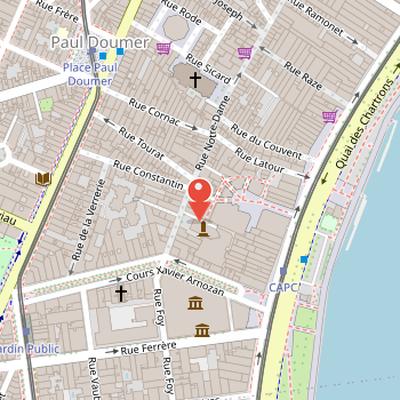
Nearby Objects
-
 Hôtel Fenwick 120 m away
 -
 CAPC musée d'art contemporain de Bordeaux 200 m away
 -
 Saint-Louis-des-Chartrons Church 200 m away
 -
 Jardin Public 500 m away
 -
 Place des Quinconces 500 m away
Ancient Protestant Temple in Chartrons
The temple des Chartrons is an ancient Protestant temple located in the Chartrons district of Bordeaux, France. It was built in 1835 and remained in use until it was decommissioned in the 1970s. Its history reflects its long-standing role as a Protestant place of worship in this part of the city.
History of the Temple des Chartrons
A place of prayer was founded in Les Chartrons in 1776 in an old chai. In 1788, architect Louis Combes designed a temple project, but it was abandoned at the Revolution. The Reformed Church was dispersed between 1793 and 1794, and in 1795 the temple was still located in the chai, where it had begun to deteriorate. A new project was proposed in 1817 by Eugene Cabillet in a Palladian style, but it was not realized.
The path to the present building advanced with the enlargement of the land in 1828. Definitive funding was secured in 1832, with one-third provided by the Protestant community and the remainder by the city and the State. Construction began after 1832, following a plan by Armand Corcelles established in 1831. The temple was completed in 1835 in a neoclassical architectural style. Antoine Vermeil, pastor in Bordeaux from 1824 to 1840, was the initiator of the Chartrons temple.
Later additions and changes also shaped the building. Its organ was built around 1886 by Gaston Maille and restored in the 1960s by Beuchet-Debierre. The temple was deconsecrated in the 1970s and sold to the City of Bordeaux. It was listed as a historic monument on an unspecified date, and its annexes were destroyed in 1984. The building later reopened to the public for an exhibition by Gonzalo Borondo.
Architecture and Materials
The temple des Chartrons was built on a narrow plot, reflecting the strip parcel pattern of the Chartrons neighborhood. This pattern resulted from the earlier presence of wine warehouses in the area. The building uses stone as its main material, specifically calcaire a asteries, the most sought-after type of Bordeaux stone because of its firmness. The upper courses are made of Langoiran stone, which is less dense and more porous.