Avenue des Champs-Élysées is one of the widest and most majestic avenues in Paris, and one of the most famous streets in the world. It extends for 1,910 metres through the 8th arrondissement in northwest Paris, continuing from Rue de Rivoli and stretching from Place de la Concorde in the east to Place Charles-de-Gaulle in the west. The avenue includes the obelisk at Place de la Concorde and the Arc de Triomphe at Place Charles-de-Gaulle, and it forms part of the historical axis line. It also defines the so-called Golden Triangle of Paris.
The avenue originated as simple fields. In 1616, Maria de' Medici created a long tree-lined avenue connecting the Louvre and the Tuileries Gardens. It was extended in the 18th century to the top of Chaillot hill, and later transformed from a disreputable road into a fashionable avenue during the Second Empire. This period saw the construction of elegant hôtel particuliers and luxury shops, shaping its character as a prestigious walking place. Today it contains cinemas, cafés, and luxury shops.
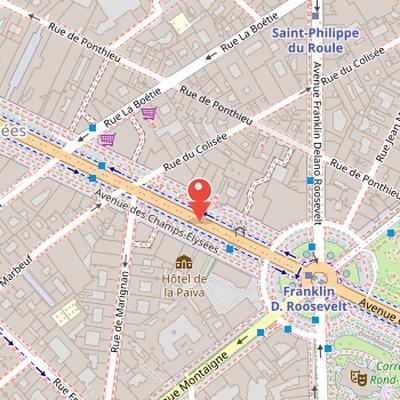
Nearby Objects
-
 Avenue Montaigne 350 m away
 -
 Palais de la Découverte 450 m away
 -
 Grand Palais 500 m away
 -
 Palais de l'Industrie 550 m away
 -
 Théâtre des Champs-Élysées 550 m away
Development and Character of the Avenue
The Avenue des Champs-Elysees is one of the widest and most majestic avenues in Paris, and one of the most famous streets in the world. It stretches for 1910 meters through the 8th arrondissement in northwest Paris, continuing from Rue de Rivoli from Place de la Concorde in the east to Place Charles-de-Gaulle in the west. Along its route are the obelisk at Place de la Concorde and the Arc de Triomphe at Place Charles-de-Gaulle. The avenue also forms part of the historical axis line and defines the so-called Golden Triangle of Paris.
Its history began with simple fields. In 1616, Maria de' Medici created a long tree-lined avenue connecting the Louvre and the Tuileries Gardens. The avenue was extended in the 18th century to the top of the Chaillot hill, where the Arc de Triomphe is located. Originally a disreputable road, it was transformed into a fashionable avenue during the Second Empire. This period saw the construction of elegant hotel particuliers and luxury shops, which helped establish it as a prestigious walking place.
Today, the avenue contains cinemas, cafes, and luxury shops, which contribute to its public image and commercial character.
Location, Axis, and Layout
Avenue des Champs-elysees is located in the 8th arrondissement of Paris, in the northwestern part of the city. It extends for 1,910 meters on an east-west axis, connecting Place de la Concorde to Place Charles-de-Gaulle, the latter formerly known as Place de l Etoile. At Place Charles-de-Gaulle, the avenue reaches the northern side of Chaillot hill at its highest point; between 1768 and 1774, the top of the hill was lowered by about five meters, and the excavated material was used to reduce the slope of the street. As a result, the avenue has a regular slope from Rond-Point des Champs-elysees to Place Charles-de-Gaulle, where the Arc de Triomphe is located.
The avenue is 70 meters wide in total. Its central roadway is 30 meters wide and divided into four lanes in each direction, with sidewalks about 20 meters wide on both sides. East of the Champs-elysees-Marcel-Dassault roundabout, it is flanked by contre-allees known as the promenade des Champs-elysees, which border the gardens of Champs-elysees. These gardens extend for about 700 meters and vary in width from 300 to 400 meters. They are arranged as a series of rectangular spaces, or piazze, distributed symmetrically on both sides of the avenue. All of these piazze except the last one have had a fountain since the reconstruction works carried out under architect Jakob Ignaz Hittorff between 1840 and 1847.
The straight layout of the avenue provides an urban perspective that begins at the Louvre Palace and continues through a sequence of aligned landmarks. This urban axis includes the equestrian statue of Louis XIV in the Cour Napoleon at the Louvre, the Arc de Triomphe du Carrousel, the Tuileries Gardens, the Luxor Obelisk at Place de la Concorde, and the Arc de Triomphe. The alignment extends westward beyond the city limits to the Grande Arche de la Defense. This line is known as the historic axis of western Paris.
From Marshland to Grand Promenade
The Champs-Elysees area was originally marshy and uninhabited land. Its later transformation began in 1616, when Queen Maria de' Medici promoted a long tree-lined avenue along the Seine beyond the Palais des Tuileries. The inauguration of Cours la Reine that same year, inspired by the park of Cascine and intended for aristocratic promenade, became a conceptual precursor to the Avenue des Champs-Elysees. It also reflected an early urban design to extend Paris westward with tree-lined avenues and representational spaces.
A more direct intervention came under Louis XIV, when the territorial expansion of France made Paris fortifications obsolete. He decided to demolish the medieval walls and open new roads, influenced by Jean-Baptiste Colbert's ideas. A decree of August 26, 1667 ordered the creation of a road for court carriages to Saint-Germain-en-Laye and Versailles. André Le Notre, known for his work on the gardens of Versailles and the Tuileries, mapped a monumental axis from the Tuileries residence toward the Roule hill, crossing Place de la Concorde and the Rond-point des Champs-Elysees.
The route passed beyond the wall of Luigi XIII and crossed the Grand Egout at the current rue Marbeuf. In 1710, a stone bridge was built on the initiative of the Duke of Antin, extending the Champs-Elysees to the so-called Etoile de Chaillot and matching the current full layout; the work was completed in 1724. The village of Le Roule was annexed to Paris in 1722, and in 1765 construction was authorized on both sides of the avenue. Five years later, the Marquis de Marigny leveled the hill of Le Roule, renewed plantings, and designed new adjoining avenues including Avenue de Marigny, Avenue Matignon, and Allee des Veuves. In 1774 the avenue was widened and extended toward the Seine via Avenue de la Grande-Armee and Avenue Charles-de-Gaulle.
The avenue's naming also evolved over time. It was known under various names, including Grand Cours, avenue de Neuilly, route de Saint-Germain, Avenue Royale de la Grille in 1678, and Avenue du Palais des Tuileries in 1680. The name Champs-Elysees first appeared in 1694 and was officially consolidated in 1709. The name refers to the Elysian Fields in Greek mythology, and Storia suggests that it contrasted with the lower part of the avenue, which was then unhealthy, marshy, and associated with prostitution.
Despite its planned grandeur, the avenue carried a mixed reputation in the late 18th century, with fair stalls, poor cafes, criminals, and prostitutes. A luxurious amusement park, the Colisee, opened at the Rond-point in 1771 but declined because of the area's poor reputation. At the same time, Cours la Reine along the Seine remained popular for bocce, tennis, and bar visits.
During the French Revolution, the avenue gained visibility through major political events. The women's procession of Paris marched along it toward Versailles, and on 25 June 1791 the royal family returned to Paris via the Champs-Elysees, escorted by two wings of National Guards after the Varennes flight. Later, during the Terror, Place de la Concorde became a site of capital executions, while the Marly Horses by Guillaume Coustou were placed near the western entrance on pedestals designed by the painter David.
Theatres, Panoramas, and Entertainment Sites
The area around the avenue became closely associated with entertainment architecture and exhibition spaces during the 19th century. Storia states that Hittorff signed the panorama project, with Jean-Charles Langlois directing the art, and that it was inaugurated with Fire of Moscow. In 1855, the panorama was converted into an exhibition hall for the Universal Exhibition, where the Sèvres and Gobelins manufactures and the Crown jewels were displayed. It was demolished in 1856 to make way for a connection to the Palais de l Industrie, and a new panorama was built in 1860 by Gabriel Davioud with Langlois at the corner of Avenue Franklin Roosevelt and the current Theatre du Rond-Point.
Several performance venues were also established nearby. Storia built the first Marigny theater in 1855 at the corner of Avenue Gabriel and Avenue Marigny, with 600 seats, and entrusted Jacques Offenbach with its management. The site had previously hosted a show of funny physics and phantasmagoria active from 1835. The first theater was replaced in 1880 by a larger structure designed by Charles Garnier, later renovated by Edouard-Jean Niermans.
Other venues contributed to the same cultural landscape. Alcazar d Ete was built at number 8 Avenue Gabriel in 1841 and hosted Thera sa and chansonnier Paulus; its building is now known as Pavillon Gabriel. Cafe des Ambassadeurs, rebuilt in Place des Ambassades in 1841, had an original authorization dating to 1772 and was managed by the widow Rouget in 1816. It became popular for revue shows from 1897 until its demolition in 1929. Concert de l Horloge, initially at the west end of Cours la Reine, was demolished in 1852 to make room for the Palais de l Industrie, then relocated by Madame Picolo to the beginning of Avenue Edward-Tuck. It was noted for an innovative sliding mobile roof.
Storia also designed pavilions in Place Marigny and Place Ledoyen to host the Laurent and Ledoyen restaurants. Both pavilions have polychrome columns and pediments in 19th-century style, adding to the area s built environment and its association with dining and public leisure.
The Second Empire Transformation
During the Second Empire, the avenue des Champs-elysees became the focal point of Parisian elegant life. Under Napoleon III, engineer Adolphe Alphand led the landscape development of the site, and Napoleon III advanced Storia's interventions on the avenue. From the 1855 Universal Exposition onward, the Champs-elysees became a fashionable promenade. At the beginning of this transformation, the avenue had six buildings. Within a few decades, it was bordered by bourgeois residences and private palaces. Two new residential neighborhoods also appeared near the avenue: one to the north on the former Beaujon gardens, and one to the south on the Marbeuf gardens.
From Exhibition Hall to New Monuments
Between 1853 and 1855, the Palais de l'Industrie was erected on the site of the grand carre des Jeux. The building was 200 meters long and was inaugurated on May 15, 1855 by Napoleon III. It later served the Universal Exhibitions of 1855, 1878, and 1889, and was also used for commercial fairs, agricultural and horticultural exhibitions, equestrian shows, and official ceremonies.
From 1896, the Palais de l'Industrie was demolished in preparation for the 1900 Universal Exhibition. Its removal made space for the Petit Palais and the Grand Palais, and also allowed the opening of the monumental axis between the Invalides and the Palais de l'Elysee via the Pont Alexandre III.
In front of the Elysee, the Petit-Paillard restaurant, now the Pavillon de l'Elysee, was inaugurated in 1898. It was designed in an eclectic style by the architect Albert Ballu, and its dining room decoration was made by the sculptor Jean-Baptiste Hugues.
Public Events and Political History
The Champs-Elysees has repeatedly served as a setting for major state occasions, public demonstrations, and mass celebrations. In October 1896, Tsar Nicholas II and Tsarina Alexandra passed through the avenue in a cortege that traveled via Porte Dauphine and Avenue du Bois to the Russian embassy, while a large crowd gathered along the route, sometimes hanging from trees. The avenue was also the site of an attack on President Armand Fallieres on December 25, 1908, when Jean Mattis, a waiter and street vendor, scratched him on the neck and right ear; Mattis was later sentenced to four years in prison.
The avenue has also been used for commemorative and political ceremonies. On May 5, 1921, ceremonies for the centenary of Napoleon Bonaparte's death took place on the Champs-Elysees and at Hotel des Invalides. During the Second World War, Nazi troops marched under the Arc de Triomphe for the first time on June 14, 1940, and a student demonstration on November 11, 1940 was harshly repressed by Nazis. After the liberation of Paris, General Charles de Gaulle marched along the avenue on August 26, 1944, preceded by tanks of the 2nd Armored Division.
In later decades, the Champs-Elysees continued to attract large crowds for political and national events. On May 30, 1968, a demonstration supporting de Gaulle gathered between 300,000 and 500,000 people. The avenue also became a place of collective celebration after sporting victories, with over one million people gathering on July 12, 1998 after France won the World Cup, followed by a parade of the national team on an open bus the next day. Similar scenes were reported in 2000 after the European Championship win. The avenue was also the scene of Maxime Brunerie's attempt to assassinate President Jacques Chirac during the military parade on July 14, 2002.
March 16, 2019 Clashes on the Champs-Elysees
On March 16, 2019, the Champs-Elysees was the site of violent clashes with police during Yellow Vest protest act XIX. Storia reported that more than 1,500 rioters, including Black Bloc groups, tried to storm the Arc de Triomphe. The unrest caused extensive damage along the avenue: 216 shops were damaged, and 80 percent of them were described as severely damaged. Twenty-seven shops were looted, including the Fouquet's brasserie. Storia also reported 79 fires, including five in buildings, and said that almost all newspaper kiosks on the Champs-Elysees were destroyed. In the clashes, 31 police officers and firefighters were injured.
Changing Commercial and Public Role
The Champs-Elysees are undergoing changes, and their role in the city is being redefined. The avenue attracts luxury brands such as Dior, Saint Laurent, and Louis Vuitton, while more accessible brands also take advantage of the tourist influx. At the same time, local residents tend to avoid the area, which is often perceived as crowded, noisy, and lacking authenticity. In response, local administrations and commercial stakeholders are seeking to balance these tensions through transformation. Proposed measures include planting more trees, reducing motorized traffic, and diversifying commercial offerings to include culture and events. Other proposals focus on controlling rents and regulating real estate so that small local businesses are not pushed out. Cultural events and local initiatives are also being promoted in order to encourage the Champs-Elysees to function as a lived space rather than only a tourist showcase.
Leisure, Commerce, and Renewal on the Champs-lysees
In the 19th century, Avenue des Champs-lysees became a privileged place for strolling and leisure among Parisian society. According to Economia, this role was reinforced by the nearby Longchamp racecourse, which encouraged a range of leisure and equestrian activities along the avenue. These included horseback riding schools, stables, coachmaker workshops, saddleries, specialized tailors for riders, car rental companies, and dance halls. The intense social life in private salons and public establishments also favored the establishment of fashion and gastronomy boutiques.
The avenue later became more accessible to a wider audience with the arrival of RER Line A, which made it easy to reach for residents of all social backgrounds. Economia notes that this accessibility accelerated the arrival of popular brands and activities, illustrated by the opening of Virgin Megastore in 1988. In 1994, the Comit des Champs-lysees was created by mayor Jacques Chirac and Roland Pozzo di Borgo to promote urban and commercial renewal. Its aim was to renew the avenue's image while preserving its historic and social identity. The avenue continued to reflect the diversity of its visitors, while also showing clear differences between its two sides. The north sidewalk, in particular, is described as sunnier, directly connected to the RER station, and marked by higher foot traffic and greater commercial density.
Commercial Rents and Retail Concentration
Economia has described Avenue des Champs-Elysees as one of the most expensive streets in the world in recent decades. In 2018, it ranked fourth globally for average commercial rent cost, at 16,350 dollars per square meter, with only Causeway Bay in Hong Kong above it in the ranking. The avenue was also placed ahead of Fifth Avenue in New York and New Bond Street in London in that year. On the north sidewalk, annual ground floor rental rates were reported to range between 8,000 and 10,000 euros per square meter, excluding taxes and fees.
These costs have had visible effects on the built and commercial structure of the avenue. Economia reports that high property values contributed to progressive residential depopulation, while upper floors were converted into offices or commercial spaces. The commercial distribution is described as asymmetrical, with the north side traditionally more expensive than the south side. Since the 2000s, the south side has included Louis Vuitton, Nike, Omega, Montblanc, Eden Shoes, and Fouquets Barriere, while the north side has included Cartier, Guerlain, Montblanc, McDonalds, Adidas, and the Marriott hotel. Marriott is identified as the only hotel with a direct entrance onto the avenue.
Economia notes that rising rents risk compromising commercial diversity. Only textile and luxury brands are said to be able to sustain the high rental costs. A 2006 study by the Paris municipality found that textile activity accounted for 20 percent of commercial activity on the avenue, or 39 percent when shopping centers were included. Municipal authorities warned that exceeding 39 percent textile activity would reduce commercial variety. The article also reports owner strategies such as non-renewal of leases with eviction compensation set at 10 to 12 times annual rent, as well as entrance fees imposed on new tenants. These practices are linked to commercial homogenization and to the broader difficulty of balancing prestige, accessibility, and tourist appeal. Economia states that, at present, only political interventions prompted by associational movements offer concrete prospects for preserving the avenue's identity and symbolic urban role.