The Palais de la Découverte is a science museum designed by Jean Perrin starting in 1934 and created in 1937. It was conceived to show science in the process of being made, with Raymond Grégoire entrusted with the conception and organization of the radioactivity space. Paul Valéry also wrote a description of it in his collection Vistas sobre le monde actuel. The government decided to perpetuate the Palais by decree on 8 April 1938, and a decree of 9 January 1940 associated it with the University of Paris. Its sections included fluorescence, phosphorescence, optics, gas discharges, electrostatics, the Foucault pendulum, cathode rays, X-rays, biology, and a planetarium. From the 1970s, its formal character gradually disappeared and experiments became more interactive. Later decrees transformed it into an autonomous public institution and, in 1990, gave it the status of grande institution. Since 1 January 2010, it has been grouped with the Cité des sciences et de l'industrie within Universcience.
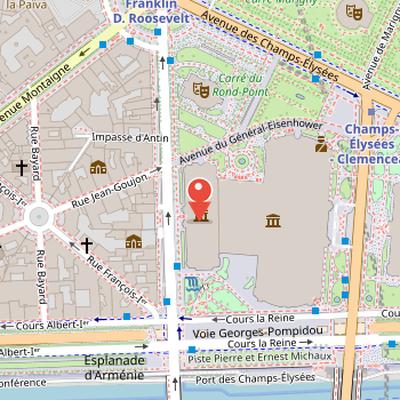
Nearby Objects
-
 Grand Palais 120 m away
 -
 Palais de l'Industrie 250 m away
 -
 Petit Palais 250 m away
 -
 Avenue Montaigne 350 m away
 -
 Avenue des Champs-Élysées 450 m away
Design and Institutional History
Jean Perrin designed the Palais de la Decouverte starting in 1934 and created it in 1937. He conceived it as a place to show science in the process of being made. Perrin entrusted Raymond Gregoire with the conception and organization of the radioactivity space. A description by Paul Valery appears in his collection Vistas sobre el mundo actual. The government decided to perpetuate the Palais de la Decouverte by decree on 8 April 1938, and a decree on 9 January 1940 associated it with the University of Paris. In the 1970s, its formal character gradually disappeared and the experiments became more interactive. Decree no. 72-367 of 28 April 1972 transformed it into an autonomous public institution, and in 1990 it received the status of grande institution by decree no. 90-99 of 25 January. Since 1 January 2010, it has been grouped with the Cite des sciences et de l'industrie in a common EPIC named Universcience.
Scientific Display and Public Perception
The Palais de la Decouverte was presented as serving a desire for fundamental investigation and its methods, while research and its practical technical applications were associated with the Museum of Science in London and the Deutsches Museum in Munich. Technique was said to belong to the Museum of Arts and Crafts. The Palais included sections on fluorescence, phosphorescence, optics, gas discharges, electrostatics, the Foucault pendulum, cathode rays, X-rays, biology, and a planetarium. According to the provided account, this character gradually disappeared from the 1970s. New projects, including those by Denis Buican, were criticized on the grounds that the Palais looked more like a fair. At that time, the museum did not include a refreshment area. A large glass column later replaced the current refreshment area, showing that nature no longer has horror vacuum beyond a certain water height.
Experiments and Memory
The oral mediation notes that most main scientific experiments are not shown to students because of a lack of time or resources. It also says that experiments are usually presented through diagrams and only rarely through films. In this setting, the experience is often quickly forgotten, with only the result remaining in memory. However, the mediation observes that young people who actively take part in demonstrations such as electrostatics or liquid nitrogen tend to remember the phenomena better. This stronger retention is linked to experiences associated with life-changing events, while the size and dramatization of experiments also reinforce long-term memory. At the same time, the text remarks that a scientific concept is not always easy to understand, even when experimental manipulations are interesting.
Public Engagement and Science Mediation
Palais de la Decouverte is presented as a place focused primarily on popularizing science through direct public engagement. Its demonstrations are described as oral mediation, meaning presentations led by mediators with audience participation. These sessions place young people at the center of a dialogue with a passionate scientific mediator, with the aim of turning attendance into a knowledge adventure and often changing their view of science.
The museum's approach relies on focused questioning and on confronting visitors with confusing real experiences. This method is said to be one of the keys to its success. In 20 presentation rooms, visitors can encounter more than 80 different daily presentations, including an example in which a visitor on an inertial carousel discovers the curved trajectory of a ball. According to this model, attention is first captured, and then visitors can begin discovering concepts they may previously have misunderstood.
The institution also offers exhibitions aimed at family audiences, such as dinosaur displays with large, non-strictly scientific realistic reconstructions and animated models. Visitors are encouraged to play with researchers by observing and comparing scenes in order to form ideas, and then to discuss them with real scientists who present engaging experiments. The overall objective is to give children the keys to understanding science and to develop their interest in it.