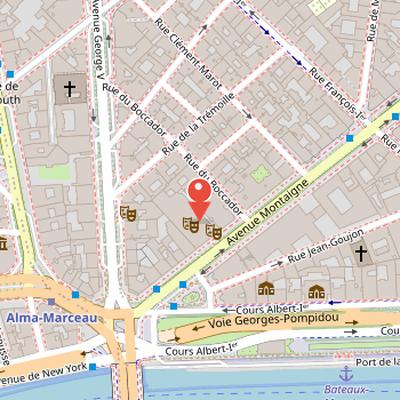
The Théâtre des Champs-Élysées is an ensemble of three performance halls located at 15, avenue Montaigne. Inaugurated on an unspecified date, the building also houses the Caisse des dépôts et consignations, which has owned the walls of the property since 1970 and is the main patron of the programming of the different halls. The property also includes the restaurants Gigi and Le Manko.
Built in 1913, the Théâtre des Champs-Élysées was designed in a sober and rigorous style and is considered one of the first representatives of Art Deco architecture. The project was initially planned with a steel structure, but it became the first concert hall built entirely of concrete. Gabriel Astruc chose Henry Fivaz and Roger Bouvard as architects, later joined by Henry Van de Velde before Auguste Perret replaced him. Perret’s work included the concrete frame, travertine facade cladding, and Allier marble on the stage frame. The facade features five marble bas-reliefs by Bourdelle showing allegories of the arts, while four groups of interior columns remain visible. The facade is classified as a historic monument by official decree.
Nearby Objects
-
 Crazy Horse 100 m away
 -
 Le Zouave 250 m away
 -
 Flame of Liberty 250 m away
 -
 Avenue Montaigne 250 m away
 -
 Place Diana 250 m away
Location and Ownership
The Theatre des Champs-Elysees is an ensemble of three performance halls located at 15, avenue Montaigne. The building was inaugurated on an unspecified date and also houses the Caisse des depots et consignations. This institution has owned the walls of 15 avenue Montaigne since 1970 and is the main patron of the programming of the different halls. The property at this address also includes the restaurant Gigi and the restaurant-cabaret Le Manko.
Architecture and Interior Decoration
Built in 1913, the Theatre des Champs Elysees was designed in a sober and rigorous style and is considered one of the first representatives of Art Deco architecture. It was aligned with neighboring three-level buildings and contains three performance halls, with a restaurant at the top. The building was initially planned with a steel structure, but the structure was instead planned in concrete, making it the first concert hall built entirely of concrete. The concrete frame was constructed by the Perret company. Gabriel Astruc chose Henry Fivaz and Roger Bouvard as architects, Henry Van de Velde joined the project in 1910, and Auguste Perret later replaced him. Perret covered the facade with travertine slabs and decorated the stage frame with Allier marble slabs. The facade includes five marble bas-reliefs by Bourdelle representing Sculpture and Architecture, Music, Tragedy, Comedy, and Dance, and its facade is classified as a historic monument by official decree. The four groups of interior columns remain visible. The interior also includes works by Bourdelle in bronze and frescoes. Maurice Denis decorated the dome between 1910 and 1912 with The Greek Orchestra, The Opera, The Symphony, and The Lyric Drama, as well as tondi illustrating The Chorus, The Orchestra, The Sonata, and The Organ. Additional decor was contributed by painters Edouard Vuillard, Ker Xavier Roussel, Jacqueline Marval, and Raphael Drouart, while Rene Lalique created 62 original pieces including lighting fixtures and stained glass. The restaurant at the top has also been the subject of a Council of State ruling, which stated that its 17 meter elevation required a building permit, although it is not yet recognized administratively.
Ownership and Financial Structure
The financial history of the Theatre des Champs-Elysees has been marked by unusual ownership and persistent deficits. Ganna Walska bought the theatre in 1922 after marrying Harold McCormick, and she stated to the Chicago Tribune that she invested her own funds, not those of her husband. She paid the theatre's deficit until the 1960s, and also signed a promise to sell the theatre to American promoters. When the risk of expropriation arose, the government asked the Caisse des depots et consignations to intervene provisionally, and in 1970 the Caisse des depots et consignations bought 80% of the theatre's shares.
Today, the Theatre des Champs-Elysees is a public limited company with a board of directors. It is described as the only theatre listed on the stock exchange while still running a deficit. Its annual revenue and budget are about twenty million euros. The Caisse des depots et consignations provides a subsidy equal to 52% of revenue, while ticket sales generate 33% and other proprietary revenues, including sponsorship and rentals, account for about 15%.
The board and leadership have also been clearly identified in recent years. Eric Lombard chaired the board of directors from 2020 to 2024, Sophie Quatrehomme has chaired it since 2025, and Raymond Soubie is the honorary president. Michel Franck directed the theatre from 2010 to 2025, with Baptiste Charroing appointed as his successor in 2025.
Premieres, Residencies, and Early Programming
The salles at the Theatre des Champs-Elysees have been associated with major orchestral and theatrical events from the outset. The venue was inaugurated by a French music concert featuring works conducted by Camille Saint-Saens, Claude Debussy, Paul Dukas, Vincent d'Indy, and Emmanuel Chabrier. It later hosted the world premiere of Igor Stravinsky's The Rite of Spring, conducted by Pierre Monteux, an event that caused a major public uproar. The theatre also presented the world premiere of Edgard Varese's Deserts, combining electroacoustic and instrumental music with Pierre Henry and Hermann Scherchen; this premiere provoked boos, laughter, and mockery comparable to the reaction to The Rite of Spring 41 years earlier.
The halls have also welcomed many major orchestras, including the Vienna Philharmonic Orchestra, Munich Orchestra, New York Philharmonic Orchestra, Bavarian Radio Symphony Orchestra, and the Royal Concertgebouw Orchestra. At present, the salles host the Orchestre national de France in residence.
In the 1920s, the theatre became closely linked with Ballets suedois. Jacques Hebertot rented the venue for three nights in 1920, engaging a 45-musician orchestra conducted by Desire-Emile Inghelbrecht. The performances featured Ballets suedois, choreographed by Jean Borlin, in pieces inspired by Siam and cubist African statues. Their success led Rolf de Mare to ask Hebertot to find a large Paris venue for regular performances. Hebertot then took the lease of the Grand theatre and Comedie, making the theatre the Paris base of Ballets suedois while continuing to run both halls under personal responsibility.
Over four years, Hebertot assembled a wide artistic circle, including Georges and Ludmilla Pitoeff, Louis Jouvet, and Gaston Baty, along with authors such as Jean Cocteau, Paul Claudel, and Blaise Cendrars, and composers including Francis Poulenc, Darius Milhaud, Georges Auric, Germaine Tailleferre, and Erik Satie. He also involved affichistes such as Paul Colin. Financial problems later led to a break with Rolf de Mare, and Hebertot left the theatre in 1925, abandoning the direction of the Comedie to Louis Jouvet and the Studio to Gaston Baty. Rolf de Mare then converted the large hall into a music-hall and programmed the Black Birds and Revue negre dancers from October.
Jose9phine Baker and the Revue Ne8gre
Jose9phine Baker, a female black dancer in the Revue ne8gre, became closely associated with the theater after arriving in France with the troupe. Born in Saint-Louis, Missouri, to a white mother and black father, she was said to have escaped her condition through dance. Her performances used animal-like gestures and disjointed splits, and Robert de Flers described her dance as scandalous. Baker also drew admiration from a number of major cultural figures, including Pablo Picasso, Fernand Leger, Kees Van Dongen, Rene Crevel, Colette, and Jean Cocteau. Her presence in the Revue ne8gre made the theater a notable site for a performance that attracted both controversy and artistic interest.
Renovation and Later Use
From 1949 to 1978, the Theatre des Champs-Elysees hosted Musigrains, a series of music-conferences founded by Germaine Arbeau-Bonnefoy. These programs covered classical music, contemporary music, classical and modern dance, folklore, and jazz, reflecting a broad cultural role beyond standard theatrical performance.
A major renovation began in 1984 under Pierre Lebailliff and Georges Francois Hirsch, with work carried out over four summer inter-seasons so that the establishment could remain open. The renovation focused on both the stage area and public spaces. It was delayed when the main company responsible for modernizing the stage cage went bankrupt. When the theatre reopened, Benvenuto Cellini was performed, recalling the work that had opened the theatre in 1913. The direction also chose to install a new hydraulic scenographic machinery system, with support from CDC. This system mechanized the stage, orchestra pit, and flies in order to allow faster changes between shows. Some of this hydraulic equipment was later adopted by the Comedie Francaise during its own renovation two years afterwards.
In 2005, the theatre began another renovation aimed at correcting acoustic issues. A Ministry of Culture report stated that two thirds of the seats offered satisfactory visibility. In 2008, Dominique Meyer replaced the carpet in the orchestra and corbeille with parquet to improve acoustics, while the concert decor in wood was redesigned and the orchestra pit and undersides of the stage were remodeled. In 2010, the theatre joined 50 private Parisian theatres in the association Theatres parisiens associes. That same year, Michel Franck became general director for five years, replacing Dominique Meyer.
The theatre also remained a concert venue. At one performance, Kurt Masur conducted the Orchestre national de France in works by Dmitri Shostakovich and Piotr Tchaikovsky. During the concert, he tripped on a platform near the first violins and fell off the stage, then was taken to Georges-Pompidou hospital, where medical examinations were reassuring.
Theatre programming and leadership
The salles opened with L'Exilee by Henry Kistemaeckers and the revue En douce with Mistinguett, setting an early pattern of varied programming. In 1914, they staged L'Annonce faite a Marie by Paul Claudel, directed by Lugne-Poe, and alternated it with La Gloire ambulanciere and Le Poulailler by Tristan Bernard. The venue continued to present new work in 1920 with L'Enfantement du mort by Marcel L'Herbier and Le Boeuf sur le toit by Jean Cocteau and Darius Milhaud. During this period, the salles were renamed Comedie-Montaigne under the direction of Jacques Hebertot.
The theatre also became a site for major premieres. It premiered Le Simoun by Henri-Rene Lenormand, created by Firmin Gemier, Les Amants puerils by Fernand Crommelynck, created by Gaston Baty, and Le Heros et le soldat by George Bernard Shaw, also created by Gaston Baty. In 1922, it hosted Georges Pitoeff and his troupe, installed by Jacques Hebertot, before the troupe left for the Theatre du Vieux-Colombier in 1924. Jacques Hebertot further transformed the salles in 1923 into a performance venue at Galerie Montaigne, with the layout entrusted to Louis Jouvet and the artistic direction entrusted first to Kommisarjevski and then to Gaston Baty.
From 1925, the theatre was directed by Louis Jouvet, under whom it premiered Siegfried, Amphitryon 38, and Intermezzo by Jean Giraudoux. The venue also hosted the first French screening of Les Aventures du prince Ahmed by Lotte Reiniger. After Jouvet's departure in 1934, the direction passed to Jean Sarrus, then to Roger Capgras in 1936. The theatre remained under the responsibility of the Societe des Auteurs during World War II, and in 1944 it was co-directed by Claude Sainval and Roland Pietri.
Subsequent leadership changes continued to shape the theatre's identity. Claude Sainval directed it alone until 1977, with the Studio added to his responsibilities from 1966. Later directors included Guy Descaux, Jacqueline Cormier, Michel Fagadau, who directed the theatre and the Studio from 1994 until 2011 and was assisted by Viviane Elbaz from 1997 to 2005, and Stephanie Fagadau-Mercier, who followed after his death in 2011. Other named directors in its history include Camille Corney in 1928, Gerard Batbedat in 1931, Louis Ducreux and Paul Alain in 1943, Maurice Jacquemont in 1944, and Antoine Bourseiller, who held artistic direction from 1960 to 1965. Since 1966, the direction has been held by directors of Comedie des Champs-Elysees.