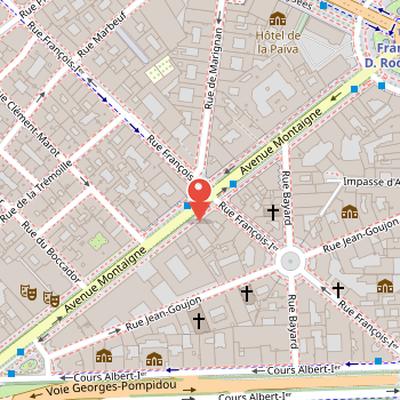
Avenue Montaigne is an avenue in Paris that measures 615 meters in length and 33 meters in width. It begins at Place de l’Alma, on the banks of the Seine, and ends at the rond-point des Champs-Élysées. The avenue slopes gently toward the Champs-Élysées and is lined with small gardens enclosed by grilles. It marks the southern boundary of the triangle d’or and is served by Alma - Marceau station on metro line 9 and by Franklin D. Roosevelt station on lines 1 and 9.
The avenue is one of the main centers of Parisian fashion and became a notable location for luxury commerce after the installation of Christian Dior following the Second World War. It contains boutiques of major French and foreign luxury brands and is less animated than the avenue des Champs-Élysées, with a stronger emphasis on luxury and haute couture. Since 1911, it has also housed the Théâtre des Champs-Élysées, an Art Deco building, and the Plaza Athénée. Since 1973, the Comité Montaigne has promoted the avenue and rue François- through France and worldwide.
Nearby Objects
-
 Théâtre des Champs-Élysées 250 m away
 -
 Crazy Horse 350 m away
 -
 Palais de la Découverte 350 m away
 -
 Avenue des Champs-Élysées 350 m away
 -
 Le Zouave 450 m away
Location and Access
Avenue Montaigne is 615 meters long and 33 meters wide. It begins at Place de l Alma, on the banks of the Seine, and ends at the rond-point des Champs-Elysees. It marks the southern boundary of the triangle d or. The avenue is served by metro line 9 at Alma - Marceau station, and by metro lines 1 and 9 at Franklin D. Roosevelt station.
Luxury, Fashion, and Landmark Buildings
Avenue Montaigne slopes gently towards the Champs-Elysees and is enhanced by small gardens enclosed by grilles. It is one of the main centers of Parisian fashion, comparable to rue du Faubourg-Saint-Honore to the north, and it developed further as a luxury shopping street after the installation of Christian Dior following the Second World War. Today, it contains boutiques of major French and foreign luxury brands and is less animated than the Champs-Elysees, with a stronger emphasis on luxury and especially haute couture.
The avenue also has some of the highest commercial rents in Paris, although they remain lower than those on the Champs-Elysees. In 2024, the average price per square meter ranged from 13 239 EUR to 30 681 EUR, with an average of 21 676 EUR. By 2026, the average price per square meter rises to 23 393 EUR, making it the most expensive street in Paris.
Since 1911, avenue Montaigne has housed the Theatre des Champs-Elysees, an example of Art Deco style, and the Plaza Athenee, one of the twelve Parisian palaces. It has also formed twinning links with Madison Avenue in New York, the Ginza district in Tokyo since 1989, Sakae Machi in Nagoya since 1998, the avenue Louise district in Brussels, and since 2014 with Konigsallee in Dusseldorf. These twinned locations are all luxury hubs in their respective cities.
Comite Montaigne and Local Luxury Promotion
Since 1973, the Comite Montaigne has worked to promote the image of Avenue Montaigne and rue Francois-Ier in France and worldwide. Chaired by Jean-Claude Cathalan, former leader of the Revlon-Luxe group and husband of Hiroko Matsumoto, the committee brings together most of the couture and luxury houses located on the avenue. Cathalan also led Revlon, Karl Lagerfeld, Parfums Caron, and the Jean-Louis Scherrer haute couture house. The Comite Montaigne organizes several public events, including Vendanges Montaigne in September, La fete des Catherinettes, and the holiday tree lighting on the avenue.
Early History of Avenue Montaigne
In 1672, a simple path was recorded at the location of avenue Montaigne. At that time, the path served the gardener huts of the marsh des Gourdes, land that belonged to the ladies of the Visitation-Sainte-Marie. The area was described as being limited to the west by the Grand Egout descending from Ménilmontant to the Seine, identified with the current rue Marbeuf, to the east by the odd side of avenue Montaigne, to the north by the Champs-Elysees, and to the south by the Seine. The term gourde referred to a type of squash grown as a vegetable. Later names also marked the site: it was called the allée des Soupirs around 1720 and the avenue Verte around 1750. In 1770, by order of the marquis de Marigny, a double row of elm trees was planted on the path, indicating an early effort to shape the site as a more formal tree-lined route.
From Disreputable Lane to Fashionable Avenue
Before it was renamed avenue Montaigne in 1850, the route was known as the alllee des Veuves, a nickname linked to encounters with solitary women seeking romantic adventures. It was described as poorly lit and disreputable, with shady guinguettes, and it even appears in Les Mysteres de Paris from 1838. One account also places stolen Crown jewels buried at the foot of an elm tree in the alllee des Veuves near woman Brule's house. The avenue's character changed in the 19th century with the construction of elegant houses, which established it as a fashionable place near the Champs-Elysees. It was then mainly residential, with beautiful buildings and mansions inhabited by the nobility and high bourgeoisie until the end of the 19th century. The avenue also hosted Hippolyte Triat's covered gymnasium, begun in 1846 with a 40 meter long floor, and the Palais des Beaux-Arts, built by architect Hector-Martin Lefuel for the 1855 Exposition universelle. In the 20th century, it attracted industrialists and bankers as company headquarters and couturiers as ateliers, and after the Liberation it became home to some of the most luxurious haute couture boutiques. The extension beyond the Champs-Elysees was known as rue Montaigne and was renamed in honor of aviator Jean Mermoz in 1937.
Buildings and Memory on Avenue Montaigne
Avenue Montaigne includes several sites recorded in Batsiments remarquables et lieux de memoire, combining commercial use, commemorative markers, and architectural change. At 34 avenue Montaigne, there is a commemorative plaque for Madeleine Vionnet, and at 41 avenue Montaigne, a plaque marks Callot Soeurs. Another plaque records diplomat Luiz Martins de Souza Dantas as a resident from 1922 to 1944. The list also includes the Hotel de Lariboisiere at 52 avenue Montaigne.
The avenue has also seen recent redevelopment. From 2020 to 2021, a major restructuring preserved the neoclassical facade facing the avenue while replacing the building core with a concrete and glass structure. The new interior provides 7000 square meters of office and employee facilities. The site has housed a Paul and Joe fashion store on the ground floor, and in 2022 it established a Henry Jacques luxury perfume boutique.
The Prince Napoleon Palace Project
Prince Napoleon, son of King Jerome and brother of Princess Mathilde, dreamed of building a palace for his mistress, the actress Rachel. He acquired land near Avenue Montaigne and Rue Jean-Goujon, on the site where the Palais des Beaux-Arts stood during the 1855 Exposition Universelle. Construction began in 1856 near the Hotel Soltykoff and continued until 1860. The architect Auguste-Jean Rougevin was first entrusted with the project and was sent to study original models at Pompeii, but he died there. Jacques Hittorff then replaced him, before retiring quickly, and Alfred-Nicolas Normand took over project management in 1858 on Hittorff's recommendation. The main structure was completed in 1858, the same year Rachel died of tuberculosis in January.
The building's facade had a severe peristyle with red and yellow colors. Inside, Normand and the ornamentist Charles Rossigneux created decorations inspired by European museum works. The central atrium contained a white marble statue of the emperor by Eugene Guillaume. The statue showed the emperor in a toga holding the Code Civil, with a laurel head and an eagle at his feet, and it was surrounded by busts of imperial family members. Painted decorations on maroufl canvas were made by Sebastien Cornu and Jean-Leon Gerome, using Pompeian motifs on red antique or black backgrounds. Furniture in bronze and wood imitated ancient styles.
Maison Pomp eienne on Avenue Montaigne
According to Bâtiments remarquables et lieux de mémoire, the house on Avenue Montaigne was closely associated with Prince Napol eon. After his marriage to Clotilde de Savoie in 1859, he resided at the Palais-Royal and organized parties at Avenue Montaigne. The house was inaugurated on May 4, 1860, with antique-style festivities attended by Napoleon III, the Empress, and the court. The same source states that Prince Napol eon placed his collection of paintings and Egyptian antiques in the house. In 1862, Charles Christofle produced a dessert service in silverware based on designs by Jules Dieterle. As relations with the emperor deteriorated, the prince left France for his Swiss residence at Prangins in 1865, and he sold Maison pomp eienne in 1866. It was then bought by Arsène Houssaye and Ferdinand de Lesseps among others, who turned it into an antiques museum. Arsène Houssaye and Théophile Gautier wrote the museum guide, but the museum had a short life because the house was heavily damaged in 1870.