Palais de l'Industrie, also known as Le palais de l'Industrie et des Beaux-arts and Palais des Champs-Élysées, was an old building constructed for the Exposition universelle de 1855 on the avenue des Champs-Élysées in Paris. Designed by an architect and an engineer, it was intended as a permanent exhibition venue and stood in the heart of the city. The building presented rationalist iron-and-glass construction behind an eclectic stone façade designed to give the structure a monumental character. Its façade included a large triumphal arch portico opening onto a central nave, round-arched arcades, and four corner pavilions, and the upper cornice carried a sculpture by Élias Robert. The building served as a location for artistic salons from 1857 to 1897, hosted the first Exposition internationale d'Électricité in 1881, and was used as a temporary military hospital during the siege of Paris. Demolition began in 1896 to make way for the Petit Palais and the Grand Palais.
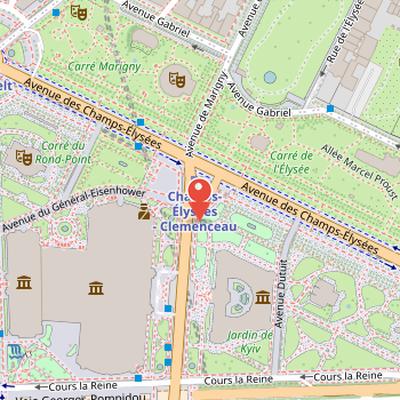
Nearby Objects
-
 Petit Palais 110 m away
 -
 Grand Palais 150 m away
 -
 Palais de la Découverte 250 m away
 -
 Élysée Palace 400 m away
 -
 Rue du Faubourg-Saint-Honoré 450 m away
History and Uses of the Palais de l'Industrie
The Palais de l'Industrie, also known as Le palais de l'Industrie et des Beaux-arts or the Palais des Champs-Elysees, was an old building constructed for the Exposition universelle of 1855 on avenue des Champs-Elysees in Paris. It was designed by an architect and an engineer. From 1857 to 1897, it served as a venue for artistic salons, and in 1881 it hosted the first Exposition internationale d'Electricite. During the siege of Paris, it was also used as a temporary military hospital. Demolition began in 1896 to make way for the Petit Palais and the Grand Palais.
The Palais de l'Industrie and the First French Universal Exposition
The Palais de l'Industrie, known as L'embleme de l'Exposition, was inaugurated by Louis-Napoleon Bonaparte, who had recently become Emperor Napoleon III. It served as the emblem of the first French Universal Exposition, an event that attracted more than five million visitors. This exposition was presented as the French head of state's response to the 1851 London Universal Exposition, which had been celebrated for the audacity and novelty of its Crystal Palace.
Unlike most buildings constructed for such expositions, the Palais de l'Industrie was intended to provide a permanent exhibition venue. Located in the heart of Paris, it combined a symbolic role as the public face of the exposition with a practical purpose that extended beyond the event itself. Its planned permanence set it apart from the more temporary character of many exposition structures.
Architecture and Layout of the Palais de l'Industrie
The Palais de l'Industrie was built in 1852 along the Champs-Elysees in the grand carre des Jeux, on the axis of the palais de l'Elysee and avenue de Marigny. In that year, the city of Paris retroceded the land to the State for its construction. The building presented a rationalist architecture of iron and glass placed behind a stone facade of eclectic style. This facade was intended to give the monument a grand character while concealing the structure behind it.
The main front was long and featured a huge triumphal arch portico opening onto a large central nave. It was divided into two levels of round-arched arcades and marked by four imposing corner pavilions. The building measured in width and in depth, including the Galerie des machines, and covered over two hectares. It had a height of and contained 408 windows.
The upper cornice of the monumental portico carried a sculpture by Elias Robert representing La France distributing crowns to Commerce and Industry, surrounded by imperial symbols. Among these symbols was a cartouche with an eagle held by children, created by Georges Diebolt. Some elements of the cornice were later deposited in the Domaine national de Saint-Cloud.
Access to the annex gallery was provided through a rotunda called Panorama, leading to the Galerie des Machines, which measured long and high and ran along the banks of the Seine.
Uses and Historical Role of the Palais de l'Industrie
Officially named the palais de l'Industrie et des Beaux-arts, the building was constructed with cut stones taken from several quarries, including the Loups quarry in Nanterre, the Moulin quarry in Arcueil, the Moulin a Vent and Voie des Bornes quarries in Ivry, and quarries in Vitry. It was intended to host an exhibition of technical and artisanal innovations across approximately stands, and it later became one of the major exhibition spaces in Paris. The Palais de l'Industrie hosted the Universal Exhibitions of 1855, 1878, and 1889, and it also served as the venue for art salons between 1857 and 1897. Other uses included agricultural and horticultural exhibitions, horse shows, public celebrations, and ceremonies.
The building was also associated with major award ceremonies. One medal presentation took place there on a specific date and was attended by approximately guests together with an orchestra conducted by Hector Berlioz. Medals were awarded by the Jury, and the Emperor also offered 40 additional personal distinctions. Some recipients could receive lifelong pensions for services to civilization. The Palais de l'Industrie later housed the Campana Collection from May to an unspecified date.
In 1881, it became the site of the first International Electricity Exhibition, where many inventions were presented publicly for the first time. This exhibition was described as marking the beginning of a new era in electricity production and transport. Among the last events held there was the Book and Paper Industry Exhibition, opened on a specific date and directed by the Ministry of Fine Arts, Etienne Charavay, and John Grand-Carteret. That exhibition offered a wide overview of the book's evolution and reconstructions of work in the book trade.
The Palais de l'Industrie also figured in public festivities, serving as the start and finish point for the Boeuf Gras carnival procession on the 16th and 17th of an unspecified month and date, and the procession was celebrated there again after 26 years of interruption. On a specified date, the burned bodies of victims of the bazar de la Charite fire were brought there for identification by families. Demolition began in 1896 in preparation for the 1900 Universal Exhibition.
Demolition and Urban Legacy
The demolition of the Palais de l'Industrie made possible the creation of the present avenue Winston-Churchill, formerly known as avenue Alexandre-III. This route links the Hotel des Invalides to the palais de l'Elysee through the Alexandre-III Bridge. Its removal also opened up a broad perspective known as the axe republicain. In addition, metal and cut stones from the building were reused in the structure of the Notre-Dame-du-Travail church in Paris.