The Augustinian Convent in Toulouse was founded in 1268 for the order of the Hermits of Saint Augustine. Originally located outside the city walls near the Matabiau gate, the community found its first site inadequate and later obtained authorization from Pope Clement V to sell it and acquire a new location within the city. The present convent was then built between 1310 and 1341 at the corner of rue du Musée and rue des Arts.
The complex includes medieval remains of historical and architectural interest. Its church was completed and decorated with paintings reminiscent of northern Spain in the first half of the 14th century, as well as miniatures produced in the royal milieu of Philip the Fair. The bell tower has a square plan near the choir, and the cloister was completed in 1396. The convent was suppressed in 1790 and now houses the musée d'art de Toulouse. Its medieval parts have been classified as monuments historiques since 1840, and the escalier Darcy has been registered since 1990.
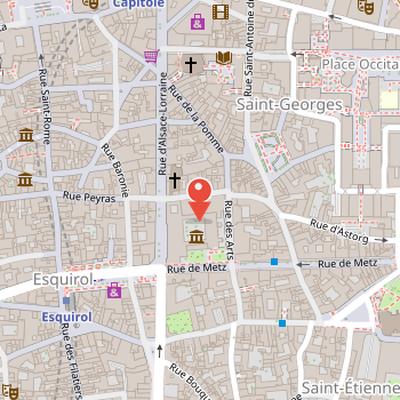
Nearby Objects
-
 Musée des Augustins 30 m away
 -
 Place Saint-Georges 150 m away
 -
 Étienne-Esquirol Square 150 m away
 -
 Place de la Trinité 250 m away
 -
 Saint Jerome Church 250 m away
History and Location of the Augustinian Convent
The Augustinian convent was founded in Toulouse in 1268 as a convent of the Augustins de Toulouse for the order of Ermites de saint Augustin. It was first located outside the city walls near the porte Matabiau. During the stay of pope Clement V at the abbaye de Bonnefont, the convent requested permission to buy properties within the city. After this permission was granted, the convent was built between 1310 and 1341 at the corner of rue du Musee and rue des Arts. The convent was suppressed in 1790. Today, the building houses the musee d'art de Toulouse. Its medieval parts have been classified as monuments historiques since 1840, and its escalier Darcy has been registered since 1990.
History and Architectural Development
A community of Hermits of Saint Augustine was founded outside Toulouse near the Matabiau gate in 1269 by the chapter of the regular canons of Saint-Sernin, which agreed to build a convent and had received lands and rights from the new arrivals through earlier donations. The first site soon proved inadequate for the needs of the community. In 1309/1310, the hermits obtained authorization from Pope Clement V to sell that first foundation and then acquired the present site, where the existing buildings were erected inside the city walls.
The church was built in full and decorated with paintings resembling those of northern Spain from the first half of the 14th century. It also received miniatures produced in the royal milieu of the time of Philip the Fair. The bell tower was built on a square plan near the choir, and access to it was through the opening now leading to the sacristy. Construction of the cloister began with the eastern part in 1341, and the other three sides were started in 1396 by the mason Jean Maurin; the cloister was completed that same year.
The convent also benefited from contributions by Louis d'Anjou, lieutenant of the king in Languedoc from 1364 to 1380, especially for the construction and decoration of the Notre-Dame-de-Pitie chapel east of the great cloister. The chapel gate bears his coat of arms. In the 15th century, a great fire that devastated much of Toulouse caused most of the roofs to collapse and destroyed part of the archives. Roof reconstruction began in 1495 with the masons Martin Pujol and Pierre d'Arroye, and the rebuilt building was consecrated on April 18, 1503.
Monastic Population at the Convent
The Augustinian convent once housed up to two hundred monks. Over time, its monastic population declined steadily. By 1518, the number of monks had fallen to one hundred forty. In 1649, it had decreased further to sixty, and by 1680, only thirty-one monks remained. These figures show a gradual reduction in the size of the convent community across several centuries.
Later History and Reuse
The Augustinian convent in Toulouse underwent repeated damage, upheaval, and reuse in the late medieval and modern periods. In 1542 it suffered looting of books, archives, liturgical objects, and furniture. Its bell tower was also severely damaged when lightning struck it on the feast day of the Exaltation of the Holy Cross, destroying the spire and upper floors. The tower was reduced by one and a half floors and was not rebuilt. The convent was further affected by religious change: three Augustins were publicly whipped for leaving the convent, apostasy, and marrying Augustin nuns, and all Augustin nuns of Toulouse except one converted to the Protestant Reformation. The convent house in Toulouse was later given to the Jesuits.
In the revolutionary period, the convent became national property by decree of December 2, 1789, and it was disused after the suppression of monastic orders in 1790. A plan to establish a parish dedicated to Saint-Augustin there was abandoned in 1791. In April 1791, Francois Bertrand proposed creating a museum for Haute-Garonne and neighboring departments. Parts of the convent were then adapted to other uses: the refectory and dependencies were sold in 1793 to Suzanne Azimon for use as a fodder sales place. The Museum of Art of Toulouse opened on November 8, 1793, and the art school in Toulouse was transferred to museum annex rooms in 1804, where it remained until 1892.