The Musée des Augustins is an art museum in Toulouse, Haute-Garonne. Created by decision of the Conseil Général and opened in 1795, it is housed in the former convent of the Augustins. The museum holds important collections of painting and sculpture and reopened its doors in 2005 after nearly six years of closure for structural work and adaptation to new cultural uses.
The museum occupies buildings that were once a house of the order of hermits of Saint Augustine, inside the walls of the city. The Augustins convent in Toulouse began to be built from 1310 with papal authorization. Its museum history makes it one of the oldest museums in France, shortly after the Louvre. Its first collections were formed from revolutionary seizures and works from the Royal Academy of Painting, Sculpture and Architecture of Toulouse. Over time, it received important deposits and artworks from Italy, Flanders, and France, contributing to the breadth of its collections.
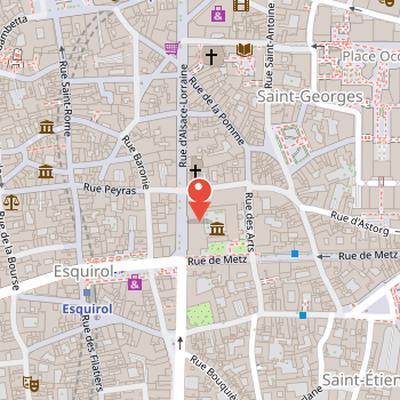
Nearby Objects
-
 Augustinian Convent 30 m away
 -
 Étienne-Esquirol Square 130 m away
 -
 Place Saint-Georges 200 m away
 -
 Place de la Trinité 200 m away
 -
 Saint Jerome Church 250 m away
Mus e des Augustins in Toulouse
The Mus e des Augustins is located in Toulouse, in the Haute-Garonne, and was created by decision of the Conseil G n ral. It opened in 1795 and is housed in the former convent of the Augustins in Toulouse. The museum holds important collections of painting and sculpture, making it a significant cultural institution in the city. It was closed for nearly six years because of structural work and the adaptation of the building to new cultural uses, before reopening in 2005.
Origins at the Augustins Convent
The Musee des Augustins is housed in buildings that once formed a house of the order of hermits of Saint Augustin. Its location lies inside the walls of the city, where the Augustins convent of Toulouse was built from 1310 with papal authorization. The site was consecrated on an unspecified date, and the museum was established at the Augustins and opened its doors solemnly on an unspecified date.
Early Formation and Imperial Deposits
Musée des Augustins is one of the oldest museums in France, created shortly after the Louvre. Its first collections were formed from revolutionary seizures and from works of the Royal Academy of Painting, Sculpture and Architecture of Toulouse. It was then included among the fifteen museums established by the Chaptal decree, reflecting a proposal to distribute works so that each city would possess collections representing all masters, genres, and schools.
The museum was also required by another decree to prepare a suitable gallery to receive deposited works. These deposits were substantial: more than 600 works were received in 1802 and 1805, along with further works by imperial decree. One of the largest deposits came through that imperial arrangement. In 1800, the sculptor François Lucas obtained a shipment of works from Paris in exchange for Toulouse paintings, and the museum continued to receive artworks in 1803 and 1805 under the Consulate and Empire.
The holdings included works from Italy, Flanders, and France, among them Saint John and Saint Augustin by Perugin, Apollon flaying Marsyas by Guido Reni, and Christ on the Cross by Rubens. Many of the paintings came from seizures in countries occupied by the French army. In 1804, the museum and the School of Arts were installed in the East wing of the Renaissance small cloister. Napoleon later confirmed the cession of the convent to the city for museological purposes during his visit to Toulouse in 1808. The museum received further paintings from Napoleon in 1812, including Dutch, Flemish, Italian, and French works such as the Reception of the Duke of Longueville into the Order of the Holy Spirit by Philippe de Champaigne.
From Church Complex to Museum
The site of the Musee des Augustins changed through a long sequence of architectural adaptations and renovations. In 1823, architect Jacques-Pascal Virebent proposed removing the partitions between the sacristy, the Notre-Dame-de-Pitie chapel, and the chapter room to create a single gallery. This direction was carried further in 1828, when the School of Arts demolished walls and high windows in order to display antiques. During the same renovation campaign, the mayor allocated additional funds for urgent repairs to the ruined apse walls and cracked vaults, while a suspended barrel vault was added to reduce the religious character of the building. In 1831, architect Urbain Vitry completed the work and created a painting gallery in the church, then called the Temple of Arts.
The transformation continued in the later 19th century. The west wing and large refectory were purchased in 1862 and destroyed in 1868. In 1873, the municipality assigned Eugene Viollet-Le-Duc to renovate the building into a museum. He and his collaborator Denis Darcy created the monumental staircase, and Darcy later resumed the renovation after Viollet-Le-Ducs death. The current building along Alsace-Lorraine street was constructed between 1880 and 1901, and the new museum was completed in 1901. Plans and elevations of the museum were also drawn in 1880. The School of Fine Arts moved from Augustins to Daurade in 1895, and Antoine-Marie Roucole painted La Salle capitulaire that same year.
The building remained a subject of restoration and reorganization in the 20th century. In 1950, the administration of Monuments historiques restored the church to its ancient aspect because of space issues, and artworks were stored while the layout was reorganized. The church is described as a Southern Gothic heritage site with a unique nave of eight bays on rib vaults, lateral chapels between buttresses, and a star-vaulted choir. From 1975, the museum increased exhibition space and restored the convent. Restoration also included rebuilding walls separating the chapel and sacristy in the eastern wing, and a new southeast entrance was made using the portal from the chapel of Black Penitents. These works were completed in 1980 under conservators Paul Mesple and Denis Milhau and architects Sylvain Stym-Popper and Yves Boiret, and the renovated museum reopened that year.
More recent works began in 2018, causing first partial and then full closure. The closure was linked to new structural and cultural usage works, including renovation of the painting salons with stained glass, air conditioning, and reserves, a redesigned museographic layout, archaeological excavations, cloister works, a new reception area by the Portuguese agency Aires Mateus, and improved accessibility through elevators and PMR ramps. A total reopening is scheduled from 2024 to Spring 2027.
The Museum Garden
The jardin du musee des Augustins was established for an exhibition called Les jardins d un couvent and resulted from a partnership between the museum's conservation team and Toulouse's green spaces. Its plots were composed according to the plan of the abbaye de Saint-Gall gardens in Switzerland, and the garden is divided into four parts with distinct functions. In total, it contains 112 plant species distributed according to their use.
The central garden is mainly decorated with flowers intended for bouquets for altars, including roses, lilies, violets, nasturtiums, acanthus, and periwinkles. The second part, called Herbularius or jardin des plantes medicinales, is located near the physician's residence and is dedicated to plants used by the physician for remedies. Among them, marjoram has antiseptic properties and is used by infusion against nervousness and headaches, while wormwood is used for stomach ailments such as seasickness and nausea.
The third part, Hortus or le potager, is located near the kitchens and contains vegetables and herbs for religious dietary use. This part follows the strict plan of the abbaye de Saint-Gall and includes zucchini, parsley, carrots, and batavia lettuce. The fourth part, Arboretum or Fructum, is generally located near the cemetery and functions as an orchard. It contains fruit trees and shrubs used for food and garden decoration, including apple trees, cherry trees, pear trees, and blackcurrant bushes.
Painting and Sculpture Collections
The collections at the Musee des Augustins were accumulated through revolutionary seizures and fund transfers from the former Academie royale de peinture, sculpture et architecture de Toulouse. They comprise more than 2,000 artworks, divided equally between paintings and sculptures. The holdings present French artistic currents from classicism and neo-classicism to realism, and they are displayed in the Rouge, Bleu, and Blanc salons as an exceptional collection of French paintings.
A major strength of the museum is its range of French painting from the 17th to the 20th centuries. Among the earlier works are more than forty paintings by Louise Moillon, including Fruits, also known as Nature morte aux mures. The collections also include four paintings by Philippe de Champaigne, works by Valentin de Boulogne, Simon Vouet, Sebastien Bourdon, Pierre Mignard, Charles de La Fosse, Pierre Subleyras, Nicolas de Largillierre, Claude Joseph Vernet, Joseph-Marie Vien, Pierre-Henri de Valenciennes, and Jean-Antoine Houdon. Other notable paintings include Jean Jouvenet's Le Christ descendu de la croix from 1714, three paintings by Jacques Stella including Le Mariage de la Vierge and Sainte Famille, and two still lifes by Jean-Baptiste Monnoyer.
The museum also emphasizes painters from Toulouse and southern France, including Antoine and Jean-Pierre Rivalz, Francois de Troy, Joseph Roques, and numerous works by Nicolas Tournier. Tournier is represented by paintings such as Le Roi Midas, Saint Pierre, Le Christ descendu de la Croix, Le Joueur de luth, Le Portement de Croix, and Le Christ porte au tombeau, as well as parts of the large painting Bataille de Constantin contre Maxence. The collections also include works by Hyacinthe Rigaud and Jean-Baptiste Oudry. Rigaud is represented by Portrait of Germain Louis Chauvelin, garde des sceaux (1727), which shows Germain Louis Chauvelin in his French first magistrate costume holding a document inscribed Au Roy. Oudry is represented by chassant le cerf (1730), a hunting scene in the Saint-Germain-en-Laye forest commissioned in 1728 and noted for its detailed, portrait-like depiction of each character.
The 19th and 20th centuries are represented by an important collection that includes works by Henri de Toulouse-Lautrec, Dominique Ingres, Antoine-Jean Gros, Eugene Delacroix, Eugene Leygue, Evariste-Vital Luminais, Camille Corot, Henri-Arthur Bonnefoy, Gustave Courbet, Edouard Manet, Berthe Morisot, Edouard Vuillard, Edouard Debat-Ponsan, Achille LaugE, Paul Charavel, Louis Latapie, Jules Cavailles, Maurice Georges Poncelet, Yves Diey, Amelie Beaury-Saurel, Maurice Denis, and Isidore Pils. Specific works mentioned include Toulouse-Lautrec's Portrait of Francois Gauzi, Delacroix's Sultan Moulay Abd Al-Rhaman surrounded by his guard leaving his palace in Meknes, Debat-Ponsan's Le Massage, scene de hammam from 1883, Beaury-Saurel's Apres dejeuner from 1899, and Pils's La mort d'une soeur de charite from 1850.
Italian Painting in the Collections
The collections at the Musee des Augustins include a notable body of Italian painting, spanning several periods. Among the earliest works are a few Italian primitives from the 13th century, including examples that show the transition from Italo-Byzantine style toward a more typically Italian manner, especially in Sienese and Florentine painting. These works also feature humanized figures and compositions with complex landscapes and architecture. The collections later extend to Italian paintings from the Baroque movement of the 17th century. Together, these works reflect the presence of many Italian painters who came to work in Toulouse and give the museum a broad representation of Italian art across time.
Notable Paintings and Crucifixes in the Collections
The Musee des Augustins collections include several notable works of religious art spanning the early 14th to the 15th century. Among them is Le Christ en croix avec l'orant du cardinal Guilhem Peire Godin by an anonymous artist from the early 14th century. The collections also hold a crucifix painted in tempera on canvas glued on wood, originally found in Saint-Etienne Cathedral in Toulouse in 1847. This crucifix came from the Jacobins convent complex, was transferred to the Saint-Raymond Museum at the end of the 19th century, and was later donated to the Augustins. Painted on both sides in the Florentine art style, it presents the same image on each face: the crucified Christ with blood and a praying cardinal.
Another important work is Le Christ en croix, la Vierge, saint Jean et sainte Madeleine by Neri di Bicci. This painting reuses a previous Christ en croix by Lorenzo Monaco, with Neri di Bicci painting around the existing cross. A skull of Adam appears at the base of the crucifix, a detail that symbolizes original sin in Christian Crucifixion iconography. This work was bought for the Augustins Museum by the archaeologist Alexandre Du Mege.
The collections also hold a major Renaissance panel by Pietro di Cristoforo Vannucci, known as Le Perugin. Dating from the 15th century, the panel is titled Saint Jean l'Evangéliste (?) and saint Augustin. It belonged to a dismantled altarpiece later scattered across Europe and the United States. The panel shows two monumental figures against a clear landscape background. The right figure is identified as saint Augustin, bishop of Carthage, while the left figure remains unidentified and may be saint Jean l'Evangéliste or saint Philippe.
The Baroque Collection
The collections present the Baroque current as a major artistic movement that settled in Europe after the Renaissance. The term Baroque is said to come from the Portuguese word barroco, meaning irregular pearl, and was first used to describe this period and its art in the mid-19th century by a Swiss historian. The collections place the Baroque era roughly between 1580 and 1720, in opposition to Protestantism and Lutheran thought in Italy.
In artistic terms, Baroque is described as valuing asymmetry, irregularity, and movement. It affected all the arts and is characterized by overload, exuberance, grandeur, and dramatic effects. In painting, it was meant to show the grandeur of God through impressive and dazzling effects that glorified religion. The collections also note that characters' attitudes and expressions were used to reflect their feelings.
The section includes The Glory of all Saints by Giovanni Francesco Barbieri, known as Le Guerchin, dating from the mid-17th century. The collections also note that Baroque gradually gave way to the Rococo style in the early 18th century.
Baroque Paintings in the Collections
The museum's collections include The Glory of all Saints, a painting that represents saints protecting the city of Modena through light and vivid colors. Its upper register shows Jesus at the center, with God, Mary, Joseph, and a group of angels. The lower register presents Saint Francis of Assisi at the center, with Saint Geminianus, Saint Peter, Saint Paul, and Saint John the Baptist on the right, and Saint Sebastian, Saint Gregory, Saint Jerome, and Saint Stephen on the left. Another Baroque work in the collections is Apollo Flaying Marsyas by Guido Reni. This painting depicts a scene from Greek mythology in which the god Apollo flays Marsyas after Marsyas challenged him to a flute contest. The work contrasts Marsyas's face, distorted by pain, with Apollo's serene expression, and also sets Marsyas's golden skin against Apollo's white skin to emphasize divinity.
Dutch and Italian Paintings at the Musee des Augustins
The collections at the Musee des Augustins were formed through a long sequence of seizures, donations, legacies, government deposits, and later acquisitions. Dutch paintings have been present since 1795, beginning with revolutionary seizures sent to the Musee central des arts, now the Louvre, and with works distributed by Jean-Antoine Chaptal of the interior ministry to 15 French cities, including Toulouse. In 1803, the museum obtained 31 first paintings, among them Saints Catherine at Mount Sinai and The Martyrdom of Saint Lawrence by Jan Erasmus Quellinus. Further Dutch works arrived in 1812, including The Adoration of the Magi by Matthias Storm and Humanity Before the Flood by Cornelis Van Haarlem. The museum also received paintings from the duke of Brunswick collection housed at Salzdalhum castle in Germany, and it retains seven Dutch paintings authorized for restitution by King Louis XVIII after the Treaty of Paris, despite a refusal to return them announced by the prefect of Haute-Garonne on September 29, 1816.
The Dutch holdings are substantial, with about one hundred paintings from the 16th, 17th, and 18th centuries. They include works by Antoine Van Dyck, Willem van Aelst, and Cornelis Cornelisz van Haarlem. The collection was enlarged by a significant group of small-sized Dutch works from the seizure of Anne-Francois-Victor Le Tonnelier de Breteuil's collection during the Revolution, and by later gifts and deposits. Among the works specifically mentioned are Vase of Flowers by Willem van Aelst, Lucretia at Work by Willem de Poorter, and Nymphes et Satyres dans un paysage by Cornelis Van Poelenburgh. The museum's Dutch paintings remained largely unchanged until the end of the 19th century, when they were expanded through Pierre Maury's legacy, which donated all his assets to Toulouse, followed by 20th-century Louvre deposits and museum acquisitions. These later additions included Aelbert Cuyp's Vaches au bord d'une riviere, acquired in 1967 from Abbe Marcel Haynaud, and Christiane Calvet's collection, bought by the city of Toulouse in 1971.
The collections also preserve a broad range of other paintings. They hold works by Jacopo Zucchi, Marco Basaiti, Bernardo Strozzi, Giuseppe Maria Crespi, Carlo Maratta, Gioacchino Assereto, Giovanni Battista Gaulli, Antonio Verrio, Francesco Solimena, and Francesco Guardi. One notable work is Saint Felix of Cantalice, an oil on canvas by Antonio Verrio created between 1635 and 1707, which underwent restoration from 2007 to 2010 and inspired a temporary monographic exhibition titled Antonio Verrio: chronicles of an Italian traveling painter, 1636-1707. The museum also houses San Diego de Alcala de Henares by Bartolome Esteban Murillo, from the convent of the Franciscans of Seville.
Overall, the collections at the Musee des Augustins present many currents of Dutch painting and represent all genres. They are described as consisting mainly of intimate paintings, still lifes, delicate scenes, and broad luminous landscapes. Landscape painting is dominated by the Haarlem school and includes three examples of Rhenish views. The holdings also contain historical paintings influenced by Rembrandt and by Haarlem mannerism and Utrecht Caravaggism, as well as Italian historical landscapes, artworks of the fijnschilder genre, bamboccianti paintings such as players of morra, and paintings by the Flemish artist Pieter van Bloemen. Three portrait works are also noted, illustrating sober realism, Baroque Flemish influence, and aristocratic painting styles. Before renovation, the museum's church and salon vert displayed several specific works, including Le Christ entre deux larrons by Pierre Paul Rubens, Le Martyre de saint Jacques by Thomas Willeboirts Bosschaert, Serpents, crapauds et papillons by Otto Marseus van Schrieck, Tete de vieillard by Pieter Verelst, Le Christ presente au peuple by Wenzel Coebergher, L'Humanite avant le deluge by Cornelis Cornelisz, and Nature morte de fruits avec coupe d'argent by Pieter II van der Bosch.
Le Nord en Lumires at the Musee des Augustins
At the Musee des Augustins, the exhibition Le Nord en Lumires was realised by Alain Daguerre de Hureaux and Axel Hemery and commissaried by Arnauld Brejon de Lavergnee and Monique Rey-delque. It updated attributions and information from the museums 1908 catalogue and presented 88 works, including 30 shown for the first time in about 25 years. Before the exhibition, paintings were restored and new frames were created. The display adopted a stylistic approach rather than a chronological or thematic one. It included sections on the 16th century, mannerism, caravagism, and Rubens school, and explored relations between northern schools, France, and Italy. The exhibition also emphasized the concept of series and monochrome color preferences. For large works that could not be moved, it extended into the permanent collections.
Nineteenth-Century Sculpture at the Musee des Augustins
The Musee des Augustins preserves a remarkable collection of 19th-century sculpture, notable for both its scale and quality. The collections document the democratization of sculpture beyond the Church and princes, as well as its growth through numerous public commissions. They also reflect broader 19th-century change: urban transformation, societal secularization, and the rise of a wealthy bourgeoisie. State commissions were accompanied by urban planning programs, and sculpture became ornamentation for major monuments, public spaces, and cemeteries. In Toulouse, this period was marked by large urban projects and commemorative or funerary sculpture.
The collections present 19th-century sculpture as rich and diverse in subjects, techniques, and scale. They also show the influence of neoclassicism, inspired by Antiquity and archaeological discoveries, and shaped by ideals of beauty, heroic nudity, and antique draperies before ending in the mid-19th century. The Toulouse school, formed around Alexandre Falguiere at the Ecole des beaux-arts de Paris, is represented through masterpieces displayed in the Viollet-le-Duc monumental staircase built in 1882 at the museum.
Among the works and displays are busts of Auguste Rodin and Camille Claudel in the Salon Rouge, as well as many bronze, marble, and original plaster works, including David vainqueur de Goliath by Antonin Mercie from 1870.
Alexandre Falguiere and the Museum Collections
The collections at the Musee des Augustins include several sculptures by Alexandre Falguiere, showing the range of his work and the place he occupies in 19th century French sculpture. Falguiere graduated from the Ecole des Beaux-Arts de Paris and became a major sculptor of the Third Republic. The collections present him as an artist strongly attached to antique art, while also interested in realism and contemporary forms.
Among the works on display is Tarcisius martyr chretien, created in 1868. The sculpture depicts a young Christian trapped by pagans while carrying the eucharist to martyrs, and he is shown as being stoned for trying to save the host from profanation. Another work, Nymphe chasseresse, created in 1888, is described as based on the physical traits of women of the 1880s. It represents a probable servant of Artemis, with rounded shapes and short wavy hair. This work reflects Falguiere's practice of keeping mythological subjects while adding realism to his sculptures.
The museum also displays Junon, or La Femme au paon, which is noted for an expression close to the symbolist movement. Other Falguiere works in the collections include Faune a la grappe, a youth masterpiece associated with his attachment to antique art, as well as A la porte de l'ecole, Diane, Henri de La Rochejaquelein, and La Suisse accueille l'arme francaise. Together, these works indicate the variety of subjects he explored, from mythological and allegorical figures to historical and genre themes.
The collections also situate Falguiere within wider artistic networks. The Monument a Balzac project by Auguste Rodin was rejected and reassigned to him, and the collections note that Falguiere had friendly relations with Rodin. In this way, the museum presents not only individual sculptures, but also a broader view of Falguiere's place in the artistic debates and commissions of his time.
Philopoemen at Sellasie
Bernard Lange was inspired by Plutarch's Parallel Lives when he created Philopoemen at Sellasie. The sculpture depicts the courage of the young Achaean warrior Philopoemen against Spartan troops in the Battle of Sellasie. According to the account, Philopoemen was pierced by a javelin through both thighs, pulled it out, continued fighting, and routed his enemies. The figure is mounted on a pedestal adorned with a medallion representing the sculptor. It is presented as representative of ancient art through the warrior's nudity, ideal proportions, and use of marble.
Eclecticism and Modern Sculpture in the Collections
The collections trace the birth of eclecticism in the second half of the 19th century, a period marked by the confrontation of different aspirations in which genres, styles, and sources coexist and merge. This tendency continued through the Second Empire and the first decade of the Republic, when sculptural production remained both abundant and eclectic. The museum includes works by Laurent Marqueste that illustrate this period, including a bronze of the well known sculpture Perseus and the Gorgon.
The collections also show how some sculptors responded to Impressionism, a movement based on personal impressions rather than general rules. In sculpture, this led to refined works with surfaces designed to catch and retain light. Later modern movements such as Fauvism, Cubism, Abstract art, and Surrealism are also noted as having emerged afterwards. Within this broader context, the collections refer to Alexandre Falguiere as an influence for Toulouse sculptors studying in Paris. They also mention Antonin Mercie, a student of Falguiere, and his David vainqueur de Goliath, as well as Gloria Victis, exhibited at the Salon of 1874, and Quand meme, which reflects the memory of resistance during the siege of 1870.
Another strand in the collections concerns Symbolism, represented by Eugene Thivier, a little known Parisian sculptor. His marble group Le Cauchemar, dated 1894, depicts a nude woman attacked by a griffon. The interwar period brought a renewed interest in antique style sculpture, exemplified by Sylvestre Clerc's L Hercule enfant, which recalls characteristics of ancient art.
The collections also include a bust by Auguste Rodin that marks a break from the symmetrical frontal posture and reflects his naturalist attention to morphological detail. Created near the end of the 19th century, it is presented as a crucial turning point in art. The bust portrays the artist's younger brother at age sixteen as a young Roman, wrapped in a draped garment, with a smooth face contrasted against the folds of the tunic revealing the body. Modeled in 1884, cast in bronze in 1895, it was used as a model for four other bronze works. Jean-Paul Laurens appears in the bust as a sign of friendship and support, while the collections also recall that Rodin was falsely accused of molding L Age d airain from a live model.
The MNR Works at Musee des Augustins
The Musee des Augustins is associated with a group of MNR works, a category of about 2,200 artworks selected by the artistic recovery commission after World War II. These works are entrusted to the care of national museums and are not state property. They may be restituted to their legitimate owners without any prescription date. Within this framework, seven artworks are under the provisional guardianship of the Musee des Augustins.
The museum also includes three artworks of Italian origin in its Italian collection. Among them is a tempera painting dated between 1450 and 1460, which was attributed by the Louvre in 1951 and has been deposited at the Musee des Augustins in Toulouse since 1957. Another linked work is Allégorie de la Justice, also known as Venise tronnant, by Francesco Fontebasso, which was held by the museum from 1959 to 2013. The modello of this work is conserved in the Louvre Paintings Department, and the Fontebasso work appears in the 2003 catalogue raisonne of the Italian collection by Alex Hemery.
A painting by Francesco Guardi was displayed with the Italian collections from 1952 to 2005 and was later restituted to the heirs of Anna Jaffe after being looted during the Occupation. The work had been purchased by John Jaffe in the 1880s and bequeathed to Anna Jaffe in 1933. After Anna Jaffe died in 1942, it was looted by the Vichy government, sold at the Hotel Savoy in Nice on December 12, 1942, then bought by Madame Bonfils and sold to the art dealer Hildebrand Gurlitt. It was sold to the Fuhremuseum Linz in 1944, recovered by the Allies in Altaussee, Austria, transferred to the Munich Central Collecting Point in 1945, repatriated to France in 1946, designated as MNR, and deposited at the Louvre Museum in Paris in 1950. It was exchanged for another Guardi work at the Musee des Augustins in Toulouse in 1952 and remained there until its restitution. The heirs later sold it at Christie's to the J. Paul Getty Museum in Los Angeles.