Étienne-Esquirol is a square in Toulouse, the capital of the Occitanie region in southern France. Before its current layout in the second half of the 19th century, it was a small, narrow square dominated by a church and a hall. It contained the hall known as the halle de la Pierre, where wheat sold to Toulousains was measured. This hall stood in the center of the merchant district, near the rues des Tourneurs, des Changes, and des Filatiers. The old hall was demolished in 1863 and replaced by a covered market, which was dismantled in 1892. The square has remained one of the city’s main and busiest public spaces. It is an important crossroads between the rues Alsace-Lorraine and de Metz, and it has had underground parking and a metro station since 1993. The square is part of Toulouse’s remarkable heritage site and lies on the border between the Capitole and Carmes districts.
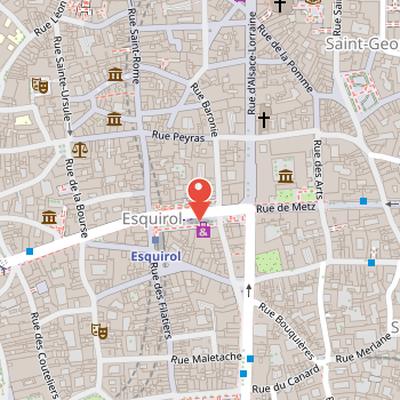
Nearby Objects
-
 Place de la Trinité 80 m away
 -
 Musée des Augustins 130 m away
 -
 Augustinian Convent 150 m away
 -
 Fondation Bemberg 200 m away
 -
 Hôtel d'Assézat 200 m away
History and urban role of place Etienne-Esquirol
Place Etienne-Esquirol is a square in Toulouse, the capital of the Occitanie region in southern France. Before its current layout in the second half of the 19th century, it was a small, narrow square dominated by a church and a hall. The square contained the halle de la Pierre, where wheat sold to Toulousains was measured, and this hall stood in the center of the merchant district near rues des Tourneurs, des Changes, and des Filatiers. The old hall was demolished in 1863 and replaced by a covered market, which was dismantled in 1892.
Despite these changes, the square remained one of the main and busiest in the city. It is an important crossroads between rues Alsace-Lorraine and de Metz. Since 1993, it has also had an underground parking facility and a metro station, reinforcing its role as a central urban space.
Location and Urban Layout
Place Etienne Esquirol is a public road located on the border between the Capitole district to the north and the Carmes district to the south. It belongs to the remarkable heritage site of Toulouse. The square forms an almost regular rectangle with an area of about 5300 square meters. It is 167 meters long and between 32 and 47 meters wide.
The space opens to the west and east onto Rue de Metz. It is bounded on the west by Rue des Changes and on the east by Rue d'Alsace-Lorraine. Rue des Tourneurs crosses it, and Impasse Saint-Geraud branches off to the north. The road layout includes one automobile traffic lane in each direction, with the even side lane reserved for public transport. Place Etienne Esquirol is part of a zone 30, with a speed limit of 30 km/h, and it also has a two-way bike lane.
The square is an important point in the Toulouse public transport network, Tisseo. The Esquirol metro station on line A is located beneath it. Surface transport is provided by Lin eo lines L1 and L2 and bus line 21. A Vel oToulouse bike-sharing station, station 204, is located at 15 place Etienne-Esquirol.
Name and Commemorative Origin
Place Etienne Esquirol is named after Jean-Etienne Esquirol, a physician and specialist in mental illness from Toulouse, born in 1772 and died in Paris in 1840. Odonymy describes him as the father of the organization of psychiatry in France. He was the son of Jean-Baptiste Esquirol, a Toulouse merchant who was prieur de la bourse des marchands and capitoul in 1787. According to Odonymy, Jean-Etienne Esquirol was born in a house at the present location of the place, which gives the site a direct historical link to his life.
The Roman Forum at Place Etienne Esquirol
According to Histoire, the site of present day Place Etienne Esquirol was part of the Roman forum of Tolosa. In the 1st century, the city was organized around the cardo maximus and decumanus maximus, whose intersection marked the city center near the north corner of the current Place de la Trinite. The forum lay northeast of this point and extended between the cardo maximus and a secondary cardo. It contained important social and civic buildings and reflects the development of Tolosa between the 1st and mid 3rd century through the construction of its monuments.
The central square was surrounded by a portico about ten meters wide, with brick columns covered by marble slabs. At its center stood a large temple built in the 1st century. Histoire describes it as one of the largest in Gaul, measuring 60 meters wide and 45 meters long. It was likely a capitolium dedicated to Jupiter, Junon, and Minerve. Its foundations were made of molasse blocks and Garonne pebbles, the walls were in limestone, and the interior had brick facing.
A Christian text from the 3rd century states that the martyrdom of Saturnin took place on the temple steps in 250, during the persecutions under Emperor Decius. Christianity then progressively imposed itself at the end of Antiquity, and pagan cults were abandoned in the 4th century. After the temple was abandoned, the forum and its monuments were used as a quarry. In the 6th century, a church dedicated to Apostle Peter was built on the temple ruins.
From Medieval Market Square to Place Etienne-Esquirol
The area now known as Place Etienne-Esquirol began as a small medieval square called Place Saint-Pierre-Saint-Geraud, measuring 22 meters wide and 36 meters long. In 1203, the capitouls bought several houses to establish their communal house and decided to enlarge the square. In the early 13th century, houses separating it from Rue des Changes were demolished to create a market hall called Halle de la Pierre. The hall became the busiest place in the city, crowded with people, pack animals, and carts, since half of the inhabitants of Toulouse made flour at home. This commercial activity enriched many merchants, some of whom gained access to the capitoulat.
The hall was rebuilt in 1408 after a major fire destroyed Rue des Changes and Place de la Pierre. After this reconstruction, it measured 66 meters long from east to west and 24 meters wide from north to south. Its main facade on Rue des Changes rested on four large stone arcades, and the roof was supported by 25 wooden pillars. Timber-framed houses were replaced by brick buildings after the rebuilding, and local elites consolidated land for grand town houses. In the mid-15th century, capitoul Jean d'Astorg bought contiguous buildings and built a large townhouse between Rue des Changes and Rue Saint-Geraud, on the site of current places 6 and 4. The commercial role of the area continued, with stone measures in the hall regularly repaired or replaced, and a clock with a dial was installed in the 17th century.
Several other historic buildings were part of this urban fabric. The Hotel de Gonil was built in the 15th century at current numbers 1 and 3. Rue Saint-Geraud bordered the hall to the north, in front of current numbers 6 to 8, and crossed Impasse Saint-Geraud, extending east to the current Place Etienne-Esquirol. The church Saint-Pierre-Saint-Geraud, one of the oldest churches in the city and known from 10th-century texts, stood at the current square. It was built on the ancient 4th-century church Saint-Pierre and faced the present square with a door opening on Rue Saint-Geraud. The church depended on the abbaye Saint-Geraud d'Aurillac, whose abbot built a nearby hotel in the 17th century at current number 8. Because of its low income, the church needed city-funded repairs in 1343, and later it was decommissioned during the French Revolution, returned to worship in 1800, decommissioned again in 1815, ceded to the city for square expansion projects, and finally destroyed in 1846. The auberge de la Clef, one of Toulouse's privileged signboard inns in the 16th century, was located on Rue Saint-Geraud at current number 10 and moved in 1571 to a neighboring building at current number 12 with an entrance on Rue des Tourneurs.
Redesign of Étienne-Esquirol Square
Étienne-Esquirol square was progressively enlarged between 1785 and 1844 through the demolition of houses between the hall of Pierre and the street of Turners. The changes were driven by practical concerns around the former grain hall, which merchants considered inconvenient and too far from the Canal du Midi and the port Saint-Sauveur, while residents complained for a long time about rats, noise, and congestion in the area. The fish market hall on street Saint-Rome was also judged outdated and needed to be decommissioned. An initial plan to transfer the fish market hall to new stalls along the street of Changes, opposite the square of Pierre, was abandoned.
In 1860, the municipality decreed the transfer of grain sales to a new hall at Dupuy square. After the hall of Pierre was destroyed in 1863, the surrounding square was significantly redeveloped and enlarged. All buildings bordering street Malcousinat-Vieil, including Hotel de Gonil, were demolished to comply with new facade alignments. An elegant covered market was erected at the center of the square and later inaugurated. Additional demolitions on the street of Changes opened the square onto the Transversal street, which had been created according to the plans of architect Jacques-Jean Esquiie between 1869 and 1871. In 1871, the major project for the transversal street was changed so that it would pass at the location of the covered market. The covered market lost its usefulness after the Victor-Hugo market hall opened in 1892, and it was dismantled that same year and sold to the city of Lourdes.
Historical Changes and Commercial Life at Place Etienne-Esquirol
Place Etienne-Esquirol has been shaped by successive changes in the surrounding street pattern and by commercial activity. Rue Saint-Geraud disappeared in the 20th century when the square was widened, while impasse Saint-Geraud to the east still exists and has kept its name since the Middle Ages. This impasse was also known in the 19th century as impasse de Palaminy, reflecting the presence of hotel Palaminy. On the south side, the street linking place de la Pierre to rue des Arts was known in the 18th and 19th centuries as rue Bertrand-David, named after a wealthy property owner, and also as rue du Malcousinat-Vieil, in connection with municipal malcousinat rights on pig and poultry sales. It later became rue de la Colombe, after an inn called la Colombe, and was renamed rue de l'Arc-en-Ciel during the French Revolution before disappearing with the creation of place Esquirol and rue de Metz. In the 20th century, place Esquirol became a notable venue, with establishments such as Paris, now Le Paris, and Paddy, now Le Paddy. The square also saw changes in its street furniture: in 1931, wooden kiosks for newspaper and flower vendors were replaced by concrete Art deco kiosks by the municipality. Commercial life continued to evolve in the later 20th and early 21st centuries, including Midica, a store specializing in rubber opened by Marcel Garrigou, which expanded into household goods and moved in 1956 into the former Grands magasins Lapersonne premises after a fire had closed that department store. In the 2000s, telephone stores increased on the square while other businesses declined.