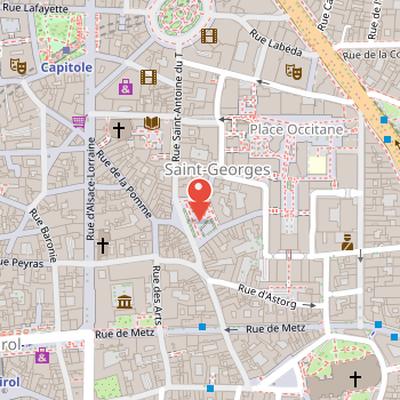
Place Saint-Georges is a square in Toulouse, the capital of the Occitanie region in southern France. Located in the heart of the Saint-Georges district, it forms an irregular pentagon bordered by rue Boulbonne to the south, rue de la Pomme to the west, rue Saint-Antoine-du-T. to the north, rue Paul-Vidal to the northeast, and rue Alexandre-Fourtanier to the east. The square has a single one-way traffic lane around it, with a meeting zone on the west side and pedestrian areas on the south, east, and north sides.
The place is also linked to the history of a small chapel dedicated to Saint George, originally located in its center and later rebuilt at the corner of rue Saint-Antoine-du-T. The chapel was rebuilt several times before being demolished in 1808. The name Place Saint-Georges comes from this chapel, while the site was originally named Place de Montaygon, after a person who owned several buildings there. The square is served by local transport, including shuttle service, nearby metro stations, bus stops, and a VélôToulouse bike-sharing station.
Nearby Objects
-
 Augustinian Convent 150 m away
 -
 Musée des Augustins 200 m away
 -
 Saint Jerome Church 200 m away
 -
 Utopia Toulouse 250 m away
 -
 Étienne-Esquirol Square 300 m away
Location of Place Saint-Georges
Place Saint-Georges is a street in Toulouse, the capital of the Occitanie region in southern France.
Location and access
Place Saint-Georges is a public road in the heart of the Saint-Georges district. It forms an irregular pentagon and connects, in ascending order, with rue Boulbonne to the south, rue de la Pomme to the west, rue Saint-Antoine-du-T. to the north, rue Paul-Vidal to the northeast, and rue Alexandre-Fourtanier to the east. Square Jean-Calas, with a children's playground, is located to the north.
The circulation arrangement around the square includes a single one-way traffic lane running from rue Boulbonne toward the other streets. The west side belongs to a meeting zone with a speed limit of 20 km/h, while the south, east, and north sides are part of a pedestrian area with limited traffic and a speed limit of 6 km/h.
The site is traversed and directly served by the shuttle service. It is also near Capitole and Esquirol stations of one metro line and François-Verdier station of another metro line. Nearby bus stops are served by Lin eo lines and bus lines, and a Velo Toulouse bike-sharing station is located at 19 rue Paul-Vidal on rue Paul-Vidal.
Origins of the Name Place Saint-Georges
The name Place Saint-Georges comes from a small chapel dedicated to Saint George. According to Odonymie, the chapel was originally located in the middle of the square, then rebuilt at the corner of rue Saint-Antoine-du-T. It was rebuilt several times before being demolished in 1808. The square itself was originally known as Place de Montaygon, a name that appears in the earliest Latin documents from the late century. Montaygon was the name of a person who owned several buildings at the site, and for a time the names Montaygon and Saint-Georges coexisted in documents from the century. The chapel was referred to under several forms, including chapelle Saint-Georges, chapelle de Montaygon, and chapelle Saint-Georges de Montaygon. During the French Revolution, the square was renamed Calas in 1794, in reference to Jean Calas, who was executed at Place Saint-Georges. This name did not remain in use for long.
Historical Role of Place Saint-Georges
In the Middle Ages, Place Saint-Georges belonged to the capitoulat of Saint-Etienne. A boundary cross stood in its center, marking the claustrum limit of the cathedral Saint-Etienne. The square also contained an oratory dedicated to Saint Georges. Its origins are obscure, but it was attested in the mid 13th century. Later, the oratory was reconstructed at the corner of rue Saint-Antoine-du-T, near the hospitals Saint-Georges and Notre-Dame-du-Puy, the latter founded in 1359. In 1515, the choir of the chapel was rebuilt by the masons Jean Faure and Raymond Caraben.
From the 16th century, an appointed guard was responsible for the security of merchants on Place Saint-Georges. The square was lined with houses occupied mainly by innkeepers, tavern keepers, bakers, some bourgeois, and notaries. Bakers were attracted by the nearby Cantegril oven, while innkeepers and tavern keepers served customers of the wine market. In 1550, the inn Cerf-Volant stood at the corner of rue Vinaigre, now rue Alexandre-Fourtanier. It was one of the sixteen privileged signboard inns in the city.
Place Saint-Georges also served as a gathering place for large popular assemblies. During Lent in 1518, the cordelier Thomas Illyricus preached there because the cordeliers church was too small for the crowds. The capitouls had a pulpit with amphitheater benches set up on the square for city companies. Thomas Illyricus also obtained ordinances from the capitouls prohibiting card and gambling games and mask wearing on the streets. At his instigation, Christ's monogram was placed on the major city gates, including Arnaud-Bernard, Matabiau, Saint-Etienne, du Chateau, and Lisle.
Public Punishments at Place Saint-Georges
From the 16th century, Place Saint-Georges was used for public punishments and executions. Before 1523, such executions took place at Place Arnaud-Bernard or Place du Salin. In 1523, a pillory was built on a stone scaffold at Place Saint-Georges, giving the square a fixed role in this judicial practice. In 1544, the pillory was enclosed by a wrought iron grille made by the blacksmith Guillaume Du Sol.
The square also appears in several later events connected with the religious and political conflicts of the period. Capitoul Pierre du Cedre lived in a house at the square, now numbered 16, but he was not executed; instead, he was dismissed by Toulouse League members on 28 August 1589. On 30 November 1589, the Protestant Philibert de Rapin was executed there by axe. On 28 May 1590, Jean-Etienne Duranti, first president of Parlement, was hung on the pillory after being dragged through the city streets and accused of Protestant sympathy.
Religious and Architectural Changes on Place Saint-Georges
In 1594, the hospitals Saint-Georges and Notre-Dame du Puy were merged at Hotel-Dieu Saint-Jacques-du-bout-du-Pont. Later, in 1655, the Discalced Augustinians were authorized to settle on place Saint-Georges by the archbishop Pierre de Marca, the Saint-Etienne chapter, and Parliament. They received hospital buildings from the Saint-Etienne chapter and became known as the Augustins de Saint-Georges. The order established and expanded its church on the square through purchases in 1668 and 1683, and later rebuilt the church because of structural danger. The square also saw several changes to its public fittings: in 1732, the old scaffold was demolished and replaced by a cross for president de Bertier, and in 1751 this cross was moved against the convent wall because it obstructed traffic. In 1747, the Discalced Augustinians and Henri Joseph de Lafage agreed to share the cost of buying five burned houses from 1745 and building a neo-classical hotel particulier in Louis XV style. After 1780, the facades on the north side of place Saint-Georges were aligned with this hotel particulier, giving the square a more regular architectural frontage.
Market Functions and Revolutionary Memory
Place Saint-Georges had a long history as a market space and also became associated with revolutionary memory. According to Histoire and Pierre Barthes, the place was the site of 171 capital executions between 1739 and 1780. In 1752, during reconstruction of the facade of the Maison commune, the market from place Royale was moved to place Saint-Georges. The area continued to serve commercial uses in later decades: in 1776, the poultry, egg, and game market was transferred there from La Daurade, before returning in 1779. In the same year, small merchants from place Royale were only allowed to set up on place Saint-Georges on Mondays, Wednesdays, and Fridays.
The place was renamed place Calas on 6 florreal An II, or May 25, 1794. Histoire also cites a law of 29 brumaire An II, or November 19, 1793, calling for a marble column to be erected on the place of Calas death with an inscription in his honor, although this monument was never built.
Commercial use remained important in the 19th century. Between 1862 and 1863, the secondhand market was transferred from place Saint-Georges to place du Marche-au-Bois, now place Victor-Hugo, and then to Saint-Sernin. In 1865, the flower market moved from place Saint-Pantaleon, now place Roger-Salengro, to place Saint-Georges, before being relocated again in 1874 to place Etienne-Esquirol.
From Sainte-Germaine Monument to Place Saint-Georges
In 1868, a committee was formed to erect a statue of Sainte Germaine de Pibrac by public subscription. The work was assigned to Alexandre Falguiere, with the canopy designed by architect Paul Pujol and the construction carried out by architect Joseph Thillet. The statue was inaugurated on the new square on May 27 and was surrounded by an iron fence. It was later removed by municipal order of Leonce Castelbou and stored in the reserves of the Musee des Augustins before being installed in the new Sainte-Germaine church in Faubourg Saint-Agne in 1890.
The square remained a place of conflict and change in the decades that followed. Histoire records an ongoing struggle between Catholic and anticlerical parties there until the early 20th century. By 1905, the place included the Catholic imagery shop A Sainte Germaine. From the 1920s to the 1950s, several restaurants and cafes occupied the square under changing names, and these establishments also served as refuges for homeless persons.
Commercial activity continues through the Saint-Georges food market, which operates from Tuesday through Saturday. In 2005, the secular association Federation de la Haute-Garonne de la libre pensee named the square after Jean Calas, and a commemorative plaque was inaugurated with local officials and representatives of the Reformed Church of Toulouse and Grand Orient. The place is also used for annual Jean Calas commemorations on March 8, including in 2015 for the 250th anniversary of his rehabilitation. The adjacent Square Jean-Calas playground was renovated in 2019, and it includes a 17-meter-long wooden dragon that evokes the legend of Saint Georges.