The Musée d'Orsay is a Parisian museum located on the left bank of the Seine near the promenade Édouard-Glissant. It has the status of national museum in France and was inaugurated in 1986. The museum is installed in the former Gare d'Orsay, built by Victor Laloux from 1898 to 1900, and rearranged as a museum by decision of President Valéry Giscard d’Estaing. Its name comes from the adjacent Quai d'Orsay, itself named in honor of Charles Boucher d'Orsay.
The collections present Western art from 1848 to 1914 in painting, sculpture, decorative arts, graphic arts, photography, and architecture. The Musée d'Orsay is one of the largest museums in Europe for this period and holds the largest collection of Impressionist and Post-Impressionist paintings in the world. It possesses nearly 4,000 paintings among more than 5,500 works. Its displays include works by Édouard Manet, Degas, Courbet, Cézanne, Monet, and Renoir. The museum also stages temporary monographic or thematic exhibitions and includes an auditorium for concerts, cinema, shadow theater, conferences, colloquiums, and shows for young audiences. Since 2010, it has been attached to the Musée de l'Orangerie.
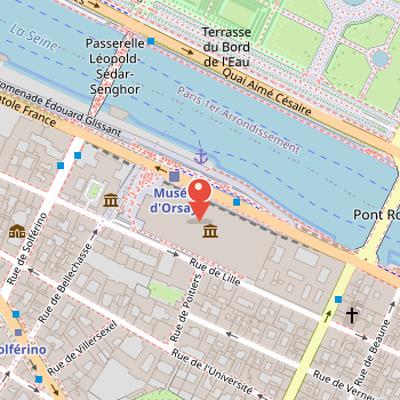
Nearby Objects
-
 Palais de la Légion d'Honneur 150 m away
 -
 Passerelle Léopold-Sédar-Senghor 250 m away
 -
 Hôtel Beauharnais 300 m away
 -
 Paris 2024 cauldron 400 m away
 -
 Tuileries Garden 450 m away
Collections and Museum Use
The Musee d'Orsay is a Parisian national museum on the left bank of the Seine, near the promenade Edouard-Glissant. It was inaugurated in 1986 and is housed in the former Gare d'Orsay, a building constructed by Victor Laloux between 1898 and 1900. The station was rearranged into a museum by decision of President Valery Giscard d'Estaing.
The museum presents Western art from 1848 to 1914 in painting, sculpture, decorative arts, graphic arts, photography, and architecture. It is one of the largest museums in Europe for this period and holds the largest collection of Impressionist and Post-Impressionist paintings in the world. Its holdings include nearly 4,000 paintings among more than 5,500 works.
Visitors can see works such as Le Dejeuner sur l'herbe and Olympia by Edouard Manet, a cast of La Petite Danseuse de quatorze ans by Degas, and works by Courbet including L'Origine du monde, Un enterrement a Ornans, and L'Atelier du peintre. The museum also displays Les Joueurs de cartes by Cezanne, five paintings from Monet's Haystacks series, and Bal du moulin de la Galette by Renoir.
In addition to its permanent collection, the museum often organizes temporary monographic or thematic exhibitions on an artist, a movement, or a question in art history. It also contains an auditorium used for concerts, cinema, shadow theater, conferences, colloquiums, and shows for young audiences. Since 2010, it has been attached to the Musee de l'Orangerie in the Jardin des Tuileries.
Name and Institutional History
The museum and the preceding buildings took their name from the adjacent Quai d'Orsay. The quay was named in honor of Charles Boucher d'Orsay, who served as provost of merchants and built the quay. In 2010, the Orangerie museum was legally attached to the public establishment of the Orsay museum. Together, the Orsay and Orangerie museums form the public establishment of Orsay and Orangerie museums, and Valery Giscard d'Estaing's name was added to the establishment's denomination.
From Royal Palace to Museum
The Musee d'Orsay occupies a site with a long and changing history. The former Orsay Palace was built from 1810 and decorated with fresques by Theodore Chasseriou. It later housed important state institutions, with the Conseil d'Etat on the ground floor in 1840 and the Cour des comptes on the first floor in 1842. The palace was burned in 1871 during the Paris Commune and left in ruins.
A new phase began when Victor Laloux constructed the Gare d'Orsay on the palace site as the terminus for the Paris to Orleans railway company for the 1900 Universal Exhibition. Much later, the building was reconfigured from 1983 to 1986 by architects Renaud Bardon, Pierre Colboc, Jean-Paul Philippon, and interior architect Gae Aulenti. This transformation followed the wish of President Valery Giscard d'Estaing and was confirmed by Francois Mitterrand to convert the building into a 19th-century art museum. The museum opened in the converted Gare d'Orsay on December 9, 1986.
The forecourt was arranged in 1985 with iron statues, including the Statues of the six continents and three of the four animal statues from the 1878 Universal Exhibition. The museum continued to evolve through later renovations, including partially renovated spaces inaugurated on December 9, 2016, after two years of work and a 24 million euro budget. That project added the Pavillon Amont with five new levels for decorative arts grouped by country affinity, renewed the Impressionist gallery with glass benches designed by Tokujin Yoshioka, redesigned the Cafe de l'horloge by the Campana brothers, and created a new temporary exhibition room.
Collections and Research
Musee d'Orsay holds a broad range of collections that combine documentary and heritage materials with major holdings in art and design. The collections will be gathered in the Centre de ressources et de recherche Daniel Marchesseau in 2027. They include books, 600 periodical titles, general documentation, 300 linear meters of work files, and 250 linear meters of archives. The museum also develops research programs on the arts of and early .
A significant part of the collections concerns decorative arts and the transformation of production linked to the industrial revolution. Since 1977, the museum has assembled decorative arts objects from 1848 to 1914, including representative works of ceramics, glassware, jewelry, and furniture. These objects are often shown outside their original context, alongside pieces from the period such as the salle a manger Charpentier of 1900 in a separate period room. The collections also include architecture and decorative arts pieces, written documents, wallpapers, models, and . They present pieces of exceptional quality from the luxury industries of the time, including some long unrecognized or undervalued masterpieces. The museum distinguishes objects produced under the Second Empire and the early Third Republic from Art nouveau style from 1890.
The collections also include reference points linked to the history of the site, such as the Musee des Arts Decoratifs, initially planned in 1879 at the site allocated to the Gare d'Orsay in 1897 and inaugurated at the pavillon de Marsan du Louvre in 1905. They note that Gare d'Orsay became a museum in 1986. Among the works visible in the collections is the plaster of La Porte de l'Enfer by Rodin at the niveau median, terrasse Rodin.
Musee d'Orsay is also known for major holdings of modern painting, with the largest collection of impressionist paintings, more than 480 works, and more than 600 post-impressionist paintings. Since 2010, a small part of post-impressionist works has been presented with the . The collections also conserve .
Selected Works in the Collection
The Musee d'Orsay collection includes a wide range of paintings and sculptures from the 19th and early 20th centuries. Among the paintings held by the museum are Frederic Bazille's Reunion de famille from 1867, Gustave Courbet's Un enterrement a Ornans from 1849, Edouard Manet's Le Dejeuner sur l'herbe from 1863, Claude Monet's La Pie from 1868 to 1869, Auguste Renoir's Bal du moulin de la Galette from 1876, Paul Cezanne's Les Joueurs de cartes from 1892, and Vincent van Gogh's Nuit etoilee sur le Rhone from 1888, Portrait de l'artiste from 1889, and L'Eglise d'Auvers-sur-Oise from 1890. The collection also holds works by Edgar Degas, including L'Etoile, ou la Danseuse sur Scene from 1878, L'Absinthe, Le Cafe-Concert des Ambassadeurs, and Danseuse.
Other notable paintings represented in the collection include Jean-Francois Millet's L'Angelus, Paul Gauguin's Arearea ou Joyeutes from 1892, Henri Rousseau's La Guerre from 1893, Georges Seurat's Le Cirque from 1891, Paul Signac's Entree du port de la Rochelle from 1921, and Andre Derain's Pont de Charing Cross. The museum also holds portraits and figure scenes by artists such as Giovanni Boldini, Jacques-Emile Blanche, Louise Catherine Breslau, Henri Fantin-Latour, Otto Scholderer, and Henri de Toulouse-Lautrec. Additional works in the collection include William Bouguereau's Dante et Virgile from 1850, Ingres' Venus a Paphos from 1852 and La Source from 1856, and Honoré Daumier's Crispin et Scapin from 1858 to 1860 and bustes charge des Celebrites du Juste Milieu from around 1832.
The sculpture holdings are also extensive. They include Jules Cavelier's Penelope endormie from 1849, Eugene Guillaume's Anacreon from 1849-1851 and Les Gracques from 1853, James Pradier's Sapho from 1852, Jean-Baptiste Carpeaux's Les Quatre Parties du monde soutenant la sphere celeste from 1868-1872 and La Danse from 1869, Charles Cordier's Negre du Soudan from 1857, Albert-Ernest Carrier-Belleuse's Hebe endormie from 1869, Alexandre Schoenewerk's La Jeune Tarentine from 1871, Jean-Baptiste Hugues's Muse a la Source from 1900, Louis-Ernest Barrias's buste d'Henri Regnault from 1871 and La Nature se devoilant a la Science from 1899, Jean-Leon Gerome's Tanagra from 1890, Denys Puech's Aurore, and Jules Dalou's Le Grand paysan from 1904. The museum parvis also includes Les six continents from 1878.
Sculpture Holdings
The museum's collections include several works by Auguste Rodin and Camille Claudel. Among the Rodin pieces are Saint Jean Baptiste, L'Hiver from 1890 in marble statuette form, Porte de l'Enfer from 1880 to 1917 in plaster, La Pensee, and Ugolin et ses enfants. The collections also hold two works by Camille Claudel: Torse de Clotho, made around 1893 in plaster, and Sakountala, etude, made around 1886 in terracotta. These holdings place the museum among institutions preserving notable examples of sculpture from this period.
Sculpture and Symbolist Works
The collections at the Musee d'Orsay include a number of sculptures and related works by prominent artists. Among the listed pieces are Paul Gauguin's Oviri from 1894, a partially glazed stoneware work in Paris, and his Maison du jouir from 1901 to 1902. Other works include Georges Lacombe's La Naissance from 1895, Antonin Carles' La Jeunesse from 1885, Max Klinger's Cassandre from 1893, Fernand Khnopff's Futur from 1898, and Adolfo Wildt's Vir Temporis Acti from 1921. The collections also contain Antoine-Louis Barye's Napoleon en empereur romain and Pierre Louis Rouillard's Cheval a la herse from 1878. Henri-Alfred Jacquemart's Rhinoceros from 1878 is located on the parvis du musee. Additional sculptures in the holdings include Francois Pompon's L'ours blanc and Antoine Bourdelle's Herakles archer. Works by Aristide Maillol are also represented, including Eve a la pomme from 1899 in bronze, Baigneuse debout from 1900 in bronze, Jeunesse from 1910, Mediterranee (La Pensee) in marble between 1923 and 1927, and L'Ile-de-France from 1925 in stone.
Photography Collection
The photography collection of Musee d'Orsay was entirely built from scratch from the late 1970s. At the time of the Orsay museum project, it had no counterparts in French fine arts museums. The collection includes works by Hippolyte Bayard, Eduard Baldus, Christian Berard, Louis-Jacques-Mande Daguerre, Celine Laguarde, Felix Nadar, Nicophore Niepce, and Constant Alexandre Famin. The museum also permits photography of works without flash or tripod.
Administration and Institutional Status
Musee d'Orsay was a national service of the Ministry of Culture until 2004, when it became an administrative public establishment and incorporated Musee Hebert. At an unspecified later date, Musee de l'Orangerie became a national service attached to Musee d'Orsay's public establishment, which then took the name 'etablissement public du musee d'Orsay et du musee de l'Orangerie'. In 2021, the government added Valery Giscard d'Estaing's name to the establishment, without changing the museums' own names. The administration is managed by the president of the board, who votes on the budget and determines management policies. The museum's cultural policy is validated by the scientific council and the acquisitions commission.
Supporter Networks and Patrons
Several support organizations are associated with Musee d'Orsay and its partner museum, Musee de l'Orangerie. The Societes d'amis du Musee d'Orsay was created in 1980 as an association under the law of 1901 and was recognized as a public utility. It brings together art enthusiasts of the second half of the 19th century and aims to enrich the collections of Musee d'Orsay while promoting the influence of both museums worldwide. The association notes the creation of the American Friends of the Musee d'Orsay in 2009 as a non-profit charity organization. This group promotes American public knowledge and appreciation of late 19th century art by supporting the collections and programs of Musee d'Orsay and Musee de l'Orangerie, with special attention to activities directly connected to the United States. The Societes d'amis du Musee d'Orsay also indicates that the two museums created the Circle of Women Patrons. Developed with the mobilization of more than a certain number of people and the support of seven influential networks, it funds projects dedicated to women through contributions from individuals and companies, while also encouraging awareness of parity, professional equality, and education. In addition, the museums and the Italian Chamber of Commerce for France created the Circle of Italian Patrons, which brings together Italian companies willing to support museum projects and reflects a close relationship between Italy and Musee d'Orsay.
Partnerships With Provincial Museums
Since 2009, Musées partenaires has signed six partnerships with museums in provinces. Its role is to build scientific partnerships and facilitate loans from the museum. These agreements show a structured effort to extend collaboration beyond the main institution and support the exchange of works through loan arrangements. The partnerships also reflect a formal framework for cooperation with regional museums, centered on scientific exchange and access to the collection through lending.