Tuileries Garden, known in French as Jardin des Tuileries, is a historic garden in the 1st arrondissement of Paris, located between the Louvre Museum and Place de la Concorde. It was created in 1564 by Caterina de' Medici as the garden of the Tuileries Palace and opened to the public in 1667. After the French Revolution, it became a public park. In the 19th and 20th centuries, it was a celebrated place for Parisians to walk and relax.
The garden was originally conceived as a separate palace and garden modeled after Florence gardens, on land that included former tile-making areas and additional parcels acquired for the project. Its early design featured an Italian Renaissance garden with fountains, a labyrinth, a grotto, rectangular compartments, lawns, flowerbeds, quinconces, vegetable gardens, and vineyards. The site also hosted royal parties and ceremonial occasions. Later, under Henry IV and gardener Claude Mollet, the garden was restored after a period of ruin and gained new features including a long covered walkway, a mulberry tree-lined path, and a large rectangular basin with a fountain.
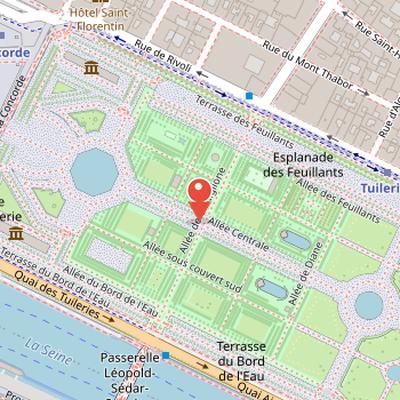
Nearby Objects
-
 Passerelle Léopold-Sédar-Senghor 250 m away
 -
 Paris 2024 cauldron 250 m away
 -
 Musée de l'Orangerie 250 m away
 -
 Jeu de Paume 250 m away
 -
 Hôtel Costes 350 m away
History and Public Use
The Tuileries Garden, or Jardin des Tuileries, is a French garden located between the Louvre Museum and Place de la Concorde in the 1st arrondissement of Paris. It was created by Caterina de' Medici in 1564 as the garden of the Tuileries Palace. The garden was opened to the public in 1667, and after the French Revolution it became a public park. During the 19th and 20th centuries, it was a celebrated place for Parisians to walk and relax.
The Tuileries Garden Under Catherine de Medici
After the death of Henry II in July 1559, Catherine de Medici moved residence to the castle of Tournelles near the Bastille, leaving the Louvre palace with the new king Francis II. She decided to build a new separate palace with a garden modeled after the gardens of Florence at Tournelles. The site extended between the Seine to the south, rue Saint-Honore to the north, the Louvre to the east, and city walls with a deep moat to the west. It also included land where tuileries, or roof tile kilns, had existed since the 13th century. Catherine de Medici acquired land that had been initially bought by King Francis I in the early 16th century and purchased additional land for the new palace and garden.
She commissioned the Florentine landscape architect Bernardo Carnesecchi to create an Italian Renaissance garden with fountains, a labyrinth, and a grotto. The grotto was decorated with faience images of plants and animals made by Bernard Palissy, whom Catherine also ordered to discover the secret of Chinese porcelain. The garden was a closed space measuring 500 meters long and 300 meters wide, separated from the new castle by a street. It was divided into rectangular compartments by six paths and contained lawns, flowerbeds, groups of five trees called Quinconces, vegetable gardens, and vineyards. At the time, the Tuileries was described as the largest and most beautiful garden in Paris. It also served as a setting for royal parties honoring the ambassadors of Queen Elizabeth I and for the marriage of Catherine de Medici's daughter Margaret of Valois to the future Henry IV.
Restoration and Garden Design under Henry IV
After King Henry III fled Paris in 1588, the garden fell into ruin. It was later restored by Henry IV and the gardener Claude Mollet. Their work included a covered walkway built the full length of the garden and a mulberry tree-lined path planted for silkworm cultivation. The garden also featured a rectangular basin measuring 65 meters by 45 meters with a fountain, supplied by the pump known as La Samaritaine, built in 1608 on Pont Neuf. The area between the palace and Charles V's former moat was transformed into the New Garden, centered on a large fountain. Although Henry IV did not live in the Tuileries Palace, he used the garden for relaxation and physical exercise.
The Tuileries Garden in the Early 17th Century
In 1610, the Tuileries Garden came under the ownership of Louis XIII at the age of nine. During this period, the gardens were used as a large playground for hunting, and an animal menagerie was kept there. Maria de' Medici also established a riding school, stables, and a covered riding arena on the north side of the gardens. When the king and court were absent from Paris, the gardens became a pleasure place for the nobility. In 1630, a rabbit hutch near the west bastion was transformed into a flower walk and a cabaret. La Grand Mademoiselle, the daughter of Gaston d'Orleans and granddaughter of Louis XIII, held a court at the cabaret, while the New Garden of Henry IV, now called Carosello, became known as the Parterre de Mademoiselle. She was expelled from the castle and the garden in 1652 after supporting the Fronde against her cousin, the young Louis XIV.
Le Notre and the Formal Garden
In 1664, Colbert commissioned Andre Le Notre to redesign the entire Tuileries Garden, and the result imposed order through a formal French garden style. The design emphasized symmetry, long perspectives, and the idea that a garden should be viewed from above, from a building or terrace. A street separating the palace from the garden was replaced by a terrace overlooking the parterre, reinforcing the visual relationship between the palace and the grounds.
Le Notre arranged three basins with fountains at the center of flowerbeds, and laid out a grand alley 350 meters long in front of the central fountain. Two paths flanked by chestnut trees ran on either side of this alley. The garden was further structured into compartments filled with different trees, shrubs, and flowers, crossed by small alleys. On the south side near the Seine, Le Notre built the Terrasse du Bord-de-l'eau, while the north side received the Terrasse des Feuillants. On the west side, two horseshoe-shaped ramps and two terraces faced an octagonal basin 60 meters in diameter, with a fountain at its center. These west terraces framed the garden's western entrance and were also intended as viewpoints for seeing the garden from above.
The work extended beyond the immediate garden. In 1662, a large mounted courtier procession took place in the new French garden, and the moat of Carlo V was filled and transformed into a parade ground, later named Place du Carrousel. In 1667, Le Notre planned a tree-lined avenue extending west to the present-day Rond-Point des Champs Elysees. The garden project required hundreds of masons, gardeners, and earth movers from 1666 to 1672. The Tuileries Garden was opened to the public in 1667 at Charles Perrault's request, becoming the first royal garden to be opened to the public, although beggars, lacqueys, and soldiers were excluded.
The Tuileries Garden in the Eighteenth Century
In the eighteenth century, the Tuileries Garden passed to the future Louis XV at the age of five after the death of Louis XIV. After having been abandoned for almost forty years, it was restored and given a series of new features that reshaped its appearance and use. In 1719, Antoine Coysevox provided two large equestrian statuary groups, La Renommee and Mercure, which were moved from the royal residence at Marly and placed at the west entrance. The garden also displayed additional statues by Nicholas and Guillaume Coustou, Corneille and Cleve Sebastien Slodz, Thomas Regnaudin, and Coysevox along the Canal Allee. Access was improved by the installation of a movable bridge, or pont-tournant, on the west side over the moat. The creation of Piazza Luigi XV, now Place de la Concorde, formed a large vestibule to the garden. The Tuileries also served as a public place for festivities, including the feast of Saint Luigi on August 25 with concerts and fireworks. It was a site of early scientific spectacle, hosting a hot air balloon flight on December 1, 1783, by Jacques Alexandre Cesar Charles and Nicolas Louis Robert. For everyday visitors, the garden offered small food stands, low-cost chair rentals, and public toilets established in 1780.
The Tuileries Garden During the French Revolution
During the French Revolution, the Tuileries Garden underwent major changes in use, control, and symbolism. On October 6, 1789, it was closed to the public except in the afternoon, and the royal family was given a private part of the garden. Its supervision increased after the kings failed escape attempt from France, and on September 18, 1791, the royal family was allowed to walk in the park in the evening. During a Constitution celebration, the park alleys were illuminated with pyramids and lanterns. The garden was first located on the west side of Promenade Bord d'eaux and later at the edges of Place Louis XV.
The garden also became a site of violence and political change. It was assaulted by a crowd on August 10, 1792, and the king's Swiss guards were chased and massacred through the gardens. After the king's removal and execution, the Tuileries became the National Garden of the new French Republic. In 1794, it was assigned for renovation to painter Jacques-Louis David and architect August Cheval de Saint-Hubert, who planned Roman porticos, monumental porticos, columns, and classical decorations, but the project was never completed. The garden still retains two exedrae, semicircular walls with statues near the two ponds.
Under the Republic, the garden also served as a public stage for revolutionary festivals. A large number of statues were transferred from royal residences for public display, and on June 8, 1794, it hosted a ceremony honoring the Cult of the Supreme Being organized by Robespierre. The ceremony included scenes and costumes designed by Jacques-Louis David, as well as the burning of effigies representing atheism, ambition, selfishness, and false simplicity, followed by the unveiling of a statue of wisdom.
The Tuileries Garden in the Nineteenth Century
In the nineteenth century, the Tuileries Garden became the preferred place for Parisians to relax, meet friends, walk, enjoy fresh air and greenery, and have fun. Its role also shifted repeatedly with political change. In 1800, Napoleone Bonaparte moved into the Tuileries Palace before becoming emperor, and he made improvements suited to imperial residence needs. These included a new road between the Louvre and Place du Carrousel, a courtyard enclosure, and a small triumphal arch at the center of Place de Carrousel. Modeled on the Arch of Septimius Severus in Rome, this arch served as the ceremonial palace entrance. In 1801, Napoleone ordered another new road along the northern edge of the Tuileries, which became rue de Rivoli, lined with arcades on the north side. The road crossed former equestrian, private, and religious grounds and absorbed part of the Terrasse des Feuillants. Napoleone made few changes inside the garden itself, but he used it for military parades and special events, including his wedding procession on 2 April 1810.
After Napoleone's fall, the garden became a camp for Austrian and Russian occupying soldiers. Later, King Carlo X renewed the old tradition of celebrating Saint Charles day there. After the 1830 revolution, the garden came under the ownership of King Luigi Filippo, who created a private garden section by fencing off an area before the palace. This section included a small moat, flower beds, and eight new statues by contemporary sculptors. In 1852, Emperor Luigi Napoleone took ownership and expanded the private garden westward to the north-south avenue crossing the large circular basin, including two small round pools. He added exotic plant and flower beds and new statues, transformed the Terrasse du Bord-de-l'Eau into a playground for the prince imperial in 1859, and had twin pavilions, Jeu de Paume and Orangerie, built on the west side, along with a new stone balustrade at the west entrance. The garden was opened to the public from May to November when the emperor was usually absent from Paris.
The political turmoil of 1870 and the Commune also left a strong mark. Emperor Luigi Napoleone was defeated and captured during the revolt, a red flag flew on the palace, and visitors could enter it for fifty centimes. The palace was then deliberately burned by Communards, with an attempted burning of the Louvre during the retaking of Paris. The palace ruins were demolished in 1883, and the former palace site between the two Louvre pavilions became part of the garden.
The Tuileries Garden in the 20th Century
At the end of the 19th century, the Tuileries Garden still hosted a range of popular attractions, including acrobats, puppet theaters, beverage stands, small boats, donkey rides, and toy sales. In 1900, it served as a venue for fencing competitions during the II Olympic Games. The garden later became a place of wartime vulnerability: in 1914, its statues were protected by sandbags, and in 1918 it was hit by two long-range German artillery shots.
Between the world wars, the garden took on an increasingly artistic role. The Jeu de Paume was converted into an art gallery, while Claude Monet's Ninfee were displayed in the western part of the garden. The Orangerie was used as a gallery of Western contemporary art. During the second world war, the Jeu de Paume was used by Germans to store art confiscated from Jews, and in 1944 the garden witnessed fierce fighting and serious damage to Monet's Ninfee paintings during the liberation of Paris.
The garden's sculpture collection also changed over time. Until the 1960s, almost all of its sculptures dated from the 18th and 19th centuries. In 1964-65, the 19th-century statues around Place du Carrousel were replaced with contemporary sculptures by Aristide Maillol. In 1994, landscape architect Jacques Wirtz redesigned the garden as part of the Grand Louvre project, adding labyrinths and low hedges radiating from the Arc de Triomphe to the square. Later additions included modern sculptures by Jean Dubuffet, Henri Lawrence, Etienne Martin, Henry Moore, Germaine Richier, Auguste Rodin, and David Smith in 1998, followed by works by living artists in 2000 and three works called priere toucher after 2000.
Jardin du Carrousel
Jardin du Carrousel, also known as Place du Carrousel, was formerly enclosed by the two wings of the Louvre and the Palais des Tuileries. In the eighteenth century, it served as a cavalry parade ground and a site for other festivities. Its central element is the Arc de Triomphe du Carrousel, which was built to celebrate the victories of Napoleon and includes bas-relief sculptures of Napoleon's battles by Jean-Joseph Espercieux. The garden was redesigned in 1995 to display a collection of twenty-one statues by Aristide Maillol, which had previously been placed in the Tuileries in 1964.
La Terrasse in the Tuileries Garden
La Terrasse is an elevated terrace between the Carrousel and the rest of the garden, used as an open space facing the Palais des Tuileries. After the Palais des Tuileries was burned in 1870, La Terrasse was transformed into a street and then buried in 1877. The area is decorated with two large vases from the gardens of Versailles and includes two statues by Aristide Maillol. It also features the Monument to Cezanne to the north and the Monument to the fallen of Port Vendres to the south.
The Fossato di Carlo V and the Tuileries Area
The Fossato di Carlo V was rebuilt as part of the Louvre in the 14th century and formed part of the ancient fortifications surrounding the palace. Its west side still shows traces from the battles of the 1590 siege of Paris by Henry IV of France. Since 1994, the site has been decorated with statues from the old Tuileries palace facade and with 19th-century bas-reliefs. These bas-reliefs were made during the French monarchy Restoration and were intended to replace Napoleonic bas-reliefs on the Arc de Triomphe du Carrousel, but they were never installed there.
Le Grand Carre de la Tuileries
Le Grand Carre de la Tuileries forms the eastern part of the Jardin des Tuileries and follows Andre LeNotre's 17th century French garden design. The area around the circular basin was used as the private garden of the king under Louis-Philippe and Napoleon III. It was separated from the rest of the Tuileries by a grille. Most of the statues in Le Grand Carre were placed there in the 19th century, adding to the area's historical character.
Le Grand Couvert and its Historic Features
Le Grand Couvert is the tree-covered part of the Tuileries Garden and includes several features linked to the garden's social and artistic history. It has two bars named after famous cafes that were once present in the garden: the Very cafe on the Terrasse des Feuillants, active from the 18th to the 19th century, and the Renard cafe, which served as a meeting place on the western terrace in the 18th century.
The area also contains two exedras, curved walls built to surround statues. These structures survived the French Revolution and were built in 1799 by Jean Charles Moreau as part of a larger unfinished project by painter Jacques-Louis David in 1794. They are now decorated with plaster casts of moldings on mythological themes from Louis XIV's park at Marly. In addition, Le Grand Couvert contains numerous important works from the 20th century and contemporary authors.
The Orangerie, Jeu de Paume, and Western Terrace
Built in 1852 by architect Firmin Bourgeois at the western edge of the garden bordering the Seine, the Orangerie, the Jeu de Paume, and the western terrace of the Tuileries form a distinct architectural ensemble within the garden. The Jeu de Paume, part of this group, was built in 1861 by architect Viraut and expanded in 1878. Over time, the site took on changing cultural functions. In 1927, the Orangerie and related spaces exhibited Claude Monet's nymphaea paintings, and the same year the Jeu de Paume became an annex of the Museum of the Luxembourg Palace to display contemporary art from outside France. During 1940 to 1944, the Jeu de Paume was used by Germans as storage for art confiscated from Jewish families. From 1947 to 1986, it became the Musee du Jeu de Paume and exhibited important Impressionist works later moved to Musee d'Orsay. Today, the Jeu de Paume is used for modern and contemporary art exhibitions.
The ensemble also has a strong sculptural presence. Its terrace includes four works by Auguste Rodin: Le Baiser, Eve, La Grande Ombre, and La Meditation avc bras. The site also contains Grand Commandement blanc by Alain Kirili, made in 1986, and the terrace opposite the Jeu de Paume hosts Le Bel Costume by Jean Dubuffet, made in 1973. The Orangerie houses the Walter-Guillaume collection of Impressionists, linking the location with both historic and modern art display.
Sculptures and Their Placement in the Tuileries Garden
The Tuileries Garden contains a gallery of sculptures distributed across several parts of the site. Among the works associated with the garden is Mercurio a cavallo di Pegaso by Antoine Coysevox, made between 1701 and 1702. It was relocated to the western entrance of the garden in 1719. The original marble sculpture was moved to the Louvre in 1986 and replaced in the garden by a copy.
Other works are placed in named areas of the garden. Nymphe by Louis Auguste Leveque, from 1866, is exhibited in the Grand Carre and placed at the beginning of the Grand Allee. Theseus and the Minotaur by Jules Ramey, from 1821, is also displayed in the Grand Carre. The Oath of Spartacus by Louis-Ernest Barrias, from 1871, is exhibited in the garden as part of the sculpture collection.
Several bronzes by Auguste Rodin are also shown there. L'Ombre, from 1881 to 1904, is displayed in bronze, as are Eve, from 1881 to around 1899, and Meditation avec bras, from 1881 to around 1905. Le Baiser by Rodin was exhibited in 1934 on the western terrace.
The sculpture gallery also includes Ninfee by Claude Monet, shown in the Orangerie from 1920 to 1926. Together, these works show the Tuileries Garden as a place where sculptures from different periods are placed in specific outdoor and indoor settings within the garden complex.