The Paris 2024 cauldron, officially named the cauldron of the Paris 2024 Olympic and Paralympic Games, is a temporary structure installed in the Jardin des Tuileries in Paris, France. It was designed by Mathieu Lehanneur and selected by the 2024 Summer Olympics and Paralympics Organizing Committee. The structure consists of a circular metallic cauldron supported by a balloon, with a flame effect created without fuel through electrically illuminated water mist around the cauldron.
The design pays homage to the first hydrogen-filled balloon flight made in 1783 from the Jardin des Tuileries. The final device includes a 7-meter diameter flame ring, 40 LED projectors, and about 200 high-pressure mist nozzles. The cauldron was first unveiled at the opening ceremony and remained operational at the Jardin des Tuileries until the day of the French Champions Parade, one week after the Paralympic Games closing. It is also temporarily reinstalled at its original location each summer from the Fête de la Musique to the Fête nationale du Sport until the 2028 Summer Olympic Games.
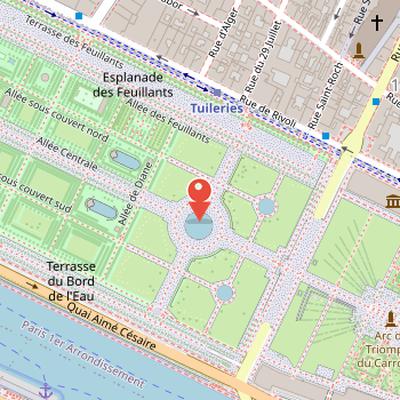
Nearby Objects
-
 Equestrian Statue of Joan of Arc 200 m away
 -
 Tuileries Garden 250 m away
 -
 Musée des Arts Décoratifs 300 m away
 -
 Passerelle Léopold-Sédar-Senghor 350 m away
 -
 Musée d'Orsay 400 m away
Design and Display of the Paris 2024 Cauldron
The Olympic cauldron of Paris, officially named the cauldron of the Paris 2024 Olympic and Paralympic Games, is a structure installed in the Jardin des Tuileries in Paris, France as part of the Olympic flame relay for the 2024 Summer Olympic Games. Designed by Mathieu Lehanneur, it is composed of a circular metallic cauldron supported by a balloon. Its flame has no fuel and is generated by electrically illuminated water mist around the cauldron. The design pays homage to the first hydrogen-filled balloon flight made in 1783 from the Jardin des Tuileries.
The cauldron is unveiled only at the opening ceremony of the event. It remains operational at the Jardin des Tuileries until the day of the French Champions Parade, one week after the Paralympic Games closing. During this period, it is displayed statically from morning until evening and takes flight at nightfall. It is also temporarily reinstalled at its original location in the Jardin des Tuileries each summer from the Fete de la Musique to the Fete nationale du Sport until the 2028 Summer Olympic Games, and this reinstallation period does not allow reference to the Olympic Games.
Design and Placement of the 2024 Olympic Cauldron
The 2024 Summer Olympics and Paralympics Organizing Committee (COJOP) chose Mathieu Lehanneur to design both the Olympic flame and the cauldron. Histoire notes that this was the first time a single artist was responsible for both elements. The torch was unveiled on an unspecified date, while the cauldron's structure and location remained unknown to the public at that time. COJOP met with Lehanneur at La Factory in Ivry-sur-Seine to discuss the cauldron.
The project also drew on earlier work by EDF. Histoire traces its origin to the 2012 London Games, when EDF Pulse Design and R and D began work on a non-fossil flame for the torch and cauldron. EDF later created the cauldron's operation without fossil energy, and the International Olympic Committee approved the electric cauldron principle in 2022. The final device included a 7-meter diameter flame ring with 40 LED projectors illuminating water from about 200 high-pressure mist nozzles. Ouest-France reported that French company Goude Glass provided technical glass elements to address thermal, humidity, and safety constraints.
The cauldron's location, codenamed project Ariane, was initially chosen by organizers and the City of Paris to be the Cour Carree within the Louvre Palace. The Eiffel Tower was later publicly speculated as the site in an unspecified month, and the Tuileries Garden was considered at a later date. During the closing ceremony of the Olympic Games on August 11, Zaho de Sagazan performed Sous le ciel de Paris at the foot of the flame cauldron.
Olympic and Paralympic Flame Cauldron
The Olympic flame cauldron was raised into the air each day after sunset until an unspecified time, becoming a recurring element of the public presentation of the Games. On one day, it did not lift because of a storm episode in Ile-de-France with hail, according to Meteo-France. It was also relit one last time in tricolor colors during the French Champions Parade concert on an unspecified date. At the end of the Olympic period, swimmer Leon Marchand extinguished the flame by taking a lantern containing the Olympic flame and blowing it out at Stade de France.
The cauldron later hosted the Paralympic flame from an unspecified date. Its final bearers were Alexis Hanquinquant, Nantenin Keita, Charles-Antoine Kouakou, Elodie Lorandi, and Fabien Lamirault, each of whom had a different disability. The flame cauldron gradually extinguished at the end of the Paralympic Games on an unspecified date.
The public could also admire the flame cauldron on the ground for free admission by registering on the official site and receiving a QR code. The visit lasted for an unspecified duration, and each day an unspecified number of people could approach the structure. In Histoire, the designer of the flame cauldron, Mathieu Lehanneur, requested on an unspecified date that the installation become permanent after the Olympic period. It was later temporarily reinstalled in its original location in the Jardin des Tuileries starting from an unspecified date and renamed vasque Paris 2024, without reference to the Olympic Games. Emmanuel Macron also made a statement regarding the renaming and its usage. Separately, Amnesty International France projected the message Stop genocide a Gaza on the balloon from an unspecified start time on an unspecified date, linking the object to its position on the Israeli-Palestinian conflict.
Design and Technology of the Cauldron
The 2024 Summer Olympics cauldron was conceived as a large captive balloon filled with helium and connected to the ground by a cable. It measured 22 meters in diameter and rose from the ground to an unspecified height. A flame-ring formed part of the structure, while the visual effect of a flame was created through water aerosol and LED lights. The installation used 40 LED projectors to produce light beams and generated a mist cloud through high-pressure atomization. Its technology was designed by EDF and was fully electric, without the use of fossil fuels. The balloon also referenced the French invention of the hot-air balloon, linking the structure to a national historical innovation.