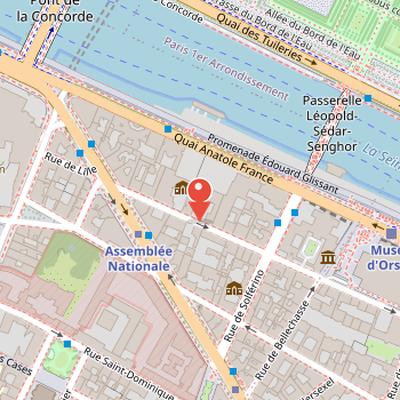
Hôtel Beauharnais is a historic hôtel particulier in the 7th arrondissement of Paris, on the left bank of the Seine. Designed by architect Germain Boffrand, it was completed in 1714. The building was commissioned by Colbert de Torcy and originally known as Hôtel de Torcy, where it housed his art collection and memoirs. It later changed owners and was plundered during the French Revolution.
The property passed to Eugène de Beauharnais, who owned it until 1803 and rebuilt it in the Empire style. He also added the current Egyptian-style porch during the French campaign in Egypt, and had the spacious rooms decorated with paintings by Hubert Robert. The building was rarely used by Beauharnais as a Paris residence.
After the Napoleonic Wars and the Congress of Vienna, it was rented and then acquired by Prussia. It became the seat of the Prussian mission in 1818 and later served as the embassy of the German Empire to the French Republic. Listed as a historical monument in 1951, it now serves as the official residence of the German ambassador to France.
Nearby Objects
-
 Palais de la Légion d'Honneur 150 m away
 -
 Passerelle Léopold-Sédar-Senghor 250 m away
 -
 Palais Bourbon 300 m away
 -
 Musée d'Orsay 300 m away
 -
 Sainte-Clotilde Church 350 m away
History and Use of the Hotel Beauharnais
The Hotel Beauharnais is a historic hotel particulier in the 7th arrondissement of Paris. It was designed by the architect Germain Boffrand and completed in 1714. The building was owned by Eugene de Beauharnais until 1803, after which he rebuilt it in the Empire style. On July 25, 1951, it was listed as a historical monument. Today, the Hotel Beauharnais serves as the official residence of the German ambassador to France.
Location and Access
Hotel Beauharnais is located on the left bank of the Seine River, between the Palais Bourbon and the Musee d'Orsay. Its main courtyard is on Rue de Lille to the south. To the north, the English Garden offers views of the Seine and extends to the Tuileries Garden. A large part of the property remains inaccessible to the public.
From Hotel de Torcy to the Prussian Mission
Hotel Beauharnais was commissioned by the minister of foreign affairs Colbert de Torcy before his dismissal by Regent Philippe d'Orleans. It was first known as Hotel de Torcy and housed elderly people of Colbert, while also preserving his art collection and memoirs. The building later changed owners and was plundered during the French Revolution.
It subsequently passed to Eugene de Beauharnais, Napoleon's stepson and Vice-King of Italy. During the French campaign in Egypt, the building received its current Egyptian-style porch. Its spacious rooms were decorated with paintings by Hubert Robert to suit Beauharnais, although he rarely used the building as a Paris residence. After Napoleon's marriage in 1810, it served as a guesthouse for King Maximilian I Joseph of Bavaria.
After the Napoleonic Wars and the Congress of Vienna, the building was rented and then acquired by Prussia. In 1818, under King Friedrich Wilhelm III, it became the seat of the Prussian mission. It later housed Otto von Bismarck in 1862 before his appointment as minister-president by King Wilhelm I. Following the Franco-Prussian War of 1870-71, the hotel served as the embassy of the German Empire to the French Republic. From 1873, Prince Chlodwig Hohenlohe-Schillingsfurst served as ambassador and held extravagant ceremonies there. The architecture and interiors of the hotel also inspired Karl Friedrich Schinkel, Leo von Klenze, and the artist Max Beckmann.
Historical Role and Later Diplomatic Use
The Hotel Beauharnais is closely linked to several major events in Franco-German history. In 1894, the theft of a letter addressed to German military attache Max von Schwarzkoppen at the embassy triggered the Dreyfus affair. The building was also connected to the events of November 7, 1938, when German diplomat Ernst von Rath was shot by Herschel Grynszpan, a 17-year-old Polish-Jewish immigrant. Grynszpan said he acted in revenge for the persecution of 12,000 Jews after learning of Gestapo orders to arrest and deport all Polish Jews from Germany. The Nazis then used the incident as a pretext for the antisemitic Kristallnacht pogrom. During World War II, the building served as the Paris residence of Otto Abetz, the German ambassador to Vichy France. It was confiscated in 1944, later owned by the French Ministry of Foreign Affairs, and returned to West Germany in 1961 during Elysee Treaty negotiations. After that, it was used only for representational purposes while a new embassy was built on Avenue Franklin Delano Roosevelt. Following significant renovation, it was restored as the ambassador's residence in 1968. The building's history has also been documented by the German Forum of Art History in Paris.