Place Drouet-d’Erlon is a square in the center of Reims, often called place d’Erlon by local people. It is one of the city’s main public spaces and is largely pedestrian, with terraces frequently occupying its surface. At the center stands Fontaine Subé, topped by the statue La Gloire. The square measures 401 meters in length and 35 meters in width, making it the longest square in France. It is longer than Place de la Concorde in Paris, Place des Quinconces in Bordeaux, and Place Bellecour in Lyon. The square also includes a parking garage 15.45 meters deep with 650 spaces on five underground levels. On the Subé-Colbert side, it opens onto the Erlon shopping center and the Lion d'Or gallery. It regularly hosts events, including Semaine de l'agriculture, a Ferris wheel during the Reims Christmas market, and the Pyramide de chaussures against landmines.
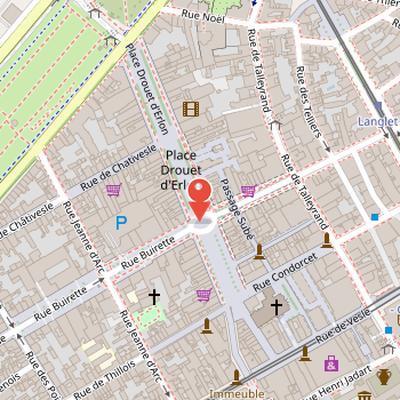
Nearby Objects
-
 Fontaine Subé 0 m away
 -
 Cinéma Opéra 130 m away
 -
 Église Saint-Jacques 150 m away
 -
 Reims Opera House 300 m away
 -
 Museum of Fine Arts of Reims 350 m away
Place Drouet-d'Erlon in central Reims
Place Drouet-d'Erlon is a public square located in the center of Reims. It is often called place d'Erlon by the people of Reims. At the center of the square is the Fontaine Sube, which is topped by a statue called La Gloire. The square's central fountain and statue give the place a recognizable focal point within the city.
Layout and Uses of Place Drouet-d’Erlon
Place Drouet-d’Erlon is a largely pedestrian public space that is frequently covered with terraces. It extends for 401 meters in length and 35 meters in width, making it the longest square in France, longer than Place de la Concorde in Paris, Place des Quinconces in Bordeaux, and Place Bellecour in Lyon. The square has a surface area of over an unspecified number of square meters. Its Sube-Colbert side opens onto the Erlon shopping center and the Lion d'Or gallery.
The site includes a parking garage 15.45 meters deep with 650 places on five underground levels. It also has a new pedestrian square inaugurated on an unspecified date. Since the end of 2019, the former Gaumont site has housed the multiplex cinema Operaims, with 11 screens.
Place Drouet-d’Erlon regularly hosts public events, including Semaine de l'agriculture, a Ferris wheel during the Reims Christmas market, and manifestations such as the Pyramide de chaussures against landmines. These uses contribute to its role as a space for circulation, leisure, commerce, and public gathering.
Historic Layers and Urban Development
Place Drouet-d'Erlon occupied land with a long sequence of uses and forms. During the La Tene period, it was inhabited by a dwelling measuring 6 by 8 metres and protected by a palisade. The area also featured an inhumation site, and part of it lay within the enclosure of the Gaulish oppidum. The ditch around the site was filled by the end of the 1st century BC.
In later periods, the settlement changed in character. Stone houses were built on both sides of an east-west road, while the site was outside the wall built in the 3rd century AD. This wall was reinforced and extended in the 4th century AD, with the extension including a district covering the streets of Chativesle, Jeanne-d'Arc, and Buirette. The Cousture square was created within this extension; its name is likely a deformation of the word culture. The square is also linked to an annual eight-day fair held at Easter, which continues the old fair associated with the St-Eloi leprosy hospital on the Paris road.
The area was also used for burial. A necropolis was identified there, with 23 tombs excavated in 1994. At the same time, the place was marshy and suitable for vegetable gardening. In 1183, Guillaume aux Blanches Mains donated the agricultural land and allowed houses to be built. After a decree requiring noisy trades to keep street-facing stalls, the site was bordered by arches.
Historic Public Executions
Place Drouet-d'Erlon, identified here with Historique, served as a public execution site. One recorded event was the hanging of the Great Jeanette in 1786 for the murder of seven people. During the French Revolution, four people were also guillotined there. The site was later closed by the new gate built for the Ferme generale tax collection in the 18th century.
Image Gallery and Documented Changes
The image gallery associated with Place Drouet d'Erlon includes several historical and contemporary views that document the evolution of the site. Among the materials are a plan from 1618 showing the cemetery of St-Jacques, and a 1759 plan indicating double rows of trees near Saint-Jacques church, Place d'Erlon, and Rue Vesle. The gallery also shows the movement of the statue of Count Drouet d'Erlon, as well as the old statue itself. More recent images present a new fountain, a taxi stand at Place d'Erlon, and a Christmas market. Together, these images illustrate the changing appearance and uses of the place across different periods.