La Comédie de Reims is a theatre building and national dramatic center in Reims, France. It occupies the former House of Culture known as L’Espace André Malraux, a building designed for cultural dissemination and labeled as remarkable contemporary architecture. The site is served by tramway lines A and B, as well as bus lines 1, 7, 8, 30, and N.
The history of the building is linked to the creation of a Maison de la Culture in Reims. During a 1961 visit, André Malraux proposed the idea, and the city later decided to provide such a venue on March 24, 1966. An association was formed in April 1966, and the foundation stone was laid on November 16, 1966. The building was constructed by architects Jean Le Couteur, Jacques Herbe, Denis Sloan, and Pierre Philippon, with technical studies assisted by the CETAC firm. The original complex included a 1,000-seat hall, an orchestra pit, a cinema hall, a media library, an exhibition room, and a cafeteria.
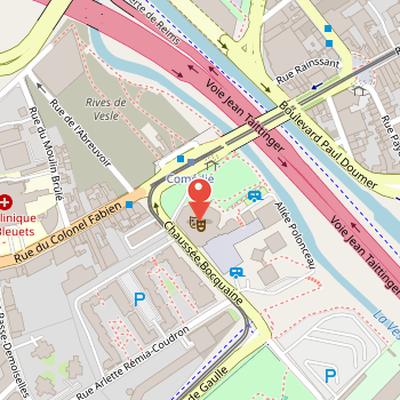
Nearby Objects
-
 Cinéma Opéra 650 m away
 -
 Église Saint-Jacques 750 m away
 -
 Place Drouet-d’Erlon 750 m away
 -
 Fontaine Subé 750 m away
 -
 Museum of Fine Arts of Reims 850 m away
Location and Cultural Role
La Comedie de Reims is a national dramatic center in the city of Reims, France, and it is identified as the old House of Culture in the city. The institution is directed by Chloe Dabert and is labeled as remarkable contemporary architecture. It is also well connected within Reims, with access by tramway lines A and B, as well as bus lines 1, 7, 8, 30, and N. These transport links place the venue within the citys public transit network and support its role as a cultural destination.
L'Espace Andre Malraux as a Cultural Venue
The building designed for cultural dissemination was known as L'Espace Andre Malraux. It initially included a large hall with 1000 seats for various performances, along with an orchestra pit, a cinema hall, a media library, an exhibition room, and a cafeteria. The large hall was also used as an exhibition space for paintings, photos, and sculptures. The building's activities were managed by about seventy employees.
From the Maison de la Culture to La Comedie de Reims
The history of La Comedie de Reims begins with the proposal made by Andre Malraux during a visit to Reims in 1961 to create a Maison de la Culture. Reims was considered to need a recognized theatrical company for decentralization to succeed, and on the advice of Pierre-Aime Touchard, the city welcomed the theatrical company of Andre Meignan, known as Andre Mairal. This company had the status of a permanent national troupe and received State subsidies.
The Reims city council decided on March 24, 1966, to provide a Maison de la Culture. In April 1966, Jean Taittinger invited cultural and union figures to form the Maison de la Culture de Reims association, which held its founding general assembly on May 11, 1966. The foundation stone was laid on November 16, 1966. The building was designed by the architects Jean Le Couteur, Jacques Herbe, Denis Sloan, and Pierre Philippon, with technical studies assisted by the CETAC firm.
The board approved the hiring of Andre Mairal and his team from December 1, 1967, to June 30, 1968, for the animation of the Maison de la Culture. The official inauguration of the prefiguration took place on April 28, 1968. The Maison de la Culture was then due to open at Chaussée Bocquaine in 1969, with Historique appointed director on a three-year contract. The board later thanked him for the work accomplished since the start of the prefiguration, before ending his contract in line with a new orientation decided by the Ministry of Culture.
This institution was the ninth of 18 Maisons de la Culture completed under Emile-Jean Biasini. The State covered half the construction cost, and the Maisons de la Culture became property of the commune upon opening. The building was inaugurated by Edmond Michelet, Minister of Culture, who asked that it be named after Andre Malraux. It was then renamed Maison de la Culture Andre Malraux, with Rene Jauneau arriving as the new director.
Theatre at the Maison de la Culture and the Making of Comedie de Reims
Robert Hossein and his company, Le Theatre Populaire de Reims, arrived in October 1971 with the creation of their theatre school. Hossein was responsible for theatre activities and for the use of the Grande salle of the Maison de la Culture Andre Malraux. His company opened with Crime et Chatiment, featuring Jacques Weber, followed by Les Bas Fonds by Gorki. The relationship between the Maison de la Culture Andre Malraux and the TPR then moved toward closer collaboration among theatre and other disciplines. Theatre occupied an important place in the institution, and audiences came by bus from across the region and from Belgium.
After Hossein's departure from Reims, Jacques Darolles arrived. Jean-Pierre Miquel replaced Hossein as director from 1978 to 1983, and Jean-Claude Drouot followed from 1984 to 1986. Theatre activity took place partly in the Grande salle of the Maison de la Culture and partly in a small room at 1, rue Eugene Wiet. This leadership sequence formed part of the Art et Technologie program proposed by the Maison de la Culture Andre Malraux. In 1984, Historique included theatre, an exhibition, an international colloquium, and the diffusion of Denis Diderot's Encyclopedie.
From 1983, the director of Historique chose the Art et Technologie option, which led to the disappearance of the Maison de la Culture at the end of 1986. The Maison de la Culture Andre Malraux team then split into two groups. Some employees remained at Chaussee Bocquaine with the National Dramatic Center, which became Comedie de Reims. Others moved with Director Jacques Darolles to rue Eugene Wiet, the circus, and the riding school of Reims. The Maison de la Culture association was dissolved at the beginning of 1987.
In the same period, the National Dramatic Center at Chaussee Bocquaine was called Le Grand Nuage de Magellan, and Denis Guenoun became director in 1987. The cultural vocation of the former Maison de la Culture building then shifted exclusively to theatre.
Directorships and Artistic Evolution
From 1991 to 2001, Christian Schiaretti directed La Comedie de Reims and reshaped it around artistic permanence and training. During this period, the cinema hall was converted into a 198-seat theater, while the exhibition hall became a workspace for training workshops and regional companies. He also commissioned Christophe Pillet, from the Philippe Starck agency, to renovate the hall and design the Bar de La Comedie. In 1998, Schiaretti created Les Langagieres, a fifteen-day event devoted to the use of language, before transferring it to the TNP in 2001.
In April 2001, Emmanuel Demarcy-Mota was appointed director. Under his leadership, the theater project was structured around three main axes: the formation of an artistic collective, creation residencies, and outreach to international and youth audiences. The former set construction workshop was transformed, with the help of the City of Reims, into L Atelier rehearsal room. Demarcy-Mota also established a permanent artistic collective including scenographer Yves Collet, musician Jefferson Lembeye, and author Fabrice Melquiot. With this team, he created several plays by Fabrice Melquiot, including Le Diable en partage, L'Inattendu, Ma vie de chandelle, and Marcia Hesse. The artistic work also developed around poetry and contemporary authors such as David Lescot and Christophe Pellet.
Ludovic Lagarde was appointed director on July 1, 2015, and led the institution for two terms. His direction continued the artistic momentum established earlier, while presenting French and European stage works with audacity and revisiting repertoire in a new way. The theater was also described as a creation theater open to international influences, contributing to the cultural influence, attractiveness, and dynamics of its territory. Under Lagarde, the Festival A Scenes Ouvertes was renamed Festival Reims Scenes d Europe and expanded to include European artistic creation and other cultural institutions in Reims. The theater gathered collaborators around associated author Olivier Cadiot and supported young directors under his guidance. In 2013-2014, stage director Remy Barche worked with five actors from national schools. The theater also used small performances outside its walls to reach varied audiences and organized meetings and workshops for artistic awareness and education.
Chloe Dabert later became head of the CDN. Under her direction, the institution aims to be an artist house open to a wide public and a space for both artists and the public. Its values are described as accessibility, exchange, questioning, discovery, transversality, and transmission. It is presented as a place of creation, mixture, and life. From 2019, Sebastien Eveno was associated as permanent actor and educational manager, alongside Thomas Quillardet, Marie Remond, Delphine Hecquet, Christophe Honore, Pierre Nouvel, Caroline Guiela Nguyen, and Les Hommes Approximatifs. The theater also hosts seasonal residencies for actors, authors, and directors and supports artists projects in their artistic singularity.
FARaway Festival and Cultural Programming
In 2020, the FARaway festival replaced Reims Scenes d'Europe after cultural leaders in Reims decided to internationalize the festival. La Comedie is one of the participating venues in FARaway, alongside Cartonnerie, Cesare, F.R.A.C., Manege, Nova Villa, and the Opera. The festival is described as bringing together agitating artists, placing La Comedie within a wider cultural network in the city.