Château Labottière, also known as Hôtel Labottière or Maison Tivoli, is an hôtel particulier located at 29 rue Labottière in Bordeaux. It was built from 1770 to 1773 for Jacques and Antoine Labottière, Bordeaux printers and publishers of the 18th century, and was designed by the architects Étienne and Jacques Laclotte. The brothers also operated a shop at Place du Palais de l’Ombrière and owned a small vineyard in the Bordeaux countryside. After the Revolution ruined them in 1790 and Antoine Labottière died in 1794, Jacques Labottière sold the estate, house, bookstore, and printing house in 1795. The property later changed hands several times and was used for leisure activities under the name Maison Tivoli. It also belonged to Antoine Gautier, mayor of Bordeaux, before being sold in 1857 to the Compagnie de Jésus, which built the Collège Saint-Joseph de Tivoli in the estate’s dependencies. The building currently houses the Institut culturel Bernard-Magrez. It should not be confused with the Petit hôtel Labottière near the Jardin public.
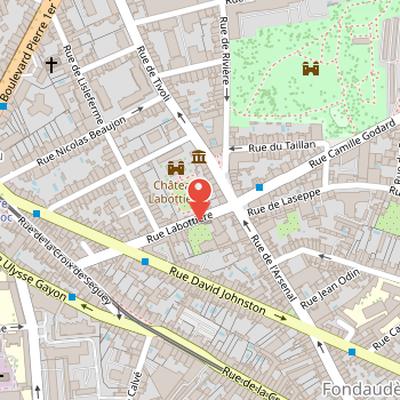
Nearby Objects
-
 Le palais Gallien 800 m away
 -
 Muséum d'histoire naturelle de Bordeaux 900 m away
 -
 Jardin Public 1000 m away
 -
 Parc Bordelais 1000 m away
 -
 Basilica of Saint-Seurin 1100 m away
Chateau Labottiere in Bordeaux
Chateau Labottiere, also called hotel Labottiere or maison Tivoli, is a hotel particulier located at 29 rue Labottiere in Bordeaux. It was built in 1773 for the brothers Jacques and Antoine Labottiere and was designed by the architects Laclotte. The building currently houses the Institut culturel Bernard-Magrez. It should not be confused with the Petit hotel Labottiere, which was built near the Jardin public by François Lhote for Etienne Labottiere, the uncle of Jacques and Antoine.
Construction and Early Ownership
Chateau Labottiere was built between 1770 and 1773 by the architects Etienne and Jacques Laclotte for Jacques and Antoine Labottiere. The Labottiere brothers were 18th century Bordeaux printers and publishers. They operated a shop at Place du Palais de l Ombriere and also owned a small vineyard in the Bordeaux countryside. Their fortunes changed with the Revolution in 1790, when they were ruined. Antoine Labottiere died in 1794, and the following year Jacques Labottiere sold the estate, house, bookstore, and printing house.
From Pleasure House to Cultural Venue
According to Histoire, the house changed hands several times and was used for a variety of purposes that reflect its changing role in Bordeaux. Under the Directory, it was acquired by M. Boers, a Dutchman, who rented it to M. Lannefranque, a show entrepreneur. Lannefranque opened a pleasure establishment called Maison Tivoli at the site. Art historian Philippe Maffre also mentioned a dance establishment named Fetes champetres, A Idalie, opened by M. Labille in 1803, and the architect Dufort-Marionneau organized parties there.
Later, Chateau Labottiere belonged to Antoine Gautier, mayor of Bordeaux from 1849 to 1863, before being sold in 1857 to the Compagnie de Jesus. The Jesuits built the College Saint-Joseph de Tivoli in the estate dependencies. After a fire in 1904 forced the Jesuits to move to avenue d'Eysines, the municipality planned to install a Museum of Decorative Arts in Chateau Labottiere, but this project was abandoned in 1911 in favor of the Hotel de Lalande. The hotel and garden then appear to have remained unoccupied or abandoned until 1918.
In 1918, Janine Lozes acquired Chateau Labottiere and lived there with architect Pierre Ferret until 1931. During the 1920s, they organized numerous parties and events at the hotel, while Ferret carried out work that respected the neoclassical spirit of the building. In June 1940, when the French government retreated to Bordeaux, the property was requisitioned to house Lycee Longchamp, now Lycee Montesquieu. In 1996, Bernard Magrez bought the building from the Suez group. Restored in spring 2011, it now hosts the Institut Culturel Bernard-Magrez, artists in residence, and modern and contemporary art exhibitions, with a particular specialization in street art.
Architectural Features and Setting
Chateau Labottiere is a rectangular building with two floors, including a ground floor. Its main composition is marked by a large entablature topped by a cornice on modillions and a balustrade, which conceals a second floor behind it. The central bay is crowned by a triangular pediment, and its tympanum includes two child figures unrolling a decorated canvas. The opposite facade is organized around a semicircular bay. The outbuildings are located to the right of the main building. In front, a modern honor grille is flanked by small pavilions, while the exterior still preserves a French-style garden. Inside, the decoration retains Louis XVI style stucco, which replaced earlier wooden paneling that had been sold.
Architectural Influence and Replicas
Chateau Labottiere had a notable impact on later architecture through direct imitation and adaptation. Répliques identifies the 19th-century Chateau Carthon-Ferrieres in Gradignan, on rue Gutenberg, as a pastiche of 18th-century neoclassical architecture directly inspired by Chateau Labottiere. The same source also notes that Chateau Labottiere's neoclassical style was exported overseas. An almost exact replica is said to stand on New York's Upper East Side under the name James Duke House. According to Répliques, this house was commissioned in 1912 by tobacco magnate James Buchanan Duke and was designed by an African-American architect. These references place Chateau Labottiere within a broader history of architectural copying and transatlantic influence.