The Basilica of Saint-Seurin is a minor basilica in Bordeaux, erected by Pope Pius IX in the early 19th century. It was classified as a historical monument in the 1840 list and inscribed on the UNESCO World Heritage List in 1998 as part of the routes of Saint James of Compostela. The basilica holds relics or supposed relics of several saints, including Saint Seurin and Saint Fort.
According to its history, the basilica was built over an ancient necropolis with early Christian burial symbols. An epitaph of Flavinus, engraved on a sarcophagus lid between 365 and 385 AD, was discovered during the 1909 excavations of the Saint-Seurin necropolis and is described as evidence of Christian presence in Bordeaux in late antiquity. The basilica is also associated with the fourth bishop and patron saint of Bordeaux, Saint Seurin, and with a major medieval pilgrimage route to Compostela. It was a stop on the Pilgrims' Way and was linked to the legend of Roland’s oliphant, which pilgrims were invited to view at Saint-Seurin.
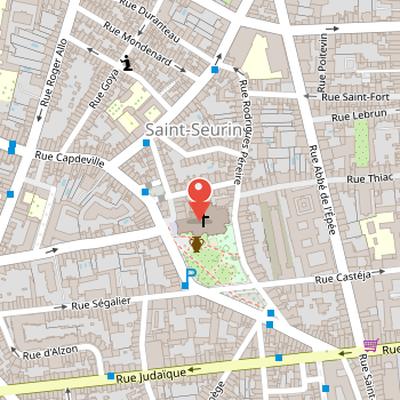
Nearby Objects
-
 Place Gambetta 450 m away
 -
 Le palais Gallien 550 m away
 -
 Porte Dijeaux 550 m away
 -
 Hôtel de Ragueneau 700 m away
 -
 Saint-Bruno Church 700 m away
Historical Status and Religious Significance
The Basilica of Saint Severinus of Bordeaux is a minor basilica erected by Pope Pius IX in Bordeaux in the early 19th century. It was classified as a historical monument in the 1840 list, showing its early recognition as a protected site. In 1998, it was inscribed on the UNESCO World Heritage List as part of the routes of Saint James of Compostela. The basilica also holds relics or supposed relics of several saints, including Saint Seurin and Saint Fort, which contribute to its religious importance.
Early Christian Burial Site and Medieval Pilgrimage
According to Histoire, the Basilica of Saint Seurin was built over an ancient necropolis that contained early Christian burial symbols. Among the finds associated with this site was the epitaph of Flavinus, engraved on a sarcophagus lid between 365 and 385 AD in Bordeaux. The presence of a chrisme on the epitaph is presented as evidence of Christian presence in Bordeaux in late antiquity. The epitaph was later unearthed during the 1909 excavations of the Saint-Seurin necropolis and is now displayed at the Musee d'Aquitaine in Bordeaux.
Histoire also places the foundation of the Saint-Seurin abbey in the 4th century and identifies it as named after the fourth bishop and patron saint of Bordeaux. Saint Seurin, originally called Severinus, is said to have been born in the Orient and to have arrived in Bordeaux in the 4th century. He met Bishop Amandus, later Saint Amand of Bordeaux, and Gregory of Tours recounts that Amandus dreamed of Severinus before the two greeted and prayed together and entered the church singing psalms. Severinus then became bishop of Bordeaux. A 6th century archbishop of Bordeaux later commissioned the life story of Saint Seurin with an angel calling, a legend that greatly increased the basilica's renown.
The basilica also held a strong place in medieval religious practice. Its canons obtained significant privileges, including an installation ceremony for new bishops. Histoire further records a legend that Roland's oliphant was placed on the basilica altar by the emperor, connecting the site to Roland, Charlemagne's nephew, who died at Roncevaux. The Chanson de Roland refers to this oliphant, and pilgrims on the medieval Pilgrims' Way to Compostela were invited to Saint-Seurin to view the relic.
Medieval Growth and Architectural Layers
The earliest religious building at the site is attested around the middle of the 9th century and was probably a chapel or an oratory. It disappeared during the Norman invasions in the 10th century. In the early 11th century, the canons of the basilica decided on a major reconstruction, creating a timber-framed Romanesque church with a basilical plan. At that time, the choir and the crypt were raised to display relics to pilgrims travelling on the routes to Saint-Jacques de Compostelle. The basilica also served as the setting for an investiture ceremony linked to the power access of the dukes of Aquitaine in the County of Bordeaux.
Further work continued in the 12th and 13th centuries with the construction of the nave and choir. In the 14th century, the canons commissioned the southern portal, which was later topped by a Renaissance style bell tower porch. They also built a monumental entrance giving access to the necropolis. This Gothic entrance has a large bay flanked by two blind arcades and is decorated with fourteen statues of the Twelve Apostles and two female figures symbolizing the Church and the Synagogue. Its main tympanum shows scenes of the Resurrection and the Last Judgment, while the two other tympana depict the visit of the Holy Women to the tomb and Saint Seurin's arrival dreamed by Saint Amand of Bordeaux. The porch with five beveled sides was added later.
The 15th and 16th centuries brought several chapels, including Notre-Dame de la Rose, dedicated to the Virgin Mary and containing an altar consecrated by Archbishop Pey Berland in 1444. This chapel is noted for its Flamboyant Gothic style, similar to late Gothic Norman and English architecture of the 15th century. The building then suffered two vault collapses in 1566 and 1698, causing major damage. In the early 18th century, architect Jean-Baptiste Augier was charged with reconstructing and consolidating the vaults with piers and stone belts. These works also required filling the church floor because of a difference in level of nearly three meters, which led to the burial of the crypt and a major modification of the 14th-century west porch floor.
Nineteenth-Century Restoration and Decoration
In the late 1820s, the conseil de fabrique de Saint-Seurin decided to restore the western facade of the basilica. The work was entrusted to architect Pierre-Alexandre Poitevin, who designed a neo-Romanesque facade and created a portal-porch that concealed the Romanesque porch. The decoration was assigned to sculptor Dominique Fortuné Maggesi, whose work included statues of Saint Seurin and Saint Amand at the entrance, the encounter of the two saints on the tympanum, and two statues of Saint Jean and Saint Pierre on the upper floor balustrade. This sculptural program aimed to unify the facade with the Romanesque bell tower.
The basilica was inscribed in the Monuments Historiques inventory in 1840. After this classification, the choir was entirely reorganized, a new marble altar was installed, and arcades were opened on the north aisle to create chapels dedicated to Saint Fort and the Sacre-Coeur. Joseph Villiet was also commissioned to create stained glass windows for the nave, with biblical scenes and stories related to the basilica.
Medieval Furnishings and Relics
The Basilica of Saint Severinus of Bordeaux was greatly stripped of its medieval furniture, but several important elements still remain. Among them are various alabaster altarpieces, including an altarpiece dedicated to the life of the Virgin in the chapel of Notre-Dame de la Rose, and another notable altarpiece at the main altar illustrating the legends of Saint Seurin and Saint Martial. The church also preserves a stone episcopal chair from the beginning of the 16th century. This seat has armrests, a backrest, and a canopy, and it was reserved for the new archbishop of Bordeaux, who swore on the relics of Saint Seurin. In the choir, a perfectly preserved episcopal seat survives, together with thirty-two of the forty-seven stalls made in the late 15th century. These stalls were intended for the chapter during offices, and their misericords depict saints, prophets, and satirical scenes. The basilica also retains several statues in very good condition, including the 16th-century alabaster statue of Notre-Dame de la Rose and the 16th-century alabaster statue of Saint Martial of Limoges. Formerly, the basilica possessed a prestigious relic, the oliphant of Roland, now lost. Tradition says that this ivory horn was placed on Saint Seurin's altar by Charlemagne. It is recorded in the 14th century and disappeared before the Revolution. Saint Seurin's tomb has been a place of worship for centuries, and his altar is already mentioned in the Chanson de Roland around 1100.
The Western Portal Capitals
The western portal of the Basilica of Saint Severinus in Bordeaux belongs to the medieval main entrance area, although the western massif underwent neo-Romanesque restoration in 1828 by the architect Alexandre Poitevin. The neo-Romanesque facade now covers the earlier Romanesque facade. At the end of a corridor-porch linking the western facade to the nave, a door gives access to the building interior; this doorway was once topped by a Romanesque tympanum and lintel, now missing. The corridor-porch has a T-shaped plan oriented east, ending at the door to the nave, and its entrance is covered by a barrel vault with a semicircular arch resting on cylindrical columns set against the wall.
The corridor-porch arcade is supported by two series of three capitals. These columns rest on flared cylindrical bases and carry capitals on each side. The capitals present a varied sculpted program, combining biblical, vegetal, animal, and commemorative themes. One north-facing capital shows the biblical scene of Abraham preparing to sacrifice Isaac from Genesis. Isaac lies on a sacrificial table with folded legs, Abraham holds a sacrificial weapon in his right hand and Isaac's hair in his left, and a figure probably an angel interrupts his armed arm. A ram appears on the right as the substitute sacrifice. This capital is flanked by two smaller capitals with vegetal and animal motifs, including a leftmost basket decorated with palmettes.
On the south side, a capital shows birds pecking at a bunch of grapes, with two animal-themed capitals beside it. Another central capital depicts intertwined serpents darting a trifid tongue, while the rightmost capital is carved with monstrous birds with bulging eyes. The abacuses are decorated with interlacing patterns and leaves forming further interlacing, while the astragals are simple rounded moldings without decoration.
Among these capitals, one white marble capital was re-used from a Gallo-Roman capital, probably from the Palais Gallien in Bordeaux. Another unusual capital, likely made around 1856, represents a cenotaph tomb including Saint Seurin wrapped in a shroud on a parade bed with small columns. Smaller capitals are also embedded in the right wall near the nave entrance door on the south side and in the left wall near the nave entrance door on the north side, reinforcing the sculpted character of the passage leading into the nave.
Portail Sud and Its Sculptural Program
Portail Sud is located at the height of the second bay of the building, near the belfry built between 1538 and 1540. It is considered one of the most curious monuments left by the cathedral. The southern transept where it stands was the largest cemetery in the city in the 13th century, and the portal itself was constructed by the canons in that century to honor the Christian place of worship.
The portal has a tripartite entrance with pointed arches, quadripartite voussoirs alternating vegetal motifs and bas-relief figures, and three tympana with architectural decoration. Its tripartition symbolizes the Trinity: the Father, the Son, and the Holy Spirit. The main opening is pierced with a trilobe, and the torus ends in cabbages. A Latin inscription runs along the arch and commemorates the death of Raymond de Lafont, canon and priest of the church, in 1267. A marble slab also marks his tomb, placed at the threshold of the door to paradise as an act of humility.
The sculptural decoration is extensive. The frieze figures are individualized with attributes and wear antiquity-style clothing with pronounced folds. Their pedestals are supported by interlaced motifs that form the capitals of the columns on the jambs. The jamb columns create an ornamental unity with vegetal hook motifs, while the openings are also marked by closely spaced bundles of small columns with capitals decorated with animals and vegetal forms. Above the central arcade, the spandrels are decorated with vine shoots pecked by birds, symbolizing divine food and the blood of Christ. The capitals' decoration continues into a frieze and a superimposed cornice.
In total, the portal features fourteen statues with distinct attributes and postures. Among them are the Twelve Apostles, arranged from right to left, and a figure of the Synagogue, shown with eyes blindfolded by a serpent and a crown on the ground.
The Southern Portal Figures
The south portal of the Basilica of Saint Severinus of Bordeaux is marked by a series of saintly figures. It shows Saint Matthew holding a book and a halo, Saint Jude also called Thaddaeus, Saint John the Greater, and Saint Matthias, identified as the replacement of Judas Iscariot. The portal also includes statues of Saint Paul, Saint Peter holding the keys of paradise, Saint Andrew as the brother of Peter, Saint James the Less, Saint Thomas, Saint Bartholomew, and Saint Philip. Together, these figures give the portal a strongly devotional character and define its sculptural program.
The South Portal and Its Sculpted Program
The south portal presents a dense sculpted program centered on the Last Judgment and the Resurrection of the Dead by the call of the Apocalypse trumpet. The main portal depicts Jesus Christ in a toga, with his hands directed toward the sky as he awaits the naming of the elect and the damned. Saint John, called Le Bien Aime, stands to Christ's left, and the Virgin Mary to his right; both are shown in prayer. Above Christ's head, two angels hold the sun and the moon, while other angels stand beside him carrying the instruments of the Passion. A crown is held above Christ by angels placed along the ogive, and the scene also includes angels identified as the angel of prayer, the angel of adoration, the angel of love, and the angel of thanksgiving. The composition refers to the biblical verse about casting crowns before the throne.
The portal is arranged in triple archivolts. Their decoration includes palm leaves, buttercups, violets, birds, and toads set between the archivolts. The second archivolt represents Virtues, Angels, and Archangels, while the last one symbolizes Dominations, Powers, and Principalities, identified through robes, staffs, censers, and cups. The lintel below the scene is framed by two angels contemplating bodies rising from tombs after a trumpet sounds. Two celestial figures play the trumpet, and the composition shows bodies filled with hope or rage awaiting the weighing of souls by Archangel Saint Michael, who stands at the center while the devil perverts the balance. Apostles are shown with Christ presiding over the Last Judgment scene.
To the right of Christ, a tympanum presents the episode of the Holy Women at the tomb. An architectural arcade frames an angel beside an empty tomb, while another angel converses with three troubled women. Three stunned soldiers appear as the pendant of the three women. The women are identified as Mary wife of Cleophas, Mary Salome wife of Zebedee, and Mary Magdalene. The scene relates their arrival after the Sabbath to an empty tomb with a turned stone, and the angel announces Christ's resurrection and tells them to spread the news, though they do not do so out of fear. Above this episode, an archivolt shows angels, two of them holding a key and the Agnus Dei, and the second archivolt is adorned with holy figures.
The south portal faces a cemetery, giving the Last Judgment motif a funerary setting. It is intended both to allow the deceased to meditate and to remind the faithful entering the church of the requirements of piety. The voussures of the collegiate church are also decorated with bas-reliefs of seraphim and angels. In the east blind arch, a separate scene shows a figure with bishop attributes, including a chasuble, mitre, and a left hand holding a crozier now missing, leaning toward a kneeling younger man in a tunic with a short beard and elongated face. The kneeling man has his hands joined on his chest. Behind the bishop is a figure whose role is unclear, possibly a holy water container with a skullcap. Another scene shows a seated character and a dignitary ecclesiastic holding a staff, and the portal also depicts a resurrection or healing scene from a figure with bishop attributes.
The South Portal
The south portal, Portail sud, was described in 1840 as damaged by the city architect G.-J. Durand, who restored it between 1843 and 1844. During this intervention, the base pedestal was renewed and damaged parts were replaced with putty. The portal includes a date, 1267, which indicates that it was advanced enough to be engraved, although this date is not confirmed as applying to the entire portal.
Its sculptural program is organized in two levels of voussures. The first level shows angels, while the second includes persons with bishop attributes and one figure with abbot attributes marked by a crosier. The figures rest on platforms that form canopies over the figures below. The episodes and overall arrangement are not unusual, since the Women at the Tomb is often replaced by an episode from the Virgin's life. The eastern tympanum raises questions of attribution, either to the life of Saint Seurin or to Saint Martial of Limoges, and the right-hand episode represents either a healing or a resurrection.
Portail sud references the portal of Sens cathedral and sculpted portals from Northern France, and it demonstrates the circulation of models, master builders, and stone sculptors or cutters. It also displays the style of Notre-Dame de Paris in the Christ and the angel with nails sculptures, and represents the Parisian style dating from around the 1230s. The portal's doubled monumental entrance indicates prestige and ambition during the Gothic reconstruction of the church. As a pilgrimage church, the basilica attracted increased nobility and attendance, and this status also affected the management of visitor flows.
The Crypts Beneath the Basilica
The crypts of the Basilica of Saint Severinus of Bordeaux are located under the altar, in alignment with it, and house the sarcophagus of Saint Seurin, the fourth bishop of Bordeaux. They originate from an early Christian building and are closely linked to the development of the church from a preexisting necropolis whose remains are still preserved. They also include part of the paleo-Christian cemetery extending from the place des Martyrs de la Resistance to rue Judaique, and they form part of the major archaeological crypt, which is among the oldest remains in Bordeaux.
From an early stage, the crypts had a funerary role. They are described as a funerary basilica, evidenced by marble sarcophagi containing the bodies of early saint bishops. Their funerary function began with the arrival of the sarcophagi of the first three canonized bishops of Bordeaux: Saint Delphin, Saint Amand, and Saint Seurin. The crypts also hold the sarcophagi of saint bishops, Saintes Veronique and Benedicte, and the tomb of Saint Fort. Tradition further associates the site with the necropolis of Saint-Seurin, said to have been consecrated by Christ and seven saint bishops, and even with the tombs of some knights who died at Roncevaux.
The crypts were also a place of gathering for early Christians before the Edict of Milan. Later, from the Catholic reform in Bordeaux until the 18th century, they became a center of sanctity. Medieval pilgrims came to pray at the tombs and to listen to the foundation legends of the basilica. The presence of late antique sarcophagi within the collegiate church helped inspire legends about Aquitaine's first holy site, and the reliquary of Saint Seurin's body forms part of these associated traditions.
The present form of the crypts reflects later transformations and extensive excavation. In 1635, the Carolingian apse was removed to create three recesses for sarcophagi and the cenotaph of Saint Fort. Numerous archaeological excavations took place between 1834 and 1841, revealing two sarcophagi and burial arrangements later interpreted by abbé Cirot de la Ville as a Christian cemetery. Paul Courteault led further excavations south of the collegiate church from 1909 to 1910, uncovering the Saint-Seurin cemetery in its medieval entirety and extracting about 160 sarcophagi. Additional campaigns in the late 1950s and between 1964 and 1969, led by Raymond Duru, contributed new elements now displayed in the publicly open crypt, which was opened to the public in the 1980s.
The crypts contain a large number of burials because of overlapping historical periods and archaeological findings, and they continue to be subject to historiographical and hagiographical reinterpretation. They are also marked by unresolved questions about the relations between the necropolis, some sarcophagi, and the origin of the cult site, as well as by the paradox between displaying relics and preserving the crypt.
The Crypts and Their Burial Program
The crypt is reached by a bent staircase from the south collateral of the nave. It is built of small stone blocks and covered by a barrel vault supported by two rows of porphyry columns at the springing of the vault. The interior is divided into three vessels: a central nave, a north lateral nave, and a south lateral nave. The central nave consists of a central chamber and an exedra with the mausoleum of Saint Fort. The north lateral nave ends in an apse housing the sarcophagus of Saint Veronica, while the south lateral nave ends in an apse housing the sarcophagus of Saint Benedict.
The central chamber is wider than the lateral vessels and contains a quadrangular pit with three limestone sarcophagi placed side by side behind a protective grille that is accessible to visitors. In total, the crypt displays approximately ten tombs, some of them unassigned and containing multiple remains. These burials are distributed across four to five levels below the floor, and the tombs are noted for the richness and precision of their architectural treatment.
Among the identified burials is the tomb of Saint Fort, made in the 12th century and elevated by six small columns with a half-moon entablature. The tomb of Saint Delphin of Bordeaux is located in the south side vessel facing the crypt entrance; it has a double-pitched cover symbolizing the Christian mountain, fish scale decoration referring to the Ichtus symbol, and was made using Saint-Beat marble. The cover lost its original appearance because of visitor erosion. The tomb of Saint Veronica in the north side nave includes a stone tank covered by a lighter stone entablature topped by a pyramid element. Opposite it, the tomb of Saint Benedict consists of a simple rectangular tank with a sloping lid, with the sarcophagus placed in front of the alcove and two other sarcophagi further inside.
The crypt also preserves tombs dated from the 4th century that remain anonymous, many of them richly decorated in the manner of early Christian art. Their ornament includes Christian symbols such as the chrisme, alpha and omega letters, rinceaux, vine networks, laurel crowns, interlaces, and the hand of God emerging from a cloud. A tomb in the north lateral nave contains the skulls of the Twelve Catholic sisters, who were guillotined on Gambetta Square. Another burial may be that of Saint Martial of Limoges, identified by a miracle staff symbol associated with control over rain and weather.
In 2017, Saint Amand's bones were rediscovered in a shoebox. A small reliquary was then commissioned from sculptor Augustin Frison-Roche and placed in the south collateral of the crypt. It is a rectangular box with a lid decorated by circular low-relief lines, showing Saint Amand lying in perpetual prayer with his mitre and episcopal staff, the name Sanctus Amandus, and a sculpted Greek cross symbolizing the Christian faith.
Revolutionary Violence at the Basilica
During the Terror period, Jean-Baptiste-Marie Lacombe, who served as president of the Revolutionary Military Commission of Bordeaux, ordered the execution of twelve nuns. The action is described as an arbitrary choice directed against the Catholic religion. These facts link the site to a violent episode in the revolutionary history of Bordeaux and to the broader conflict between revolutionary authorities and Catholic institutions.
The Crypts and Their Funerary Features
The crypts of the Basilica of Saint Severinus of Bordeaux preserve a complex funerary and architectural ensemble that has been repeatedly altered by human activity from Antiquity to a later period. Among the most notable features is a tomb that may contain two overlapping bodies, shown with their hands placed on the chest and their fingers interlaced. The crypts also hold the remains of two bishops, Saint and Saint, from the period given in the source.
A high-relief recumbent figure appears on the western wall of the crypt. This figure was originally placed in openings pierced in the wall and represents a man wearing a long tunic and a veiled head, with crossed hands on the chest. The face is strongly degraded, with only the outlines of the eyes still visible. The recumbent is associated with reused architectural elements that have been recently studied for dating. These elements include carved bas-relief decoration with geometric shapes, interlaces, and flowers, and they are attached to the stone recumbent on the western wall.
The crypts also contain terracotta tiles embedded in the wall separating the alcove of the central nave from the south lateral nave. These tiles date from between the mid- and the mid- period indicated in the source and display varied geometric shapes in ocher tones integrated into the small stone masonry.
Restoration of the Basilica
In recent decades, the basilica has benefited from restoration work on its roofs and upper parts. The chapels of Notre-Dame de la Rose and Saint-Jean, as well as the choir, were also restored. In 2005, the Gothic portal was restored with funding from the City of Bordeaux and Monuments Historiques. This restoration campaign revealed traces of the portal's original polychromy, leading it to be considered in its original state. The basilica's sacristy also suffered an accidental fire.