Parc Bordelais is an urban park in Bordeaux, located in the Caudéran district beside the commune of Le Bouscat. Covering 28 hectares, it is the largest green space in central Bordeaux. The park is accessible by tram line D at Courbet station. Its circulation network includes both asphalted and non-asphalted paths of varying widths.
The land was acquired in 1864 from Captain Frank Cutler, when a park and acclimatization garden were planned on a site previously occupied by vineyards, fields, and forests. Although the project was supported by the city of Bordeaux and by a bequest from wine merchant Camille Godard, it did not succeed. The park was designed by landscape architect Eugène Bühler and inaugurated by President Sadi Carnot. It was modeled after large Parisian parks of the second half of the 19th century.
The park’s planting included species donated by Camille Godard, such as sequoia, magnolia, American walnut, and Louisiana bald cypress, with most species introduced through Toussaint Yves Catros at the start of the 20th century. The perimeter fences and gates are registered as historical monuments by official decree.
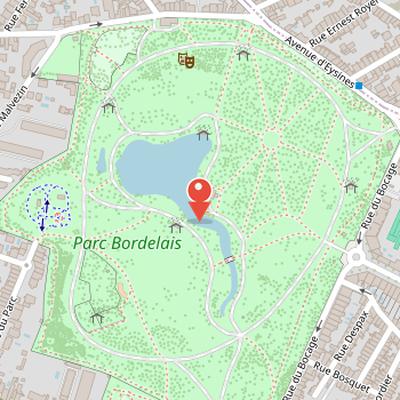
Nearby Objects
-
 Château Labottière 1000 m away
 -
 Le palais Gallien 1700 m away
 -
 Basilica of Saint-Seurin 1700 m away
 -
 Muséum d'histoire naturelle de Bordeaux 1800 m away
 -
 Saint-Bruno Church 2000 m away
Location and Size of Parc Bordelais
Parc Bordelais is located in Bordeaux, in the Cauderan district, near the commune of Le Bouscat. Covering 28 hectares, it is the largest green space in central Bordeaux. The park is also accessible by tram line D at Courbet station, making it a significant public space within the citys urban landscape.
Origins and Design of Parc Bordelais
Parc Bordelais was created after 28 hectares of park land, then occupied by vineyards, fields, and forests, were bought from Captain Frank Cutler in 1864. Historique planned to develop the site as a park and acclimatization garden, but the project failed despite support from the city of Bordeaux and a bequest from wine merchant Camille Godard. The park was designed by landscape architect Eugene Buhler and inaugurated by President Sadi Carnot. Its layout was modeled after the large Parisian parks of the second half of the 19th century. Planting also played an important part in the park's identity. New species donated by Camille Godard included sequoia, magnolia, American walnut, and Louisiana bald cypress. At the start of the 20th century, most park plant species were introduced through Toussaint Yves Catros.
Recent Changes and Heritage Status
Parc Bordelais underwent several significant changes in the late 1990s and early 2000s. A 1997 construction project in a rarely visited southern section of the park was controversial and led to the cutting down of some trees. The affected area was then temporarily used as a pony club and as storage space for gardeners before being turned into a large children's park called Parc Cerey. In 1999, a storm forced the park to close for several weeks and caused the loss of 700 trees, as well as a paid nacelle-type swing. In 2004, a total redesign was launched to create an English-style park, with children's play areas relocated, a jogging path established, and the animal area brought up to compliance standards. The park's perimeter fences and gates were also registered as historical monuments by official decree.
Circulation Paths and Urban Training Space
Parc Bordelais includes a mix of asphalted and non-asphalted circulation paths of various dimensions. Its main route is an asphalted oval track, approximately fifteen meters wide, which surrounds the park. An outer jogging trail runs parallel to this main track. In the western part of the park, a mini urban circuit installed by Prevention routiere provides an additional circulation feature. Access to this circuit is limited for school children's education.
Landscape Features and Amenities
Parc Bordelais is organized around a central artificial pond, which is 40 cm deep, and a larger pond in the northwest that is about 200 meters long and 80 meters wide, narrowing toward the southeast. The ponds are described as fish-rich, with carp and several bird species, including ducks, geese, swans, and moorhens. The park also contains wooded areas, some enclosed to preserve a wild aspect, as well as flower beds and large lawns suitable for collective games.
Its vegetation includes several notable trees, among them large plane trees measuring 30 to 40 meters, a Siberian elm on the north bank near the pond, and two groups of ginkgo biloba trees. The park formerly had an animal area with farm animals of Aquitaine species, such as pigs, sheep, goats, and chickens, although this animal park is being reduced. Free-roaming animals in the park include squirrels, rabbits, hedgehogs, and stray cats.
The park offers a range of facilities and attractions, including children's playgrounds, a Guignol theater, motorized karts, a small train, a traditional carousel, a refreshment stand, and a book box. Its artistic decoration is limited to a few statues, including Le Vaincu by Gabrielle Dumontet in white marble, as well as a bust of Camille Godard near the pond.